
[Paper Review] Observations of a PT-like phase transition and limit cycle oscillations in non-reciprocally coupled optomechanical oscillators levitated in vacuum
This study demonstrates a PT-like phase transition and limit cycle oscillations in a pair of non-reciprocally coupled optomechanical oscillators levitated in vacuum using counter-propagating laser beams. By tuning the relative power, phase, and polarization of the beams, the system exhibits non-Hermitian dynamics analogous to a parity-time (PT) phase transition, culminating in collective oscillations via a Hopf bifurcation when dissipation is reduced, offering a platform for exceptional point sensing and topological optomechanics.
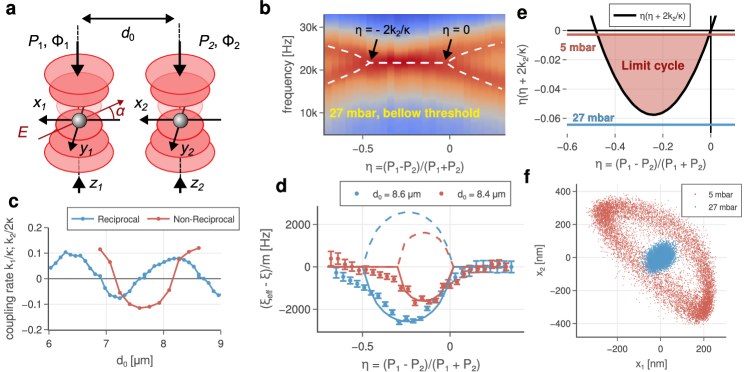
Nanoparticles levitated in an optical trap provide a versatile platform to study mechanical oscillators in a controlled environment with tuneable parameters. Recently, it has become possible to couple two of these optomechanical oscillators. Here, we demonstrate the collective non-Hermitian dynamics of such a pair of non-conservatively coupled oscillators. We take advantage of the tunability of the optical interactions between the particles in our system and set the optical interaction between the particles to be purely non-reciprocal. By continuously varying the relative power of the trapping beams, we take the system through a transition, similar to a parity-time phase transition. A Hopf bifurcation at a critical point results in the formation of collective limit cycle oscillations, resembling those observed in phonon lasers. These coupled levitated oscillators provide a platform for exceptional point optomechanical sensing and can be extended to multi-particle systems, paving the way for the development of topological optomechanical media.
Motivation & Objective
- To explore non-Hermitian collective dynamics in a system of two optically levitated nanoparticles with non-reciprocal coupling.
- To investigate the emergence of PT-like behavior in a classical, open system without true PT symmetry.
- To demonstrate a transition analogous to a parity-time (PT) phase transition through continuous tuning of laser power detuning.
- To observe the formation of collective limit cycle oscillations via a Hopf bifurcation under reduced dissipation.
- To establish a tunable, multi-particle platform for exceptional point optomechanical sensing and topological media.
Proposed method
- Optical levitation of silica nanoparticles in vacuum using two parallel pairs of counter-propagating laser beams.
- Non-reciprocal coupling induced by adjusting the relative phase, polarization, and separation of the trapping beams.
- Continuous variation of the power detuning (η) between the two beams to tune the system's non-Hermitian character.
- Use of a digital micromirror device (DMD) to shape and dynamically control the laser beam patterns for precise trapping.
- Simultaneous detection of particle positions using quadrant photodiodes (QPDs) and high-speed CMOS imaging (400 kHz sampling).
- Calibration of QPD signals via comparison with high-speed video tracking to ensure accurate position measurement.
Experimental results
Research questions
- RQ1Can a non-reciprocally coupled optomechanical system in vacuum exhibit dynamics analogous to a PT phase transition?
- RQ2What is the role of non-reciprocal optical forces in inducing collective limit cycle oscillations in a two-particle system?
- RQ3How does tuning the relative laser power detuning (η) affect the stability and spectral properties of the coupled oscillators?
- RQ4To what extent do the observed dynamics resemble those in phonon lasers or other non-Hermitian systems?
- RQ5Can this system serve as a tunable platform for exceptional point sensing and topological optomechanical phenomena?
Key findings
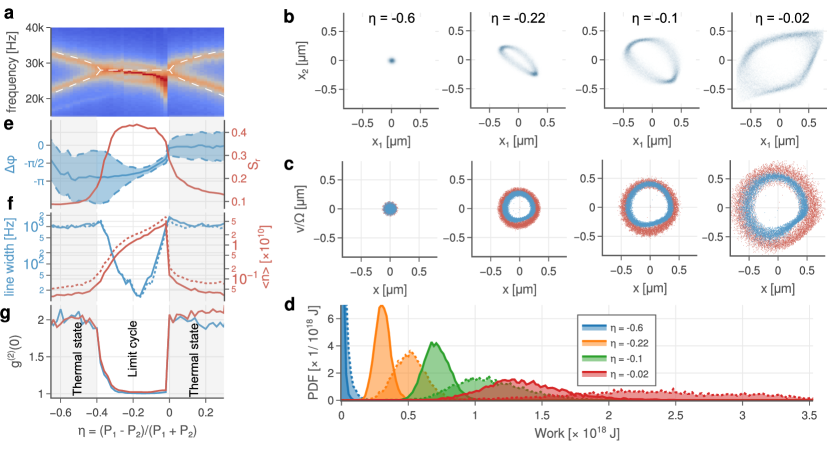
- The system exhibits a PT-like phase transition by continuously tuning the power detuning η, transitioning from a stable equilibrium to a non-equilibrium state with complex eigenvalues.
- A Hopf bifurcation occurs as dissipation is reduced, leading to the emergence of collective limit cycle oscillations in the coupled nanoparticles.
- The optical binding interaction strength is approximately 10^4 times larger than the Coulomb interaction, confirming that optical forces dominate the coupling.
- The measured coupling rate b/Ω₀ < 10⁻⁴ indicates that Coulomb interactions are negligible compared to optical binding, validating the dominance of engineered non-reciprocal optical forces.
- The system achieves stable, long-duration trajectories (up to 100,000 frames) with minimal cross-talk between particle signals due to d-shaped edge mirror separation.
- The observed dynamics are consistent with non-Hermitian physics, including exceptional point-like behavior, despite the absence of true PT symmetry in the system.
Better researchstarts right now
From reading papers to final review, dramatically reduce your research time.
No credit card · Free plan available
This review was created by AI and reviewed by human editors.