
[Paper Review] OceanNet: A principled neural operator-based digital twin for regional oceans
OceanNet is a physics-informed neural operator-based digital twin for regional ocean circulation, using a Fourier neural operator with a predictor-evaluate-corrector integration scheme and spectral regularization to suppress spectral bias and autoregressive error growth. Trained on historical sea surface height data, it achieves competitive seasonal forecast skill for Gulf Stream meanders and Loop Current eddies—outperforming a state-of-the-art dynamical ocean model (ROMS) while reducing computational cost by 500,000 times.
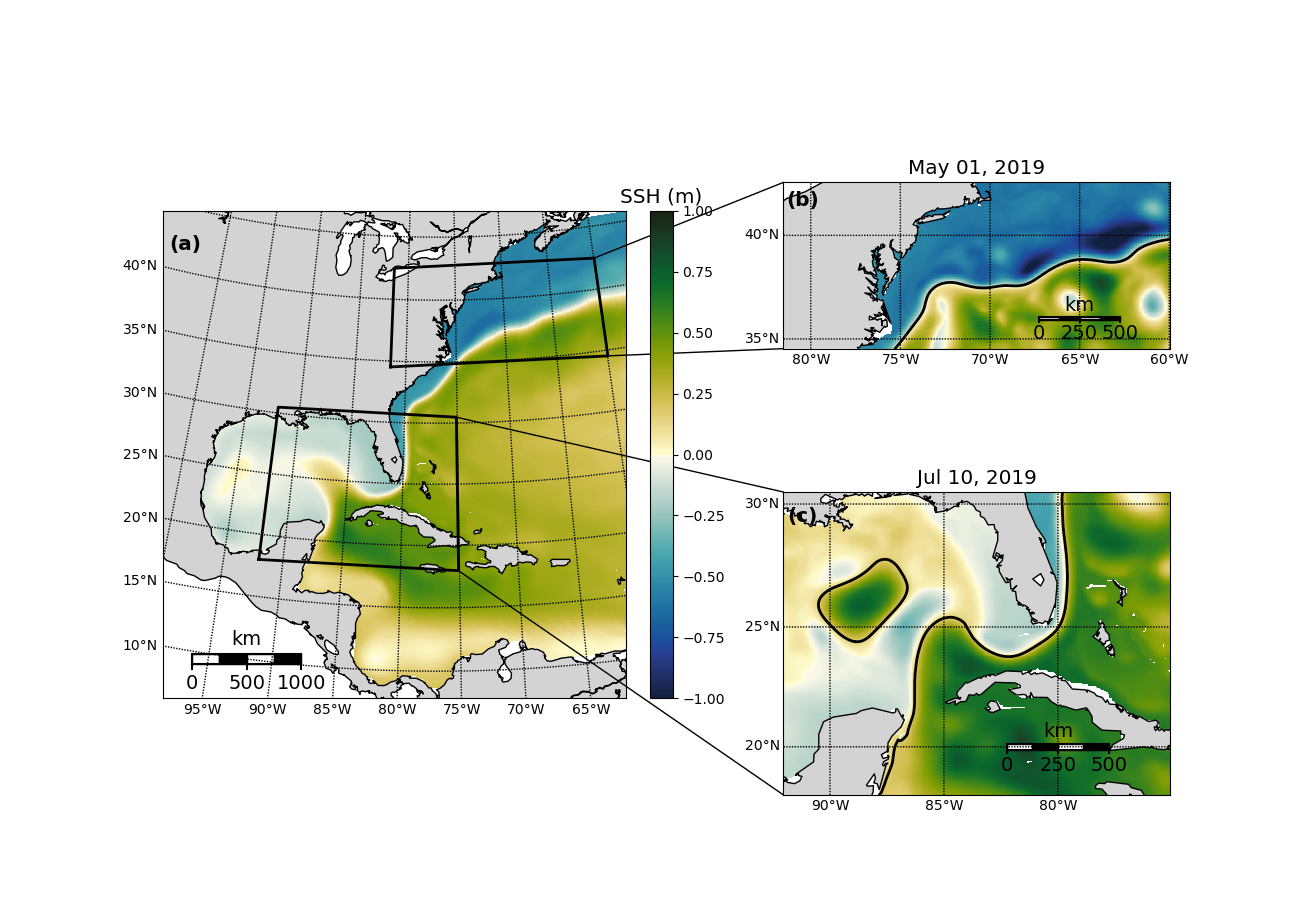
While data-driven approaches demonstrate great potential in atmospheric modeling and weather forecasting, ocean modeling poses distinct challenges due to complex bathymetry, land, vertical structure, and flow non-linearity. This study introduces OceanNet, a principled neural operator-based digital twin for ocean circulation. OceanNet uses a Fourier neural operator and predictor-evaluate-corrector integration scheme to mitigate autoregressive error growth and enhance stability over extended time scales. A spectral regularizer counteracts spectral bias at smaller scales. OceanNet is applied to the northwest Atlantic Ocean western boundary current (the Gulf Stream), focusing on the task of seasonal prediction for Loop Current eddies and the Gulf Stream meander. Trained using historical sea surface height (SSH) data, OceanNet demonstrates competitive forecast skill by outperforming SSH predictions by an uncoupled, state-of-the-art dynamical ocean model forecast, reducing computation by 500,000 times. These accomplishments demonstrate the potential of physics-inspired deep neural operators as cost-effective alternatives to high-resolution numerical ocean models.
Motivation & Objective
- To develop a stable, data-driven digital twin for regional ocean circulation that overcomes limitations of traditional numerical models in computational cost and long-term forecasting stability.
- To address spectral bias in deep neural networks that hinders accurate representation of small-scale ocean dynamics in turbulent flows.
- To enable long-term, high-resolution ocean forecasting by integrating physics-inspired deep learning with numerical integration schemes.
- To demonstrate competitive forecast skill for key ocean features such as Gulf Stream meanders and Loop Current eddies using only sea surface height data.
- To establish a scalable, computationally efficient alternative to high-resolution numerical ocean models for operational oceanography and climate applications.
Proposed method
- OceanNet employs a Fourier neural operator (FNO) to learn the nonlinear mapping between ocean state inputs and future states, enabling efficient, parameter-efficient modeling of spatial operators.
- A predictor-evaluate-corrector (PEC) integration scheme is used to mitigate autoregressive error growth during long-term forecasting, improving numerical stability.
- A spectral regularizer is applied to the Fourier spectrum of the predicted sea surface height (SSH) field, penalizing deviations in high wavenumber components to counteract spectral bias.
- The loss function combines mean squared error (MSE) over ocean grid points with a two-time-step spectral regularization loss at t+5Δt and t+10Δt to extend the model’s stability horizon.
- The spectral regularizer targets the latitude-averaged zonal Fourier spectrum for wavenumbers above a cutoff kT=100, ensuring small-scale dynamics are preserved during training.
- The total loss is a weighted sum of the two-time-step losses, enabling the model to learn accurate long-range dynamics without exponential memory growth.
Experimental results
Research questions
- RQ1Can a data-driven neural operator model achieve stable and accurate long-term forecasting of regional ocean circulation, particularly for complex features like Gulf Stream meanders and Loop Current eddies?
- RQ2How can spectral bias in deep neural networks be effectively mitigated in ocean modeling to preserve small-scale turbulent dynamics?
- RQ3To what extent can a physics-informed neural operator with a predictor-evaluate-corrector scheme outperform a high-resolution dynamical ocean model like ROMS in seasonal prediction tasks?
- RQ4Does a two-time-step loss function with spectral regularization improve the stability and accuracy of ocean forecasts beyond standard MSE training?
- RQ5Can a fully data-driven ocean model achieve competitive performance with orders of magnitude lower computational cost than traditional numerical models?
Key findings
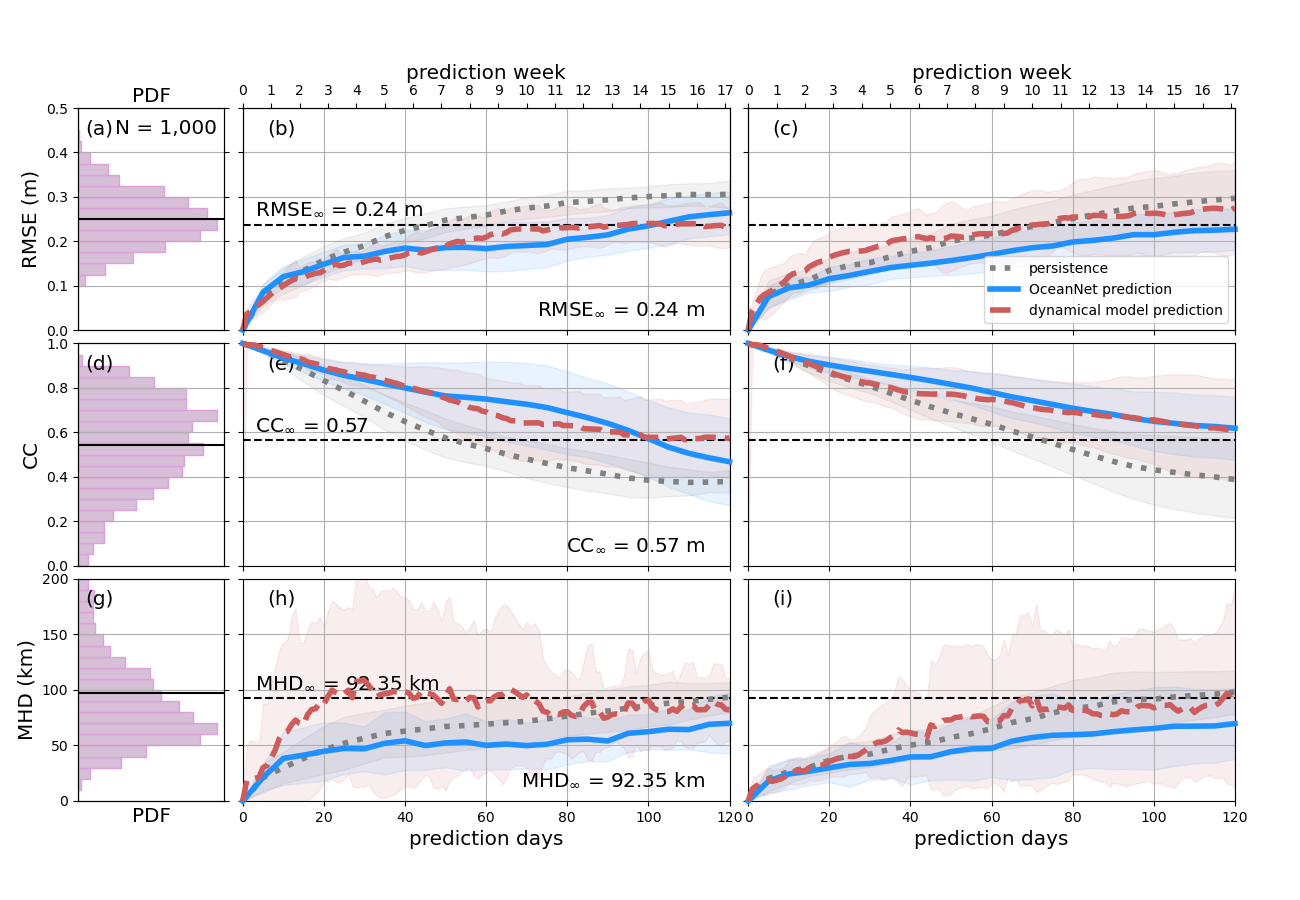
- OceanNet outperforms the state-of-the-art Regional Ocean Modeling System (ROMS) in predicting sea surface height (SSH) fields for the northwest Atlantic, particularly for seasonal forecasts of Gulf Stream meanders and Loop Current eddies.
- The model reduces computational cost by a factor of 500,000 compared to ROMS, demonstrating a major efficiency advantage while maintaining or exceeding forecast accuracy.
- The use of a predictor-evaluate-corrector (PEC) integration scheme significantly reduces autoregressive error growth, enhancing long-term stability in predictions.
- The spectral regularizer effectively suppresses spectral bias by preserving high-wavenumber components in the Fourier spectrum of the SSH field, improving small-scale feature representation.
- The two-time-step loss function (at t+5Δt and t+10Δt) extends the model’s stability horizon, enabling reliable long-term forecasts without exponential memory growth.
- OceanNet represents the first fully data-driven ocean model to demonstrate competitive or superior performance to a high-resolution numerical model in predicting high-resolution SSH fields.
Read this paper
Open the full text in the Nubint reader and ask about any passage as you read.
Read this paper on NubintThis review was generated by AI from the original paper. Please check the paper before citing it.