
[论文解读] On q-statistical approximation of wavelets aided Kantorovich q-Baskakov operators
本论文利用 Bohman-Korovkin 型定理与空间 $B_{\rho\alpha}(\mathbb{R}_+)$ 上的加权模光滑度 $ω_{\rho_{\alpha}}$,研究了小波辅助 Kantorovich q-Baskakov 算子的加权统计逼近性质。通过 Lipschitz 型最大函数建立了统计收敛速率,表明在加权范数下,这些算子具有统计收敛性,且收敛速度依赖于 $q$-整数与光滑度参数。
The aim of this research is to examine various statistical approximation properties with respect to Kantorovich extit{ ext{ exthtq}}-Baskakov operators using wavelets. We discuss and investigate a weighted statistical approximation employing a Bohman-Korovkin type theorem as well as a statistical rate of convergence applying a weighted modulus of smoothness $ω_{ρ_α}$ correlated with the space $B_{ρα}(\mathbb{R_{+}})$ and Lipschitz type maximal functions. Both topics are covered in the article.
研究动机与目标
- 分析小波辅助 Kantorovich q-Baskakov 算子在加权统计逼近下的行为。
- 利用空间 $B_{\rho\alpha}(\mathbb{R}_+)$ 上的加权模光滑度 $\omega_{\rho_{\alpha}}$ 建立统计收敛速率。
- 将经典逼近结果推广至基于小波的局部重构的 $q$-类比设定。
- 通过数值例子与图形分析证明收敛性。
- 表明统计收敛速率在矩方面与经典 q-Baskakov 算子一致,但通过小波定位实现性能提升。
提出的方法
- 在空间 $B_{\rho\alpha}(\mathbb{R}_+)$ 中利用 Bohman-Korovkin 型定理进行加权统计逼近。
- 采用加权模光滑度 $\omega_{\rho_{\alpha}}$ 量化收敛速率。
- 应用 Lipschitz 型最大函数以界定统计收敛下的逼近误差。
- 推导算子 $\mathcal{S}_{n,s,q}(x)$ 的矩估计,包括 $\mathcal{S}_{n,s,q}(\mu_{x,\alpha}^2; x)$ 与 $\mathcal{S}_{n,s,q}(\phi_x^2; x)$。
- 利用 $q$-整数与 $q$-微积分定义具有小波支持的 Kantorovich 型 $q$-Baskakov 算子。
- 通过 $st$-极限使用统计收敛分析当 $n \to \infty$ 时的渐近行为。
实验结果
研究问题
- RQ1小波辅助 Kantorovich q-Baskakov 算子如何在 $B_{\rho\alpha}(\mathbb{R}_+)$ 上实现加权统计逼近?
- RQ2这些算子的统计收敛速率是多少?其与光滑度模 $\omega_{\rho_{\alpha}}$ 的关系如何?
- RQ3$q$-微积分下,算子的矩如何影响收敛行为?
- RQ4能否通过 $q$-整数与小波定位实现统计收敛?
- RQ5在光滑度与 $q$-参数依赖性方面,其收敛速率与经典 $q$-Baskakov 算子相比如何?
主要发现
- 当 $n \to \infty$ 时,算子 $\mathcal{S}_{n,s,q}(x)$ 在加权范数 $\|\cdot\|_{\rho_{\alpha}}$ 下统计收敛于 $f(x)$。
- 统计收敛速率受 $3C_{\alpha}\omega_{\rho_{\alpha}}(f; \delta_n)$ 限制,其中 $\delta_n = \sqrt{1/[n]_q}$。
- 序列 $\delta_n$ 是统计零序列,意味着 $st$-$\lim_{n \to \infty} \omega_{\rho_{\alpha}}(f; \delta_n) = 0$。
- 矩估计结果为 $\mathcal{S}_{n,s,q}(\mu_{x,\alpha}^2; x) \leq \frac{1}{[n]_q} \|e_2\|_{\rho_{\alpha}} + \frac{3}{[n]_q} \|e_2\|_{\rho_{\alpha}}$。
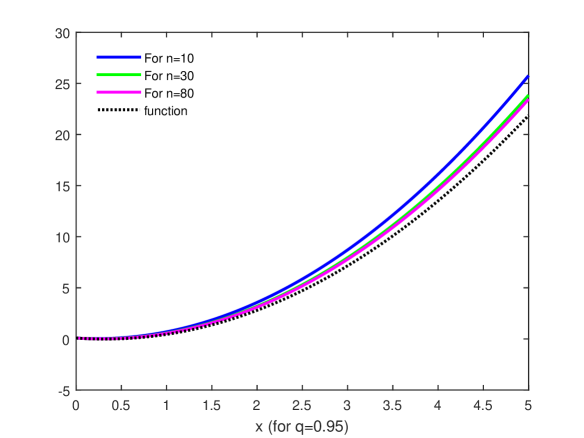
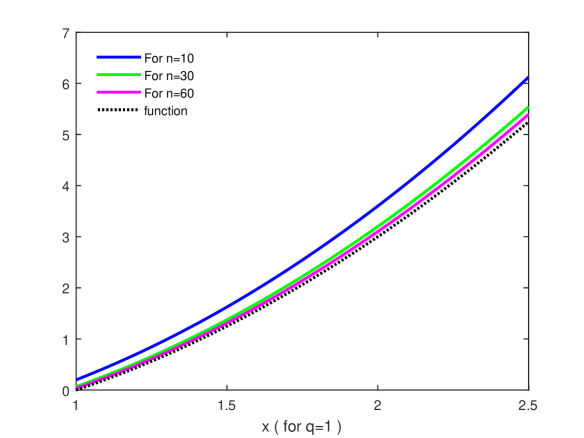
- 图形示例验证了在 $n = 10, 30, 60, 80$ 时,$f(x) = (x-1/5)(x-4/9)$、$f(x) = x^2 - 1$ 与 $f(x) = x^2 - 4x + 3$ 的收敛性。
- 逼近行为在矩方面与经典 $q$-Baskakov 算子一致,但通过小波定位获得局部优化。
更好的研究,从现在开始
从阅读论文到最终审阅,大幅缩短您的研究时间。
无需绑定信用卡
本解读由 AI 生成,并经人工编辑审核。