
[Paper Review] On the archetypal `flavours', indices and teleconnections of ENSO revealed by global sea surface temperatures
This paper introduces archetypal analysis (AA) to identify diverse 'flavours' of ENSO from global sea surface temperature (SST) and sea-level anomaly (SLA) data, revealing multiple distinct ENSO types beyond traditional EP/CP classifications. The method improves ENSO phase detection and teleconnection mapping, especially when SST alone is ambiguous, and enhances sub-seasonal-to-seasonal prediction systems by capturing nuanced event dynamics and non-stationarities.
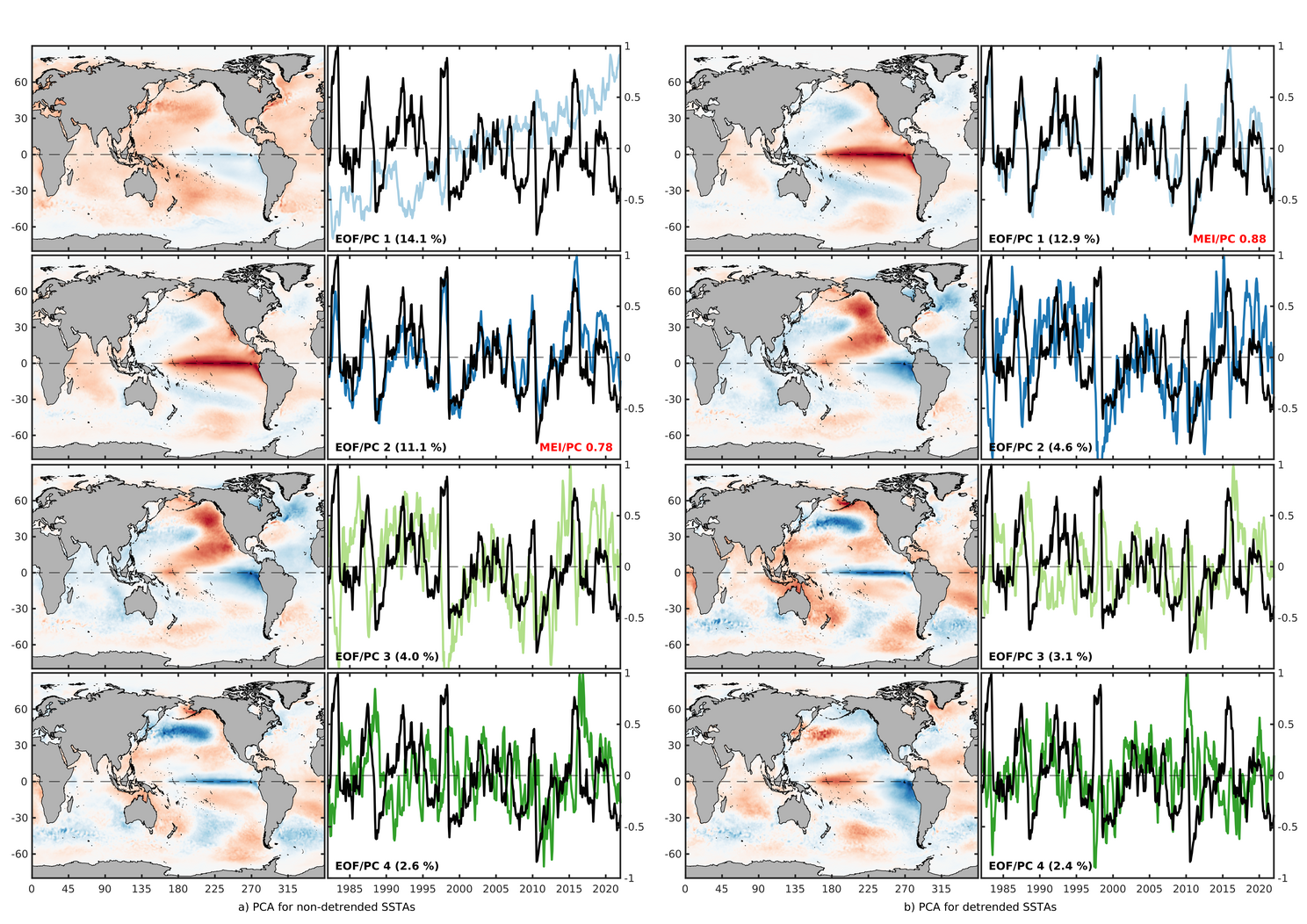
El Niño-Southern Oscillation global (ENSO) imprint on sea surface temperature comes in many guises. To identify its tropical fingerprints and impacts on the rest of the climate system, we propose a global approach based on archetypal analysis (AA), a pattern recognition method based on the identification of extreme configurations in the dataset under investigation. Relying on detrended sea surface temperature monthly anomalies over the 1982 to 2022 period, the technique recovers central and eastern Pacific ENSO types identified by more traditional methods and allows one to hierarchically add extra flavours and nuances to both persistent and transient phases of the phenomenon. Archetypal patterns found compare favorably to phase identification from K-means, fuzzy C-means and recently published network-based machine-learning algorithms. The AA implementation is modified for the identification of ENSO phases in sub-seasonal-to-seasonal prediction systems and complements current alert systems in characterising the diversity of ENSO and its teleconnections. Tropical and extra-tropical teleconnection composites from various oceanic and atmospheric fields derived from the analysis are shown to be robust and physically relevant. Extending AA to sub-surface ocean fields improves the discrimination between phases when the characterisation of ENSO based on sea surface temperature is uncertain. We show that AA on detrended sea-level monthly anomalies provides a clearer expression of ENSO types.
Motivation & Objective
- To address the limitations of traditional ENSO classification systems that rely on single indices and fail to capture the full diversity of ENSO events.
- To develop a data-driven, unsupervised method capable of identifying multiple distinct ENSO archetypes (flavours) in tropical SST anomalies across the 1982–2022 period.
- To improve ENSO phase detection and teleconnection analysis by integrating sea-level anomalies (SLA) to resolve ambiguities when SST-based classification lacks discrimination.
- To assess the robustness and scalability of archetypal analysis for characterizing ENSO onset, persistence, and decay phases, and extend its application to other climate modes.
Proposed method
- Applying archetypal analysis (AA) to detrended monthly sea surface temperature (SST) anomalies over 1982–2022 to identify extreme, representative patterns (archetypes) of ENSO.
- Extending AA to include detrended sea-level anomalies (dSLA) to improve discrimination between ENSO phases when SST patterns are ambiguous or overlapping.
- Using the affiliation probability matrix from AA as a probabilistic indicator of ENSO flavour expression, enabling conditional expectation analysis of teleconnections in atmospheric and oceanic fields.
- Validating AA-identified archetypes against established methods such as K-means, fuzzy C-means, and network-based machine learning algorithms to assess consistency and performance.
- Generating teleconnection composites using conditional expectations based on archetype membership to map atmospheric and oceanic impacts across tropical and extra-tropical regions.
- Assessing the method’s robustness across different time periods and geographical domains, and evaluating its utility as a dimensionality reduction tool for downstream statistical and machine learning models.
Experimental results
Research questions
- RQ1How well can archetypal analysis recover known ENSO flavours such as Eastern Pacific (EP) and Central Pacific (CP) events from global SST anomalies?
- RQ2In what ways does incorporating sea-level anomalies (SLA) improve the discrimination of ENSO phases when SST-based classification is uncertain or ambiguous?
- RQ3Can archetypal analysis detect and characterize nuanced ENSO phases during the onset, main phase, and decay stages of the ENSO cycle?
- RQ4How do the teleconnection patterns derived from AA compare in physical relevance and robustness to those from traditional composite analysis?
- RQ5To what extent does the probabilistic nature of AA enable detection of non-stationarities in ENSO event sequences over the 1982–2022 period?
Key findings
- Archetypal analysis successfully recovers established ENSO flavours such as EP and CP events, with results comparable to K-means, fuzzy C-means, and network-based machine learning methods.
- Incorporating detrended sea-level anomalies (dSLA) significantly improves the clarity and discrimination of ENSO types, especially when SST patterns are indistinct or overlapping.
- The method reveals that no two ENSO event sequences are identical over the 1982–2022 period, even after removing a linear trend, indicating non-stationary dynamics in ENSO behaviour.
- Teleconnection composites derived from AA are physically coherent and robust, showing clear atmospheric and oceanic responses linked to distinct ENSO archetypes.
- The affiliation probability matrix from AA provides a probabilistic framework for conditional expectation analysis, enabling more nuanced understanding of teleconnections in mean and variance.
- AA applied to sub-surface ocean fields (e.g., dSLA) enhances ENSO phase characterization, offering a viable alternative when surface-only metrics fail to distinguish event types.
![Figure 2: AA results for cardinality 4 based only on dSSTAs first 2 PCs multiplied by their respective eigenvalues, $\textbf{X}_{2\times t}=[\lambda_{1}PC_{1},\lambda_{2}PC_{2}]$ . The 2D convex hull is the black polygon. Points in the pointset are represented by coloured dots if they lay within the](https://ar5iv.labs.arxiv.org/html/2406.08694/assets/fig2.png)
Better researchstarts right now
From reading papers to final review, dramatically reduce your research time.
No credit card · Free plan available
This review was created by AI and reviewed by human editors.