
[论文解读] On the Secrecy Design of STAR-RIS assisted Uplink NOMA Networks
本文提出了一种用于STAR-RIS辅助上行链路非正交多址(NOMA)网络的保密波束成形设计方案,以在完整和统计的窃听者信道状态信息(CSI)下增强物理层安全性。该方案引入了一种交替混合波束成形(AHB)算法,联合优化接收波束成形、发射功率以及反射/透射系数,从而提升保密容量并降低保密中断概率。
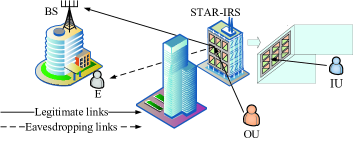
This paper investigates the secure transmission in a simultaneously transmitting and reflecting reconfigurable intelligent surface (STAR-RIS) assisted uplink non-orthogonal multiple access system, where the legitimate users send confidential signals to the base station by exploiting STAR-RIS to reconfigure the electromagnetic propagation environment proactively. Depending on the availability of the eavesdropping channel state information (CSI), both the full CSI and statistical CSI of the eavesdropper are considered. For the full eavesdropping CSI scenario, we adopt the adaptive-rate wiretap code scheme with the aim of maximizing minimum secrecy capacity subject to the successive interference cancellation decoding order constraints. To proceed, we propose an alternating hybrid beamforming (AHB) algorithm to jointly optimize the receive beamforming, transmit power, and reflection/transmission coefficients. While for the statistical eavesdropping CSI scenario, the constant-rate wiretap code scheme is employed to minimize the maximum secrecy outage probability (SOP) subject to the quality-of-service requirements of legitimate users. Then, we derive the exact SOP expression under the constant-rate coding strategy and develop an extended AHB algorithm for the joint secrecy beamforming design. Simulation results demonstrate the effectiveness of the proposed scheme. Moreover, some useful guidance about the quantification of phase shift/amplitude and the deployment of STAR-RIS is provided.
研究动机与目标
- 解决STAR-RIS辅助NOMA网络中物理层安全机制的缺失问题,此类网络因无线广播特性而易受窃听攻击。
- 设计一种保密波束成形方案,在完整窃听者CSI下最大化保密容量,同时满足用户逐次干扰消除(SIC)解码顺序约束。
- 在仅获得窃听者统计CSI的条件下,最小化保密中断概率(SOP),同时确保合法用户的服务质量(QoS)要求。
- 为安全NOMA系统中STAR-RIS的实际部署以及相位移位/幅度量化提供指导建议。
提出的方法
- 针对完整窃听者CSI,采用自适应速率窃听编码以最大化最小保密容量。
- 提出一种交替混合波束成形(AHB)算法,联合优化接收波束成形、发射功率以及反射/透射系数。
- 利用拉格朗日对偶理论与KKT条件,推导出最优的秩一接收波束成形矩阵。
- 针对统计CSI,采用固定速率窃听编码以最小化最大保密中断概率(SOP)。
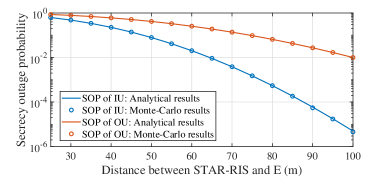
- 推导出在固定速率编码下SOP的精确解析表达式,从而实现对保密中断性能的精确优化。
- 将AHB算法扩展至联合优化统计CSI下的保密波束成形,确保收敛性与次优性能。
实验结果
研究问题
- RQ1在具备完整窃听者CSI的STAR-RIS辅助上行链路NOMA中,如何最大化保密容量?
- RQ2在保密速率最大化目标下,发射功率、接收波束成形以及反射/透射系数的最优联合设计是什么?
- RQ3当仅能获取窃听者统计CSI时,如何最小化保密中断概率?
- RQ4在不同CSI假设下,保密性能的性能极限与权衡关系如何?
- RQ5在安全NOMA系统中,STAR-RIS的最优实际部署方式与相位移位量化策略是什么?
主要发现
- 所提出的AHB算法收敛至次优解,其收敛性通过可行集的连续性与紧致性得到证明。
- 最优接收波束成形矩阵为秩一矩阵,通过KKT条件与拉格朗日对偶理论推导得出。
- 在固定速率编码下,推导出SOP的精确解析表达式,从而实现对保密中断性能的精确优化。
- 仿真结果验证了所提方案在提升保密容量与降低SOP方面的有效性。
- 本研究为相位移位/幅度量化以及安全NOMA传输中STAR-RIS的最优部署提供了实用指导。
更好的研究,从现在开始
从阅读论文到最终审阅,大幅缩短您的研究时间。
无需绑定信用卡
本解读由 AI 生成,并经人工编辑审核。