
[Paper Review] Overwriting Pretrained Bias with Finetuning Data
This paper investigates how biases from pretrained models transfer to finetuned models and demonstrates that targeted curation of the finetuning dataset—by adjusting spurious correlations or underrepresentation—can effectively overwrite pretrained bias with minimal performance cost. The key contribution is that finetuning data manipulation offers a practical, high-impact alternative to modifying large pretrained models for bias mitigation.
Transfer learning is beneficial by allowing the expressive features of models pretrained on large-scale datasets to be finetuned for the target task of smaller, more domain-specific datasets. However, there is a concern that these pretrained models may come with their own biases which would propagate into the finetuned model. In this work, we investigate bias when conceptualized as both spurious correlations between the target task and a sensitive attribute as well as underrepresentation of a particular group in the dataset. Under both notions of bias, we find that (1) models finetuned on top of pretrained models can indeed inherit their biases, but (2) this bias can be corrected for through relatively minor interventions to the finetuning dataset, and often with a negligible impact to performance. Our findings imply that careful curation of the finetuning dataset is important for reducing biases on a downstream task, and doing so can even compensate for bias in the pretrained model.
Motivation & Objective
- To investigate whether biases from pretrained models transfer to finetuned models in computer vision tasks.
- To evaluate whether bias in finetuned models can be corrected through deliberate curation of the finetuning dataset.
- To determine if such curation can maintain high performance while reducing bias, especially when pretrained models are inherently biased.
- To position the finetuning dataset as a more practical and effective intervention point than modifying large pretraining datasets.
- To provide actionable insights for practitioners on balancing performance and fairness in downstream tasks.
Proposed method
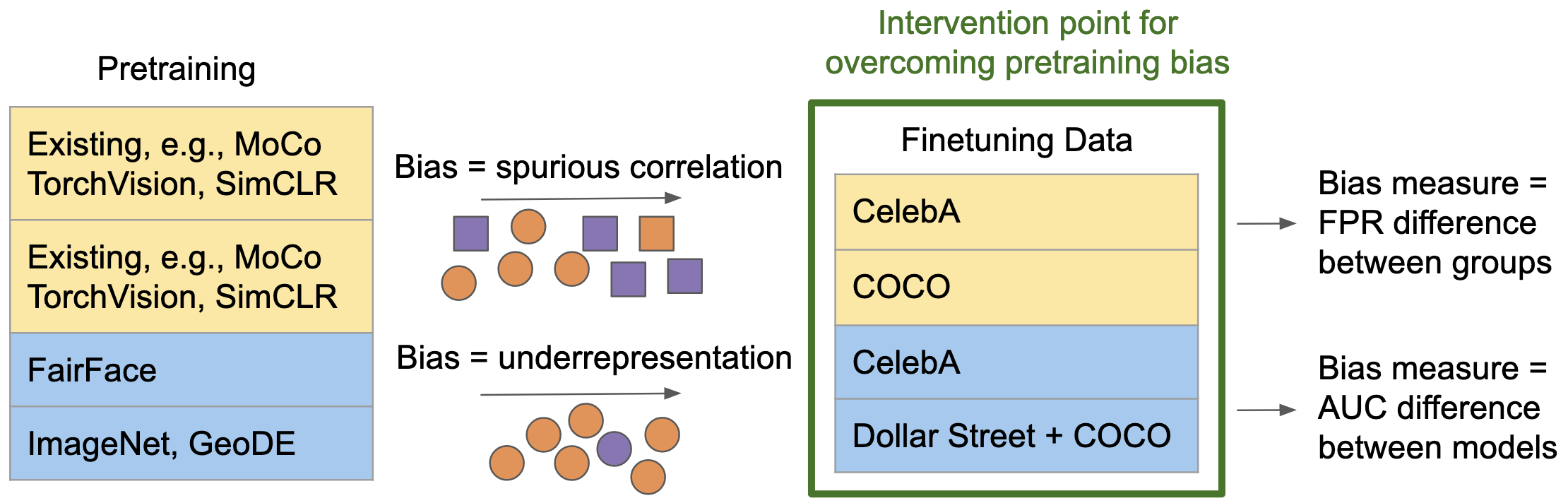
- The study uses two operationalizations of bias: spurious correlations between a sensitive attribute and target task, and underrepresentation of a group in the dataset.
- For spurious correlations, the correlation strength in the finetuning data is manipulated (e.g., from 20% to 30%) to assess its impact on bias and performance.
- For underrepresentation, the proportion of positive labels from underrepresented groups in the finetuning dataset is adjusted to counteract bias.
- Experiments are conducted on CelebA, COCO, and Dollar Street datasets using various pretrained models, including MoCo, SimCLR, and custom models.
- All models are fully fine-tuned (not frozen), and performance is evaluated on downstream tasks with bias measured via fairness metrics.
- The approach focuses on dataset-level interventions rather than architectural or loss-function modifications, emphasizing practicality and scalability.
Experimental results
Research questions
- RQ1To what extent do pretrained model biases transfer to finetuned models under spurious correlations?
- RQ2Can adjusting the correlation strength in the finetuning dataset reduce bias without degrading performance?
- RQ3How effective is modifying the class distribution in the finetuning data to correct for underrepresentation bias?
- RQ4Does finetuning data curation outperform other bias mitigation strategies in terms of practicality and performance retention?
- RQ5Can finetuning data be intentionally over-corrected to counteract biases present in the test set?
Key findings
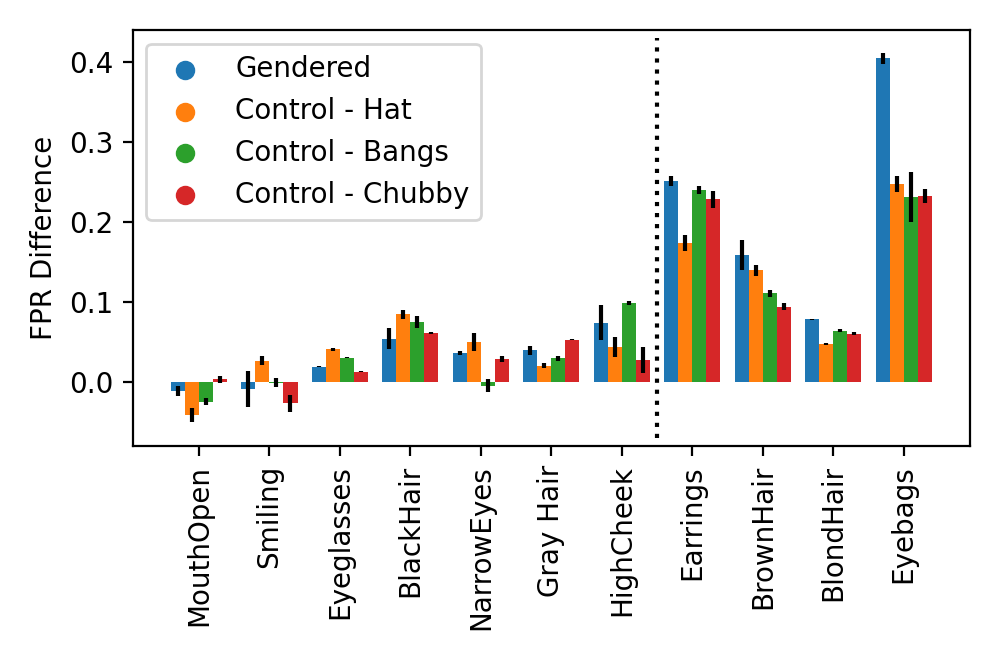
- Models finetuned on top of biased pretrained models inherit their biases, especially when spurious correlations are strong, salient, or when finetuning data is limited.
- By increasing the spurious correlation strength in the finetuning data from 20% to 30%, bias was nearly halved while maintaining high performance.
- Adjusting the proportion of underrepresented groups in the finetuning dataset effectively corrected for underrepresentation bias with negligible performance impact.
- The finetuning dataset serves as a highly effective intervention point for bias mitigation, often outperforming efforts to modify the pretraining data.
- Even with biased pretrained models, careful finetuning data curation enables models to achieve high performance and fairness simultaneously.
- These results suggest that dataset curation should be prioritized in fairness-critical applications, especially when pretraining data is unalterable.
Read this paper
Open the full text in the Nubint reader and ask about any passage as you read.
Read this paper on NubintThis review was generated by AI from the original paper. Please check the paper before citing it.