
[论文解读] Parameter identifiability, parameter estimation and model prediction for differential equation models
本文提出基于似然的方法,用于评估 ODE、PDE 和 BVP 模型中参数的可识别性、估计参数以及将预测中的不确定性传播到预测中,并在 GitHub 上提供开源的 Julia 代码。
Interpreting data with mathematical models is an important aspect of real-world industrial and applied mathematical modeling. Often we are interested to understand the extent to which a particular set of data informs and constrains model parameters. This question is closely related to the concept of parameter identifiability, and in this article we present a series of computational exercises to introduce tools that can be used to assess parameter identifiability, estimate parameters and generate model predictions. Taking a likelihood-based approach, we show that very similar ideas and algorithms can be used to deal with a range of different mathematical modeling frameworks. The exercises and results presented in this article are supported by a suite of open access codes that can be accessed on GitHub.
研究动机与目标
- 引入一个基于似然的框架,以评估数据在微分方程模型中对模型参数的约束程度。
- 展示对 ODE、PDE 和 BVP 问题使用轮廓似然进行参数估计和可识别性分析。
- 展示参数不确定性如何通过预测区间转化为预测的不确定性。
- 强调噪声模型的问题以及在实现可识别性时可能需要重新参数化。
提出的方法
- 使用一个似然框架,其中观测数据被建模为模型解的带噪声的评估(高斯或对数正态噪声)。
- 将对数似然视为对数据点的求和,将参数值与模型解 T(t) 或 u(x,t) 联系起来。
- 通过数值优化(Nelder–Mead via NLopt)估计最大似然参数。
- 构建归一化对数似然和单变量轮廓似然,以评估可识别性并基于卡方阈值计算近似的 95% 置信区间。
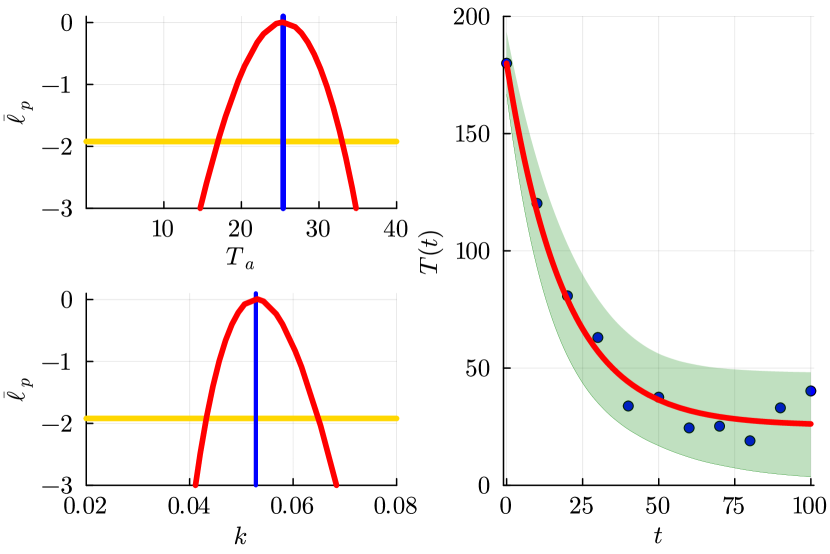
- 从置信集抽样以将参数不确定性传播到预测,生成预测区间。
- 将这些步骤应用于:(i) ODE 牛顿冷却定律、(ii) PDE 对流-扩散模型,以及 (iii) 稳态 BVP 的形态发生物质梯度,包括在可识别性受损时的重新参数化。
实验结果
研究问题
- RQ1在给定特定数据集时,ODE、PDE 与 BVP 模型的参数有多大程度的可识别性?
- RQ2参数的最大似然估计是什么,对它们的置信度有多大?
- RQ3参数不确定性如何传播到模型预测的不确定性?
- RQ4在直接参数不可识别时,重新参数化是否能恢复可识别性?
主要发现
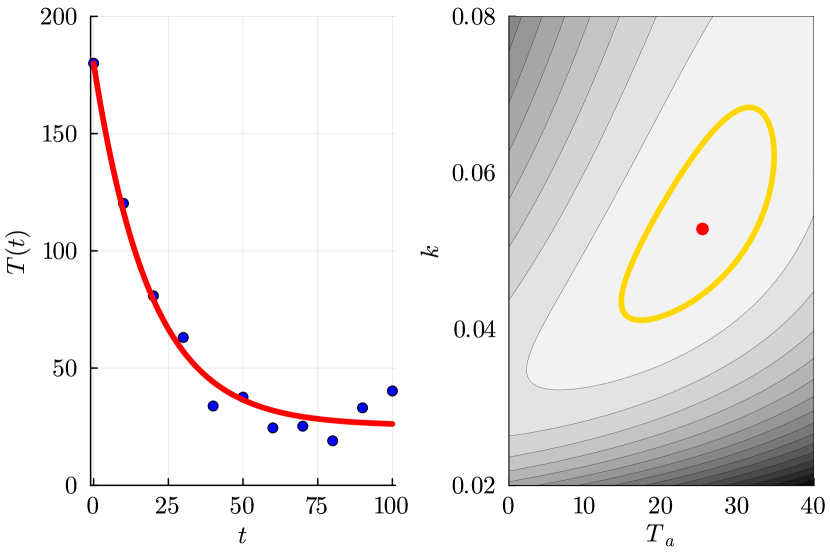
- 对于 ODE 冷却模型,MLE 为 θ̂ = (Tâ, k̂) = (25.386, 0.053),95% 置信区间为 Ta ∈ [16.977, 32.983],k ∈ [0.0432, 0.0648]。
- Ta 和 k 的单变量轮廓似然在 ODE 示例中显示单峰可识别性。
- 对于具有四个参数 (u0, h, D, v) 的 PDE 对流-扩散模型,所有参数在轮廓似然下均具有实际可识别性,且有明显峰值和 95% 置信区间:u0 ∈ [0.839, 1.156],h ∈ [42.939, 58.043],D ∈ [6.227, 13.686],v ∈ [0.990, 1.060]。
- 对 PDE 使用乘法中性对数正态噪声模型导致预测区间非负,并且相比加性高斯噪声具有更好的一致性。
- 在一个简单的 BVP 示例中,参数 (J, D, k) 因结构依赖于 J/√(kD) 和 √(k/D) 而不可识别;重新参数化为 (α, β),其中 α = J/√(kD) 且 β = √(k/D),得到可识别的量 α 和 β 及其各自的轮廓似然。
- 本文表明在原始参数化不可识别时,重新参数化可以恢复可识别性,并且可以构建反映组合参数与噪声不确定性的预测区间。
- 在各个示例中,该方法同时给出点估计和不确定性量化,且 GitHub 上提供了开源的 Julia 代码以便复现。
更好的研究,从现在开始
从论文设计到论文写作,大幅缩短您的研究时间。
无需绑定信用卡
本解读由 AI 生成,并经人工编辑审核。