
[Paper Review] Partial Identification of Causal Effects Using Proxy Variables
This paper proposes partial identification methods for causal effects using proxy variables without requiring the completeness condition, which is typically needed for point identification in proximal causal inference. By leveraging conditional independence and bounds on dependence structures, the authors derive non-smooth bounds on average treatment effects and effects on the treated, using LogSumExp approximations and bootstrap inference for practical implementation.
Proximal causal inference is a recently proposed framework for evaluating causal effects in the presence of unmeasured confounding. For point identification of causal effects, it leverages a pair of so-called treatment and outcome confounding proxy variables, to identify a bridge function that matches the dependence of potential outcomes or treatment variables on the hidden factors to corresponding functions of observed proxies. Unique identification of a causal effect via a bridge function crucially requires that proxies are sufficiently relevant for hidden factors, a requirement that has previously been formalized as a completeness condition. However, completeness is well-known not to be empirically testable, and although a bridge function may be well-defined, lack of completeness, sometimes manifested by availability of a single type of proxy, may severely limit prospects for identification of a bridge function and thus a causal effect; therefore, potentially restricting the application of the proximal causal framework. In this paper, we propose partial identification methods that do not require completeness and obviate the need for identification of a bridge function. That is, we establish that proxies of unobserved confounders can be leveraged to obtain bounds on the causal effect of the treatment on the outcome even if available information does not suffice to identify either a bridge function or a corresponding causal effect of interest. Our bounds are non-smooth functionals of the observed data distribution. As a consequence, in the context of inference, we initially provide a smooth approximation of our bounds. Subsequently, we leverage bootstrap confidence intervals on the approximated bounds. We further establish analogous partial identification results in related settings where identification hinges upon hidden mediators for which proxies are available.
Motivation & Objective
- Address the limitation of proximal causal inference, which typically requires the untestable completeness condition for point identification of causal effects.
- Enable causal effect estimation in settings where only one or insufficiently rich proxy variables are available, making point identification infeasible.
- Develop methods that provide valid bounds on causal effects even when the confounding bridge function cannot be identified due to lack of completeness.
- Extend the applicability of proximal causal inference to real-world scenarios with limited proxy availability or weak proxy relevance.
- Provide inference procedures for these bounds using smooth approximations (LogSumExp) and bootstrap confidence intervals.
Proposed method
- Derive non-smooth functional bounds on the average treatment effect (ATE) and effect on the treated (ETT) using conditional independence assumptions and proxy variable relationships.
- Use the LogSumExp approximation to smooth the non-smooth bounds for practical inference, enabling differentiability and numerical stability.
- Apply bootstrap resampling to construct confidence intervals around the approximated bounds, ensuring valid frequentist inference.
- Leverage conditional independence structures involving treatment, outcome, proxies, and unobserved confounders to derive bounds without requiring identification of the bridge function.
- Formulate bounds based on ratios of joint and product densities (e.g., $\frac{p(w,z|a,x)}{p(w|a,x)p(z|a,x)}$) to capture dependence between proxies.
- Incorporate trivial bounds based on the support of the outcome variable to ensure the final bounds are valid even when proxy dependence is weak.
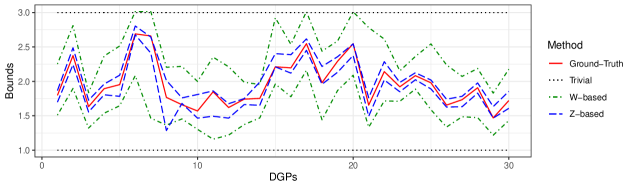
Experimental results
Research questions
- RQ1Can causal effects be partially identified when the completeness condition for proxy variables fails, preventing point identification of the bridge function?
- RQ2How can bounds on the average treatment effect be derived in settings with only a single proxy variable or limited proxy richness?
- RQ3What is the impact of relaxing the completeness assumption on the feasibility and validity of causal effect estimation using proxies?
- RQ4Can smooth approximations and resampling methods be used to construct reliable inference for partially identified causal effects?
- RQ5How do the proposed bounds compare in finite samples to alternative methods when proxies are weak or incomplete?
Key findings
- The paper establishes that causal effects can be partially identified even without completeness, by deriving bounds on the average treatment effect and effect on the treated using proxy variables.
- The bounds are non-smooth functionals of the observed distribution, derived from conditional independence and proxy dependence structures.
- The LogSumExp approximation provides a smooth, differentiable approximation to the non-smooth bounds, enabling practical estimation and inference.
- Bootstrap confidence intervals are constructed around the approximated bounds, ensuring valid frequentist coverage for the partially identified causal parameters.
- The method remains valid even when only one type of proxy is available, relaxing the need for both treatment and outcome confounding proxies.
- Theoretical results show that the bounds are tighter than trivial support bounds when proxy dependence is strong, improving estimation precision in realistic settings.
Better researchstarts right now
From reading papers to final review, dramatically reduce your research time.
No credit card · Free plan available
This review was created by AI and reviewed by human editors.