
[Paper Review] Phase-Field Modeling of Fracture with Physics-Informed Deep Learning
This paper proposes a physics-informed deep learning approach using the deep Ritz method (DRM) to solve phase-field fracture problems, enabling accurate simulation of complex crack behaviors such as nucleation, propagation, kinking, branching, and coalescence. The method achieves quantitative agreement with finite element analysis across benchmark problems while demonstrating robustness to network initialization.
We explore the potential of the deep Ritz method to learn complex fracture processes such as quasistatic crack nucleation, propagation, kinking, branching, and coalescence within the unified variational framework of phase-field modeling of brittle fracture. We elucidate the challenges related to the neural-network-based approximation of the energy landscape, and the ability of an optimization approach to reach the correct energy minimum, and we discuss the choices in the construction and training of the neural network which prove to be critical to accurately and efficiently capture all the relevant fracture phenomena. The developed method is applied to several benchmark problems and the results are shown to be in qualitative and quantitative agreement with the finite element solution. The robustness of the approach is tested by using neural networks with different initializations.
Motivation & Objective
- To develop a robust neural network and optimization framework for simulating complex fracture processes in phase-field modeling.
- To address the challenges of non-convex energy landscapes and accurate energy minimization in deep learning-based phase-field fracture simulation.
- To enable the learning of coupled displacement and phase fields with sharp gradients using physics-informed neural networks.
- To establish a foundation for solving parametric phase-field fracture problems with efficient online inference.
- To evaluate the performance and robustness of the DRM-based approach across diverse fracture phenomena.
Proposed method
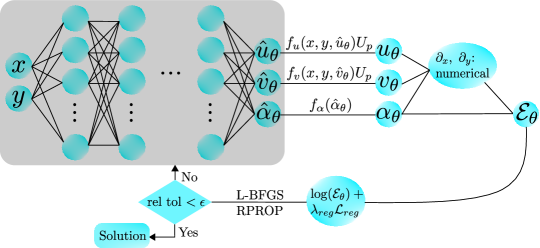
- The deep Ritz method (DRM) is employed to minimize the phase-field fracture energy functional directly, rather than solving the strong-form PDEs.
- A fully connected feedforward neural network with a modified ReLU activation function is used to approximate the displacement and phase fields.
- The loss function includes the energy functional integrated over the domain, with additional terms enforcing boundary and initial conditions.
- Weight regularization and numerical gradient computation are applied to stabilize training and improve convergence.
- The RPROP optimization algorithm is selected as the most effective for navigating the non-convex energy landscape.
- The method is trained on a single setup to simulate multiple fracture phenomena, including crack nucleation, propagation, kinking, branching, and coalescence.
Experimental results
Research questions
- RQ1Can the deep Ritz method effectively minimize the non-convex energy functional in phase-field fracture modeling using neural networks?
- RQ2How does network architecture and optimization choice impact the accuracy and robustness of crack path prediction?
- RQ3To what extent can a single neural network architecture capture diverse fracture phenomena, including branching and coalescence?
- RQ4How does the DRM-based approach compare quantitatively to finite element analysis in terms of energy evolution and crack morphology?
- RQ5Can the method remain robust across different neural network initializations while maintaining accuracy in complex fracture simulations?
Key findings
- The proposed DRM-based approach achieves quantitative agreement with finite element analysis in terms of energy evolution and crack path morphology across all benchmark problems.
- The method successfully captures complex fracture phenomena, including crack nucleation, propagation, kinking, branching, and coalescence, within a single unified framework.
- Different network initializations lead to slight variability in the critical load for crack propagation, but the energy curves remain in close agreement with FEA, indicating robustness.
- The deep Ritz method outperforms standard PINN approaches in handling the non-convex energy landscape typical of phase-field fracture.
- Despite higher computational cost than FEA—up to one order of magnitude longer training time—the method is robust and generalizable across diverse fracture scenarios.
- Two out of eight network initializations failed to converge to the correct energy minimum, highlighting the importance of optimization and initialization choices.

Better researchstarts right now
From reading papers to final review, dramatically reduce your research time.
No credit card · Free plan available
This review was created by AI and reviewed by human editors.