
[Paper Review] PINNs-TF2: Fast and User-Friendly Physics-Informed Neural Networks in TensorFlow V2
This paper introduces PINNs-TF2, a fast and user-friendly Python package built on TensorFlow 2 for accelerating physics-informed neural networks (PINNs). By leveraging XLA just-in-time (JIT) compilation and static computational graphs, the framework achieves up to 119.96x speedup over TensorFlow 1.0, with an average 18.12x improvement across eight PDE examples, while simplifying PINN implementation through Hydra-configured workflows and modular condition handling.
Physics-informed neural networks (PINNs) have gained prominence for their capability to tackle supervised learning tasks that conform to physical laws, notably nonlinear partial differential equations (PDEs). This paper presents "PINNs-TF2", a Python package built on the TensorFlow V2 framework. It not only accelerates PINNs implementation but also simplifies user interactions by abstracting complex PDE challenges. We underscore the pivotal role of compilers in PINNs, highlighting their ability to boost performance by up to 119x. Across eight diverse examples, our package, integrated with XLA compilers, demonstrated its flexibility and achieved an average speed-up of 18.12 times over TensorFlow V1. Moreover, a real-world case study is implemented to underscore the compilers' potential to handle many trainable parameters and large batch sizes. For community engagement and future enhancements, our package's source code is openly available at: https://github.com/rezaakb/pinns-tf2.
Motivation & Objective
- To address the performance bottleneck in PINN training caused by repeated gradient computations in dynamic computational graphs.
- To streamline the implementation of PINNs for both forward and inverse problems involving nonlinear PDEs.
- To improve user experience by abstracting complex PDE setup through configurable workflows using the Hydra framework.
- To evaluate the impact of compilers, batch size, and trainable parameters on PINN training efficiency and accuracy.
- To provide a publicly available, open-source tool that enhances performance and usability for PINN research.
Proposed method
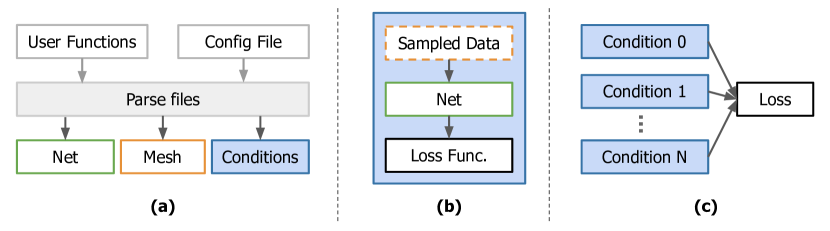
- The package uses TensorFlow 2's static computational graphs via tf.function with jit_compile=True to enable XLA JIT compilation for optimized machine code generation.
- It integrates the Hydra framework to manage configuration files, defining spatial/temporal domains, sampling strategies, boundary conditions, and neural network architecture.
- The framework supports both continuous and discrete time models, using collocation points and solution data to define loss functions for PDEs and boundary conditions.
- Multiple loss functions are combined—such as SSE and MSE—for data, collocation, and boundary conditions—shared across a single neural network.
- Training and evaluation steps are compiled using XLA, which fuses operations and optimizes memory and computation on target hardware.
- The method supports both forward and inverse problems, including parametric PDEs like Burgers’ and Navier-Stokes equations, with configurable hyperparameters and batch sizes.
Experimental results
Research questions
- RQ1How does XLA JIT compilation impact the training speed of PINNs compared to standard TensorFlow 1.0 and TF2 without compilation?
- RQ2To what extent can a modular, configuration-driven framework like PINNs-TF2 simplify the implementation of diverse PDE problems in PINNs?
- RQ3How do batch size and the number of trainable parameters influence the performance and convergence of PINNs in complex PDEs?
- RQ4Can the framework efficiently handle large-scale problems with many parameters and high batch sizes, as demonstrated in real-world case studies?
- RQ5What is the trade-off between speed-up and numerical stability when using JIT compilation in PINN training?
Key findings
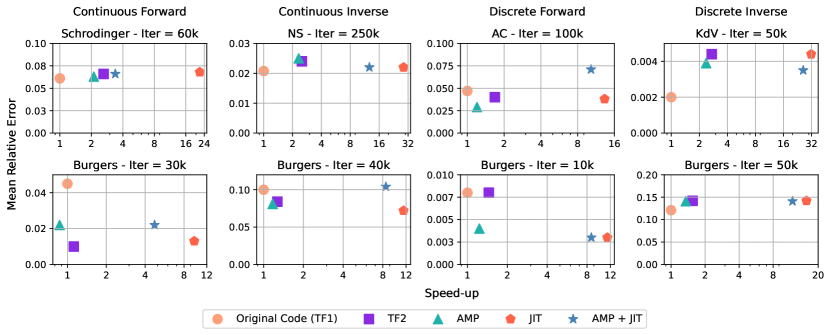
- PINNs-TF2 achieved a peak speed-up of 119.96x over the original TensorFlow 1.0 implementation, primarily due to XLA JIT compilation.
- On average, the framework delivered a 18.12x speed-up across eight diverse PDE examples, including Burgers’ and Navier-Stokes equations.
- For the discrete forward Burgers’ equation, JIT compilation alone provided a 11.39x speed-up over the original TF1 implementation.
- In the discrete inverse Burgers’ equation, JIT compilation yielded a 15.77x speed-up, with minimal degradation in solution accuracy (mean relative error of 0.142).
- The integration of the Hydra framework enabled efficient, modular configuration of PDE problems, improving reproducibility and user accessibility.
- The package demonstrated scalability on large-scale problems, such as the 3D Navier-Stokes equation with 10,000 batch size and 10×250-layer networks, confirming its practical viability.
Read this paper
Open the full text in the Nubint reader and ask about any passage as you read.
Read this paper on NubintThis review was generated by AI from the original paper. Please check the paper before citing it.