
[Paper Review] Policy Optimization for Continuous Reinforcement Learning
This paper develops a continuous-time policy optimization framework for reinforcement learning using stochastic differential equations, introducing a novel occupation time measure for discounted objectives. It derives performance-difference and local-approximation formulas, enabling continuous counterparts of policy gradient and TRPO/PPO methods without time/space discretization, with experiments showing convergence and superiority over discrete baselines.
We study reinforcement learning (RL) in the setting of continuous time and space, for an infinite horizon with a discounted objective and the underlying dynamics driven by a stochastic differential equation. Built upon recent advances in the continuous approach to RL, we develop a notion of occupation time (specifically for a discounted objective), and show how it can be effectively used to derive performance-difference and local-approximation formulas. We further extend these results to illustrate their applications in the PG (policy gradient) and TRPO/PPO (trust region policy optimization/ proximal policy optimization) methods, which have been familiar and powerful tools in the discrete RL setting but under-developed in continuous RL. Through numerical experiments, we demonstrate the effectiveness and advantages of our approach.
Motivation & Objective
- To establish a continuous-time counterpart of the visitation frequency (occupation time) in discrete MDPs for discounted objectives.
- To derive performance-difference and local-approximation formulas in continuous-time RL using perturbation analysis.
- To develop continuous-time versions of policy gradient (PG), TRPO, and PPO methods without prior time or space discretization.
- To demonstrate convergence and improved performance of the proposed methods in continuous stochastic control tasks.
Proposed method
- Introduces a new notion of occupation time specifically tailored for discounted objectives in continuous-time stochastic control.
- Derives a performance-difference formula using perturbation analysis, linking policy changes to performance shifts.
- Develops a local approximation of the performance metric with a provable bound, enabling minorization-majorization (MM) algorithm design.
- Proposes continuous-time PG, TRPO, and PPO variants by adapting discrete methods to continuous dynamics via the derived formulas.
- Employs neural network parameterizations for policy and value functions, with gradient updates based on sampled trajectories.
- Uses square-root and linear KL-divergence in CPPO to control policy updates, with ablation showing superior convergence of the square-root variant.

Experimental results
Research questions
- RQ1What is the continuous-time analogue of the visitation frequency (occupation time) in discrete MDPs with a discounted objective?
- RQ2Can a performance-difference formula be derived in continuous-time RL similar to those in discrete MDPs?
- RQ3How can trust-region and proximal policy optimization methods be adapted to continuous-time, continuous-space RL?
- RQ4Can the proposed continuous-time policy optimization methods outperform their discrete-time counterparts in terms of convergence and stability?
Key findings
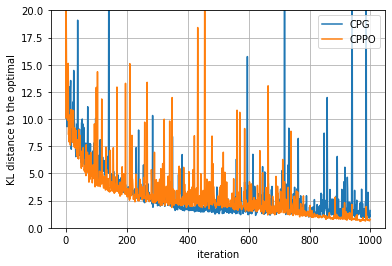
- The proposed continuous-time policy gradient (CPG) and CPPO methods converge to optimal policies in numerical experiments on stochastic control tasks.
- CPPO with square-root KL-divergence outperforms the linear KL version, avoiding local optima and showing more stable convergence.
- CPG and CPPO achieve performance comparable or superior to discrete-time PG and PPO, even with coarse time discretization (δt = 0.1), indicating potential advantages in continuous formulation.
- The continuous framework enables policy optimization without explicit time or space discretization, preserving the continuous nature of the underlying SDE dynamics.
- The performance-difference formula enables accurate estimation of policy improvement, validating the theoretical foundation of the approach.
- The method is robust to time discretization, with experiments showing consistent performance across different δt values.
Read this paper
Open the full text in the Nubint reader and ask about any passage as you read.
Read this paper on NubintThis review was generated by AI from the original paper. Please check the paper before citing it.