
[论文解读] Precision Aquaculture: An Integrated Computer Vision and IoT Approach for Optimized Tilapia Feeding
本文提出了一种集成计算机视觉与物联网(IoT)的系统,用于罗非鱼水产养殖的精准投喂,采用 YOLOv8 实现实时鱼体关键点检测与体型估算,并结合基于传感器的水质监测。该系统在关键点检测上实现了 94% 的精确度,通过优化投喂策略并减少浪费,使生产效率最高提升 58 倍。
Traditional fish farming practices often lead to inefficient feeding, resulting in environmental issues and reduced productivity. We developed an innovative system combining computer vision and IoT technologies for precise Tilapia feeding. Our solution uses real-time IoT sensors to monitor water quality parameters and computer vision algorithms to analyze fish size and count, determining optimal feed amounts. A mobile app enables remote monitoring and control. We utilized YOLOv8 for keypoint detection to measure Tilapia weight from length, achieving extbf{94\%} precision on 3,500 annotated images. Pixel-based measurements were converted to centimeters using depth estimation for accurate feeding calculations. Our method, with data collection mirroring inference conditions, significantly improved results. Preliminary estimates suggest this approach could increase production up to 58 times compared to traditional farms. Our models, code, and dataset are open-source~\footnote{The code, dataset, and models are available upon reasonable request.
研究动机与目标
- 解决传统罗非鱼养殖中因过度投喂和营养管理不善导致的效率低下问题。
- 开发一种可扩展的实时系统,利用计算机视觉实现鱼类自动计数与体重估算。
- 集成物联网传感器,持续监测水质参数(如 pH 值和溶解氧)。
- 创建一个开源数据集与模型,以支持水产养殖计算机视觉领域的可复现研究。
- 展示一种整体性、端到端的解决方案,可在提升生产效率的同时最小化环境影响。
提出的方法
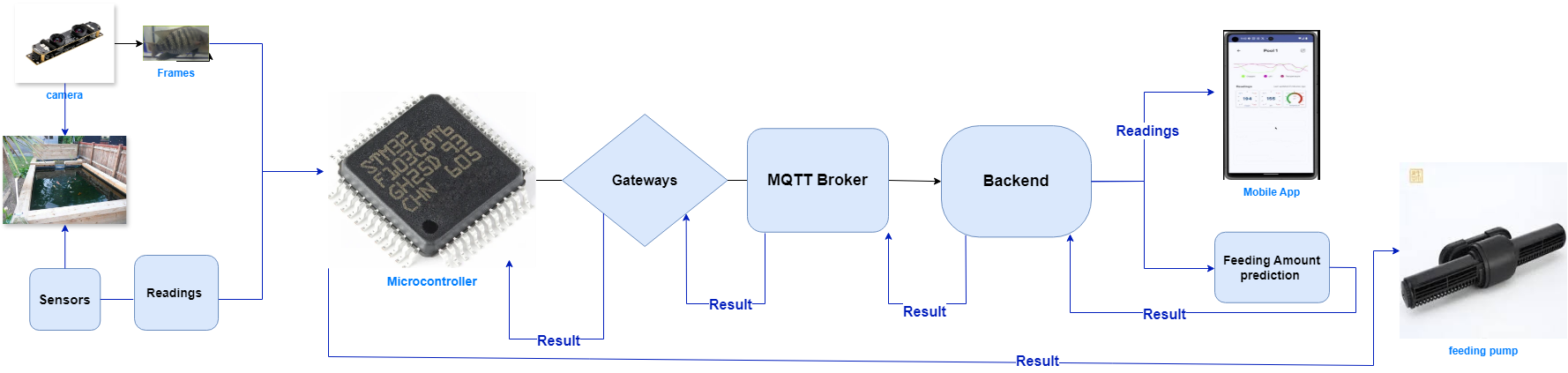
- 采用双同步正交摄像头,在受控光照与拍摄角度下捕获鱼体图像,确保数据采集的一致性。
- 使用带关键点检测功能的 YOLOv8 模型,识别罗非鱼的解剖学标志点(口部、尾柄、腹部、背部),以估算体长。
- 通过 GLPN 模型实现深度估计,将基于像素的测量值转换为实际的厘米单位,以提高体长与体重计算的准确性。
- 建立体长-体重关系模型,利用校准数据从测量体长估算鱼体重。
- 将实时物联网传感器(pH 值、溶解氧)集成至集中式系统,实现环境监测与反馈控制。
- 部署移动应用程序,支持基于实时数据与模型预测的远程监控与投喂时间表控制。
![Figure 1: Description of fish lengths. We opt to measure the maximum standard length to calculate fish weight [ Froese et al., 2014 ] .](https://ar5iv.labs.arxiv.org/html/2409.08695/assets/images/distance.png)
实验结果
研究问题
- RQ1YOLOv8 是否能在真实水产养殖环境中实现对罗非鱼的高精度关键点检测?
- RQ2基于计算机视觉的鱼类计数与体型估算相较于传统方法,能在多大程度上提升投喂准确性?
- RQ3将实时水质监测与视觉鱼类评估相结合,对整体系统性能的提升程度如何?
- RQ4在罗非鱼养殖中,采用自动化视觉-IoT 集成系统可能带来多大的生产效率提升?
- RQ5该系统在典型现场部署中边缘设备的硬件资源限制下表现如何?
主要发现
- YOLOv8 模型在 3,500 张标注罗非鱼图像的数据集上实现了 94% 的关键点检测精确度,显著优于 Faster R-CNN、Mask R-CNN 和 RetinaNet 在 AP@50 与 AP@75 指标上的表现。
- 鱼类计数准确率达到 96%,可实现对放养密度与投喂需求的可靠估算。
- 在 MCU 硬件上使用 YOLOv8 nano 变体时,推理时间低于 200ms,证实其适用于边缘设备部署。
- 通过 GLPN 实现的深度估计可准确将像素测量值转换为实际尺寸,显著提升了体长与体重估算的可靠性。
- 初步的生产效率建模表明,与传统养殖方法相比,该系统有望实现最高 58 倍的生产效率提升。
- 通过 Hugging Face 与 GitHub 开源发布模型、代码与数据集,支持研究的可复现性,并为未来扩展至其他鱼类物种奠定基础。
更好的研究,从现在开始
从阅读论文到最终审阅,大幅缩短您的研究时间。
无需绑定信用卡
本解读由 AI 生成,并经人工编辑审核。