
[论文解读] Probing the high temperature symmetry breaking with gravitational waves from domain walls
本文分析高温下的 Z2 对称性破缺,导致领域壁形成与湮灭,产生引力波;并将 GW 信号与对称性破缺能标联系起来,讨论对 NANOGrav 数据的潜在解释以及未来探测器可测试的预测。
The symmetry can be broken at high temperature and then restored at low temperature, which is the so-called \emph{high temperature symmetry breaking}. It often appears in some theories such as the high scale electroweak baryogenesis mechanism. In this paper, we probe the high temperature $\mathbb{Z}_2$ symmetry breaking with gravitational waves (GWs) from domain wall annihilation. We first introduce a scalar with $\mathbb{Z}_2$ symmetry and few of singlet fermions that interact with scalar through a five-dimension operator. This can lead to the scalar potential has a non-zero minimum at high temperature. At the early stage, the scalar is pinned at symmetric phase due to the large Hubble fraction. When the scalar thermal mass becomes comparable to the Hubble parameter, it can quickly roll down to the minimum of potential. Then the $\mathbb{Z}_2$ symmetry is spontaneously broken and the domain walls will form. With the decrease of temperature, $\mathbb{Z}_2$ symmetry will be restored. We find that if domain walls are formed at $\mathcal{O}(10^{9})~ m GeV$, the GW produced by domain wall annihilation is expected to be observed by BBO, CE and ET. In addition, we also discuss the relationships between this scenario and NANOGrav signal.
研究动机与目标
- 通过一个具有五维相互作用与单重费米子耦合的实标量来激励并建模高温下的 Z2 对称性破缺。
- 推导温度依赖的领域-wall 张力以及避免领域-wall 问题的形成/湮灭条件。
- 从领域-wall 湮灭中计算引力波谱并将峰频率/振幅与对称性破缺尺度联系起来。
- 将引力波预测与当前及未来的引力波观测台相连,并讨论与 NANOGrav 信号之间的潜在联系。
提出的方法
- 引入一个具 Z2 对称性的实标量 φ 和 Nf 个单重费米子 ψ,通过 φ^2/M_pl 算子耦合。
- 使用在有限温度下的有效势 V_eff(φ,T),在高温下产生极小点并实现 Z2 破缺,且 κ = Nf mψ / M_pl。
- 推导温度相关的领域壁张力 σ_wall(T) ∝ T^3 及避免领域壁过密封锁的条件 (ρ_wall/ρ_rad < 1)。
- 在辐射支配时期分析领域壁在 T_i 时的形成以及湮灭时刻 t_ann ≈ t_i。
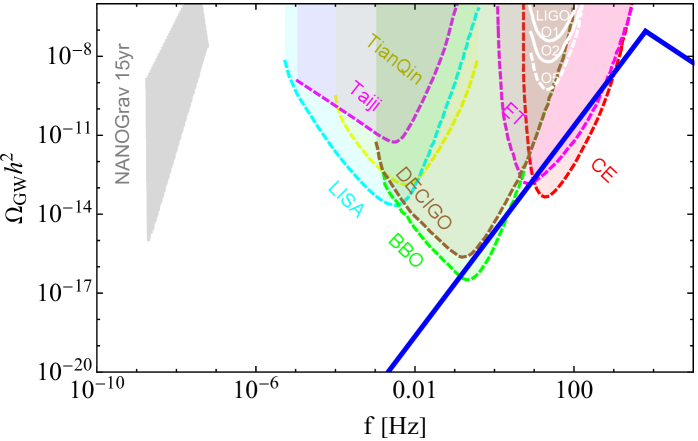
- 从领域壁湮灭计算引力波谱,给出在 t_ann 的峰振幅 Ω_gw(t_ann)_peak,以及通过已建立的关系给出当前 Ω_gw h^2_peak: (Ω_gw h^2)_peak ≈ 9×10^-14 (κ^4/λ^2) (100/g_*(T_i))^{7/3} 和 f_gw_peak ≈ 2×10^11 Hz sqrt(κ) (100/g_*(T_i))^{1/3}。
实验结果
研究问题
- RQ1κ 和 λ 的哪些参数范围在高温下 Z2 破缺且领域壁在辐射支配阶段湮灭?
- RQ2领域壁张力的温度依赖性如何影响宇宙学演化并避免领域壁问题?
- RQ3作为对称性破缺尺度的函数,领域壁湮灭引力波的振幅和峰频率的特征是什么?
- RQ4预测的 GW 光谱是否能够容纳或解释当前对随机背景的暗示如 NANOGrav,同时仍可被未来探测器测试?
- RQ5在未来 GW 实验中有哪些观测信号可以证实通过领域壁实现的高温对称性破缺?
主要发现
- 当 κ 約 10^-15 且 λ 約 10^-33 时,Z2 在约 10^9 GeV 处被破缺,GW 峰值约在 10^3–10^4 Hz,可以被 BBO、CE 和 ET 探测。
- 当 κ 約 10^-38 且 λ 約 10^-78 时,对称性破缺发生在约 10 MeV,GW 峰值在约 10^-8 Hz,可能解释 NANOGrav 15 年信号,并可被更高频段的 LISA、TianQin、DECIGO、BBO 探测。
- 当前 GW 峰值振幅遵循 Ω_gw h^2_peak ≈ 9×10^-14 × (κ^4/λ^2) × (100/g_*(T_i))^{7/3}。
- 当前峰频率的尺度为 f_gw_peak ≈ 2×10^11 Hz × sqrt(κ) × (100/g_*(T_i))^{1/3}。
- 该模型预测温度相关的领域壁张力 σ_wall(T) ∝ T^3,导致领域壁能密度迅速衰减,避免通常的领域壁过密问题。
- 如果 κ 非常小(∼10^-38)且 λ 非常微小,则可能产生质量极低的费米子,质量约 ∼10^-11 eV,潜在地与超轻量费米子暗物质的概念相关。

更好的研究,从现在开始
从论文设计到论文写作,大幅缩短您的研究时间。
无需绑定信用卡
本解读由 AI 生成,并经人工编辑审核。