
[Paper Review] Prompting is not a substitute for probability measurements in large language models
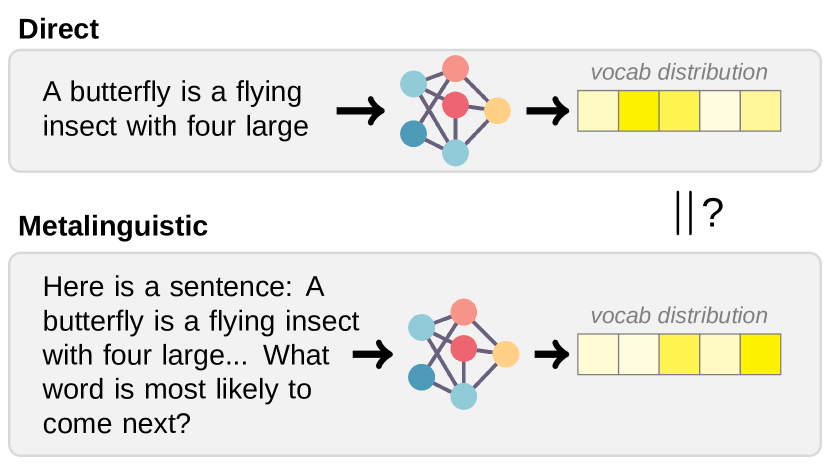
This paper demonstrates that metalinguistic prompting—using natural language queries to assess language model knowledge—yields less accurate and less consistent results than direct probability measurements from model logits. The authors find that LLMs' responses to prompting often diverge from their true internal probability distributions, undermining the validity of prompting as a substitute for direct measurement in linguistic evaluation.
Prompting is now a dominant method for evaluating the linguistic knowledge of large language models (LLMs). While other methods directly read out models' probability distributions over strings, prompting requires models to access this internal information by processing linguistic input, thereby implicitly testing a new type of emergent ability: metalinguistic judgment. In this study, we compare metalinguistic prompting and direct probability measurements as ways of measuring models' linguistic knowledge. Broadly, we find that LLMs' metalinguistic judgments are inferior to quantities directly derived from representations. Furthermore, consistency gets worse as the prompt query diverges from direct measurements of next-word probabilities. Our findings suggest that negative results relying on metalinguistic prompts cannot be taken as conclusive evidence that an LLM lacks a particular linguistic generalization. Our results also highlight the value that is lost with the move to closed APIs where access to probability distributions is limited.
Motivation & Objective
- To evaluate whether metalinguistic prompting reliably measures linguistic knowledge in large language models (LLMs).
- To compare the accuracy and consistency of metalinguistic prompting against direct probability measurements from model logits.
- To highlight the risks of relying on closed APIs that limit access to internal probability distributions.
- To argue that prompting should not be used as a substitute for direct measurement in scientific evaluation of LLMs.
Proposed method
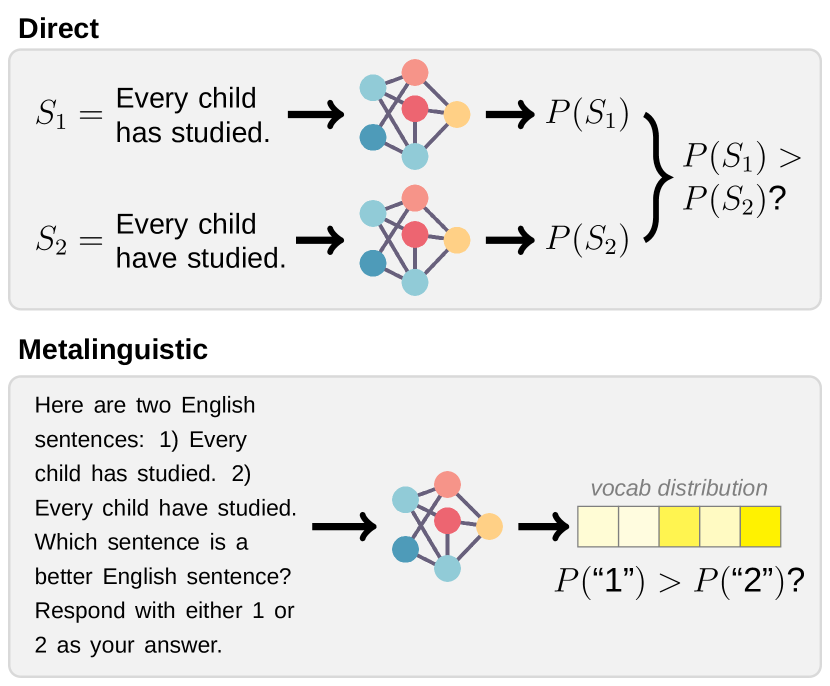
- The study compares direct probability measurements—extracting P(token|context) from model logits—against metalinguistic prompting, where models are queried via natural language about linguistic acceptability or likelihood.
- Four experiments were conducted across diverse linguistic domains, including subject-verb agreement, relative clause attachment, and semantic plausibility.
- For each task, the model's response to a metalinguistic prompt (e.g., 'What is the most likely next word?') was compared to its actual probability distribution over candidate completions.
- The authors used zero-shot prompting and direct logit access on a range of models, including GPT-3, GPT-3.5, and LLaMA, to ensure methodological consistency.
- Consistency between prompting and direct measurement was quantified by comparing rank-orderings of candidate completions across both methods.
- All experiments were replicated across multiple models and prompts, with code and data publicly released.
Experimental results
Research questions
- RQ1How do metalinguistic prompting responses compare in accuracy to direct probability measurements of LLMs’ internal representations?
- RQ2To what extent is the consistency between metalinguistic prompting and direct probability measurement affected by the structure of the prompt?
- RQ3Does the model’s performance on metalinguistic prompts reflect its true linguistic competence, or is it an emergent performance-related ability?
- RQ4Can negative results from prompting be interpreted as evidence that an LLM lacks a specific linguistic generalization?
- RQ5How does the loss of access to internal probability distributions—due to closed APIs—affect the validity of linguistic evaluations?
Key findings
- Metalinguistic prompting produces significantly less accurate assessments of linguistic knowledge than direct probability measurements, particularly for rare or complex linguistic patterns.
- The consistency between metalinguistic prompting and direct probability measurements decreases as the prompt structure diverges from a direct probability query.
- Models often fail to report the most likely next word in prompting tasks even when their internal probability distribution clearly favors that token.
- The discrepancy between prompting and direct measurement is not due to model limitations in representation, but rather in the model’s ability to access and report its internal knowledge under metalinguistic queries.
- The study demonstrates that negative results from prompting—such as rejecting a grammatically correct construction—cannot be taken as conclusive evidence of linguistic incompetence.
- The authors conclude that prompting should not be used as a substitute for direct probability measurements in scientific research, especially when access to model internals is restricted.
Read this paper
Open the full text in the Nubint reader and ask about any passage as you read.
Read this paper on NubintThis review was generated by AI from the original paper. Please check the paper before citing it.