
[Paper Review] Quasicrystalline structure of the Smith monotile tilings
This paper demonstrates that the Hat monotile tiling, though aperiodic, exhibits quasicrystalline order with hexagonal (C6) symmetry and a locked incommensurate ratio tied to the golden mean. By projecting a subset of six-dimensional hypercubic lattice points onto the 2D plane, the authors show the tiling's diffraction pattern consists of dense Bragg peaks at wavevectors proportional to integer combinations of incommensurate basis vectors, confirming its quasicrystalline nature despite the absence of periodicity.
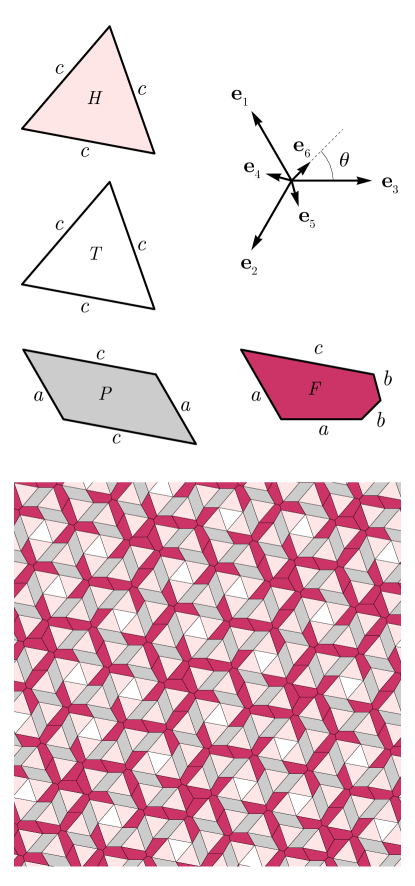
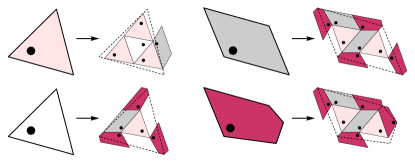
Tiling models can reveal unexpected ways in which local constraints give rise to exotic long-range spatial structure. The recently discovered Hat monotile (and its mirror image) has been shown to be aperiodic~[Smith et al., arXiv:2303.10798 (2023)]; it can tile the plane with no holes or overlaps, but cannot do so periodically. We show that the structure enforced by the local space-filling constraints is quasiperiodic with hexagonal (C6) rotational symmetry. Although this symmetry is compatible with periodicity, the incommensurate ratio characterizing the quasiperiodicity stays locked to the golden mean as the tile parameters are continuously varied. We analyze a modification of the metatiles introduced by Smith et al. that yields a set of ``Key tiles'' that can be constructed as projections of a subset of six-dimensional hypercubic lattice points onto the two-dimensional tiling plane. We analytically compute the diffraction pattern of a set of unit masses placed at the tiling vertices, establishing the quasiperiodic nature of the tiling. We point out several unusual features of the family of Key tilings and associated Hat tilings, including the tile rearrangements associated with the phason degree of freedom associated with incommensurate density waves, which exhibit novel features that may influence the elastic properties of a material in which atoms or larger particles spontaneously exhibit the symmetries of the Hat tiling.
Motivation & Objective
- To characterize the long-range order in the Hat monotile tiling, which is aperiodic but not periodic.
- To determine whether the tiling exhibits quasicrystalline properties, such as long-range order with incommensurate diffraction peaks.
- To extend the tiling framework by introducing 'Key tiles' derived from a 6D hypercubic lattice projection.
- To analyze how the substitution (inflation/deflation) dynamics behave across a continuous family of tiling parameters.
- To investigate whether the golden ratio emerges as a fixed incommensurability ratio across a 2-parameter family of tilings, despite hexagonal symmetry not forcing it.
Proposed method
- The authors define a set of 'Key tiles' by projecting a bounded subset of 6D hypercubic lattice points onto the 2D tiling plane, with the projection window defined in a 4D subspace orthogonal to the tiling plane.
- They establish that the inflation and deflation operations on Key tiles correspond to linear transformations in 6D space, enabling recursive construction of larger or smaller tilings.
- The diffraction pattern is analytically computed by placing unit masses at the tiling vertices and projecting the 6D reciprocal lattice onto the 2D physical space.
- The resulting diffraction pattern is shown to consist of Bragg peaks at wavevectors of the form (n + mφ)k₀, where φ is the golden ratio and n, m are integers, confirming quasiperiodicity.
- The Golden Key tiling is identified as the unique case where tile shapes are preserved under infinite deflation, corresponding to the limiting shape of Smith et al.'s metatiles.
- The authors compare the structure to the Penrose tiling and highlight differences, such as the absence of 10-fold symmetry and the emergence of φ-locking in a hexagonal system.
Experimental results
Research questions
- RQ1Does the Hat monotile tiling exhibit quasicrystalline order, as evidenced by a diffraction pattern with dense Bragg peaks at incommensurate wavevectors?
- RQ2Can the tiling be understood as a projection of a higher-dimensional lattice, and if so, what is the dimensionality and structure of that lattice?
- RQ3Why is the golden ratio φ locked as the incommensurate ratio in this hexagonal system, despite no symmetry forcing this ratio?
- RQ4How do the inflation and deflation operations behave across the continuous family of Key tilings, and what distinguishes the Golden Key tiling from others?
- RQ5Are there alternative tile decorations possible for the Key tiling family that reduce the number of tile types, and do they preserve combinatorial equivalence to the Hat tiling?
Key findings
- The Hat tiling is quasicrystalline, with a diffraction pattern composed of dense Bragg peaks at wavevectors (n + mφ)k₀, where φ is the golden ratio and n, m are integers.
- The tiling arises from projecting a subset of 6D hypercubic lattice points onto the 2D plane, with the projection window bounded in a 4D subspace orthogonal to the tiling plane.
- The Golden Key tiling is the unique case in which tile shapes are preserved under infinite deflation, and it exhibits mirror symmetry in its vertex set.
- The incommensurate ratio φ remains fixed as tile parameters are continuously varied, indicating a 'locking' mechanism not forced by symmetry, distinguishing it from incommensurate density waves with variable ratios.
- The Key tiling family includes cases where tile boundaries become self-intersecting upon repeated deflation, and some members do not admit a decoration by two mirror-image Hat tiles.
- The projection method allows the application of standard quasicrystal analysis tools—such as empire and phason defect analysis—to the Hat tiling, confirming its deep structural similarity to Penrose tilings despite different symmetry.
Better researchstarts right now
From reading papers to final review, dramatically reduce your research time.
No credit card · Free plan available
This review was created by AI and reviewed by human editors.