
[论文解读] Re-labeling ImageNet: from Single to Multi-Labels, from Global to Localized Labels
本文提出 ReLabel 方法,利用强预训练分类器对 ImageNet 训练集进行基于定位的多标签标注,并引入 LabelPooling 机制在训练过程中利用这些密集标签。该方法将 ResNet-50 在 ImageNet 上的 top-1 准确率提升至 78.9%,在使用 CutMix 时达到 80.2%,并在迁移学习与多标签基准测试中均实现一致的性能提升。
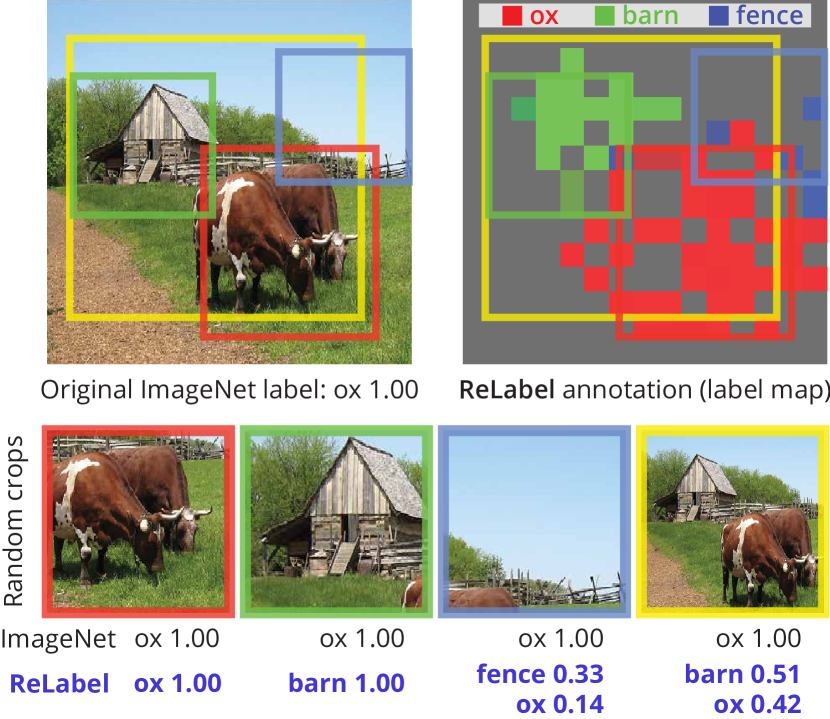
ImageNet has been arguably the most popular image classification benchmark, but it is also the one with a significant level of label noise. Recent studies have shown that many samples contain multiple classes, despite being assumed to be a single-label benchmark. They have thus proposed to turn ImageNet evaluation into a multi-label task, with exhaustive multi-label annotations per image. However, they have not fixed the training set, presumably because of a formidable annotation cost. We argue that the mismatch between single-label annotations and effectively multi-label images is equally, if not more, problematic in the training setup, where random crops are applied. With the single-label annotations, a random crop of an image may contain an entirely different object from the ground truth, introducing noisy or even incorrect supervision during training. We thus re-label the ImageNet training set with multi-labels. We address the annotation cost barrier by letting a strong image classifier, trained on an extra source of data, generate the multi-labels. We utilize the pixel-wise multi-label predictions before the final pooling layer, in order to exploit the additional location-specific supervision signals. Training on the re-labeled samples results in improved model performances across the board. ResNet-50 attains the top-1 classification accuracy of 78.9% on ImageNet with our localized multi-labels, which can be further boosted to 80.2% with the CutMix regularization. We show that the models trained with localized multi-labels also outperforms the baselines on transfer learning to object detection and instance segmentation tasks, and various robustness benchmarks. The re-labeled ImageNet training set, pre-trained weights, and the source code are available at {https://github.com/naver-ai/relabel_imagenet}.
研究动机与目标
- 解决 ImageNet 图像中多物体特性与单标签标注之间的不匹配问题,该问题在随机裁剪训练过程中引入了噪声监督信号。
- 克服为整个 ImageNet 训练集创建像素级多标签标注的高昂成本。
- 通过在训练期间提供更准确、具有空间感知能力的监督信号,提升模型的泛化能力与鲁棒性。
- 证明更清晰、定位精确的多标签监督信号不仅能提升 ImageNet 分类性能,还能在下游目标检测、语义分割和细粒度识别等任务中带来性能增益。
- 开发一种可扩展的一次性标注流水线,避免迭代蒸馏过程,实现高效密集监督训练。
提出的方法
- 在外部数据源(如大规模弱监督数据)上训练一个强图像分类器,为每个 ImageNet 图像生成密集的像素级多标签预测结果。
- 将模型最终卷积特征(全局平均池化之前)作为密集标签图 $ L ∈ \mathbb{R}^{H \times W \times C} $,表示每个空间位置上各类别的置信度。
- 提出 LabelPooling,一种训练方案:通过聚合裁剪区域内的密集标签分数,为每个随机裁剪计算多标签真实标签。
- 将 LabelPooling 与标准交叉熵损失结合,实现端到端训练,利用定位精确的多标签监督信号。
- 将重标注数据与 LabelPooling 应用于单标签与多标签基准测试,包括 ImageNet 与 COCO。
- 应用 CutMix 正则化技术,进一步提升重标注 ImageNet 数据集上的性能。
实验结果
研究问题
- RQ1用基于定位的多标签标注替代单标签标注,能否提升模型在 ImageNet 上的泛化能力与鲁棒性?
- RQ2使用预训练分类器生成密集标签图,能否在保持高质量监督的同时降低标注成本?
- RQ3LabelPooling 是否能有效利用密集的空间感知标签进行随机裁剪训练,且不会带来过高的计算开销?
- RQ4在 ReLabel 重标注数据上进行预训练,对下游任务(如目标检测与实例分割)的迁移学习性能提升程度如何?
- RQ5与标准训练方式及其他正则化技术(如 CutMix)相比,ReLabel 在多标签基准测试中的性能增益如何?
主要发现
- ReLabel 将 ResNet-50 在 ImageNet 上的 top-1 准确率提升至 78.9%,相比基线单标签模型提升 1.4 个百分点。
- 在使用 CutMix 正则化后,ResNet-50 的 top-1 准确率达到 80.2%,据我们所知,创下 ImageNet 上的新 SOTA 记录。
- 在 ReLabel 重标注的 ImageNet 上预训练的模型,在五个细粒度分类基准上均实现一致性能提升,其中在 FGVC Aircraft 数据集上最高提升达 +3.8 个百分点。
- 在 COCO 目标检测任务中,使用 ReLabel 预训练的 ResNet-50 作为主干网络的 Faster-RCNN 比基线模型 mAP 提升 +0.5。
- 在 COCO 实例分割任务中,使用 ReLabel 预训练的 ResNet-50 作为主干网络的 Mask-RCNN 实现 +0.5 mAP 提升,表明其特征学习能力更强。
- 在 COCO 多标签分类任务中,使用真实标签图(oracle label maps)的 ReLabel 方法使 ResNet-101 的 mAP 提升 +4.2 个百分点,表明在现有多标签设置中也具有显著增益。
更好的研究,从现在开始
从阅读论文到最终审阅,大幅缩短您的研究时间。
无需绑定信用卡
本解读由 AI 生成,并经人工编辑审核。