
[Paper Review] Real-Time High-Resolution Background Matting
This paper presents a real-time, high-resolution background matting method that achieves 30fps at 4K and 60fps at HD using a two-stage neural network: a low-resolution base network with error prediction and a high-resolution refinement network applied only to critical regions. The approach sets a new state-of-the-art in quality and speed, leveraging two new large-scale datasets—VideoMatte240K and PhotoMatte13K/85—trained on chroma-keyed mattes for robust generalization.
We introduce a real-time, high-resolution background replacement technique which operates at 30fps in 4K resolution, and 60fps for HD on a modern GPU. Our technique is based on background matting, where an additional frame of the background is captured and used in recovering the alpha matte and the foreground layer. The main challenge is to compute a high-quality alpha matte, preserving strand-level hair details, while processing high-resolution images in real-time. To achieve this goal, we employ two neural networks; a base network computes a low-resolution result which is refined by a second network operating at high-resolution on selective patches. We introduce two largescale video and image matting datasets: VideoMatte240K and PhotoMatte13K/85. Our approach yields higher quality results compared to the previous state-of-the-art in background matting, while simultaneously yielding a dramatic boost in both speed and resolution.
Motivation & Objective
- To enable real-time, high-resolution background matting for practical video conferencing applications without requiring green screens.
- To address the challenge of preserving fine-grained details like hair strands in real-time processing of 4K and HD video.
- To overcome the limitations of prior methods that are either too slow, low-resolution, or require manual trimap annotations.
- To develop a scalable, end-to-end trainable system that generalizes across diverse human poses and backgrounds.
Proposed method
- A two-stage neural network architecture: a base network processes the input at low resolution to predict coarse alpha matte and foreground, while a refinement network enhances only high-error regions at full resolution.
- The base network outputs an error prediction map that identifies patches requiring high-resolution refinement, minimizing redundant computation.
- A refinement network uses a stack of 3×3 convolutions with a 13×13 receptive field to improve detail sharpness in selected regions, outperforming point-based 1×1 kernel refinement.
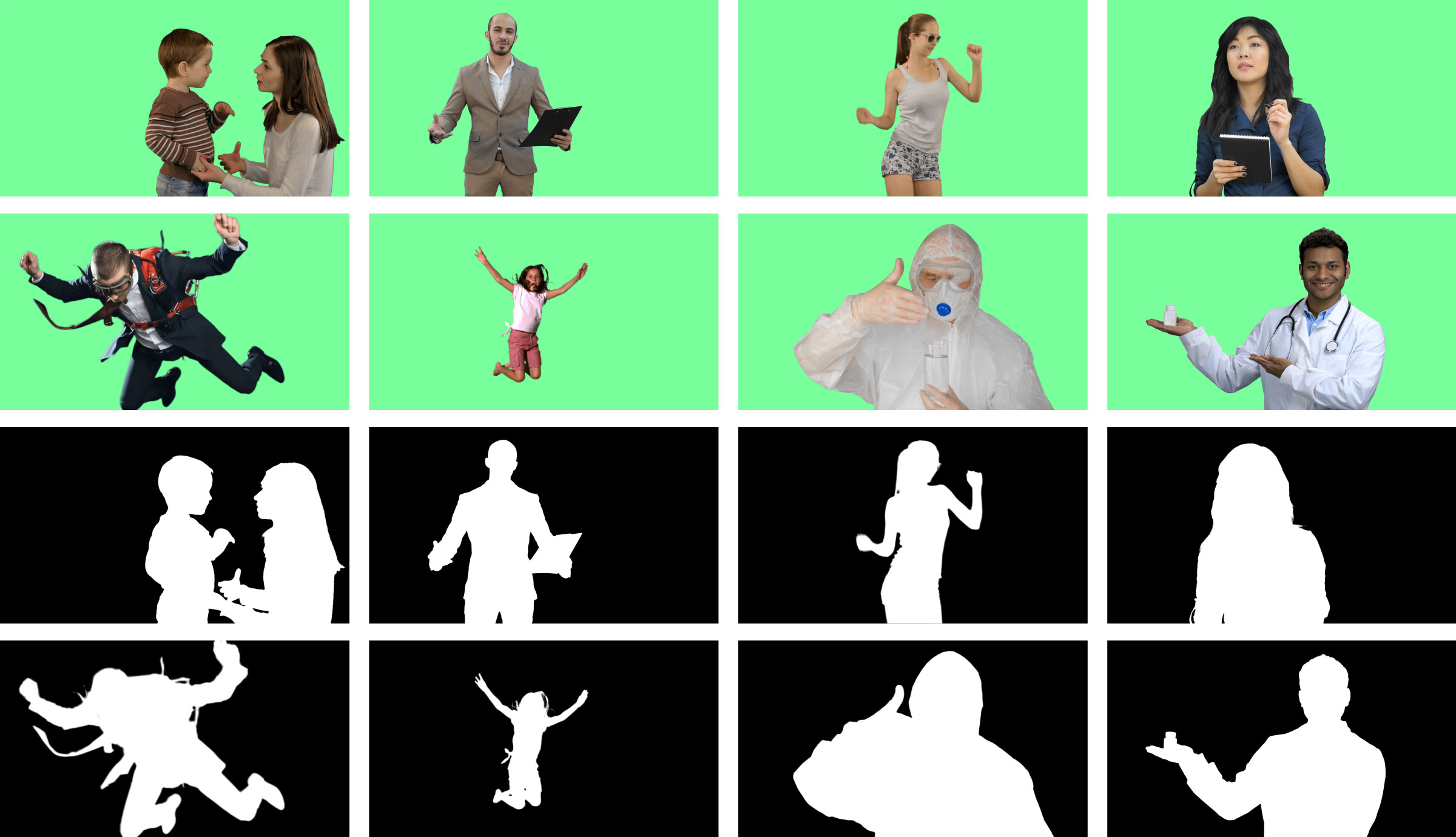
- The method is trained on two new large-scale datasets—VideoMatte240K (240K video frames) and PhotoMatte13K/85 (13K images)—with high-quality alpha mattes extracted via chroma-key software.
- The training pipeline combines diverse, high-resolution data from these datasets with manually curated datasets to improve generalization and fine-grained detail learning.
- The system is optimized for inference speed by restricting high-resolution refinement to only 5–10% of the image area, achieving real-time performance on modern GPUs.
Experimental results
Research questions
- RQ1Can a fully automated, real-time background matting system achieve high-quality results at 4K resolution without manual trimap input or green screen?
- RQ2How can high-resolution detail preservation—especially for fine structures like hair—be achieved efficiently in real-time video processing?
- RQ3What role do large-scale, high-quality datasets play in improving generalization and performance in real-world matting scenarios?
- RQ4Can selective, patch-based refinement outperform full-image refinement in terms of speed and quality while maintaining fidelity?
Key findings
- The proposed method achieves 30fps at 4K resolution and 60fps at HD resolution on a modern GPU, significantly outperforming prior state-of-the-art methods.
- On the Distinctions test set, the method achieves SAD of 9.19, MSE of 7.08, Grad of 6345, and Conn of 7216, outperforming BGM (SAD: 16.07, MSE: 21.00) and other baselines.
- Removing VideoMatte240K, PhotoMatte13K, or the Distinctions dataset from training leads to a measurable drop in performance, confirming their contribution to model quality.
- Refining only 5–10% of the image area yields the best trade-off between speed and quality, with inference dropping to 42.8fps at full 4K resolution when refining the entire image.
- The 3×3 kernel in the refinement network provides better results than 1×1 kernels due to its larger receptive field, improving detail sharpness.
- Failure cases occur when subjects cast shadows on the background, match its color, or when the background is highly textured, indicating limitations in such scenarios.

Read this paper
Open the full text in the Nubint reader and ask about any passage as you read.
Read this paper on NubintThis review was generated by AI from the original paper. Please check the paper before citing it.