
[Paper Review] RealFusion: 360° Reconstruction of Any Object from a Single Image
RealFusion reconstructs a full 360° 3D model of any object from a single image by fitting a neural radiance field guided by a diffusion-prior dream-up of novel views, achieved efficiently with InstantNGP.
We consider the problem of reconstructing a full 360° photographic model of an object from a single image of it. We do so by fitting a neural radiance field to the image, but find this problem to be severely ill-posed. We thus take an off-the-self conditional image generator based on diffusion and engineer a prompt that encourages it to "dream up" novel views of the object. Using an approach inspired by DreamFields and DreamFusion, we fuse the given input view, the conditional prior, and other regularizers in a final, consistent reconstruction. We demonstrate state-of-the-art reconstruction results on benchmark images when compared to prior methods for monocular 3D reconstruction of objects. Qualitatively, our reconstructions provide a faithful match of the input view and a plausible extrapolation of its appearance and 3D shape, including to the side of the object not visible in the image.
Motivation & Objective
- Motivate the problem of recovering a full 360° photographic object from a single view, highlighting the ill-posed nature of single-image 3D reconstruction.
- Propose a method that leverages a pretrained 2D diffusion image generator as a prior to hallucinate plausible novel views.
- Develop an efficient, multi-scale radiance-field representation with regularizers to render faithful appearance and plausible geometry.
- Introduce single-image textual inversion to condition the diffusion prior on the specific input object.
- Demonstrate state-of-the-art reconstruction quality on in-the-wild images and benchmark datasets without category-specific supervision.
Proposed method
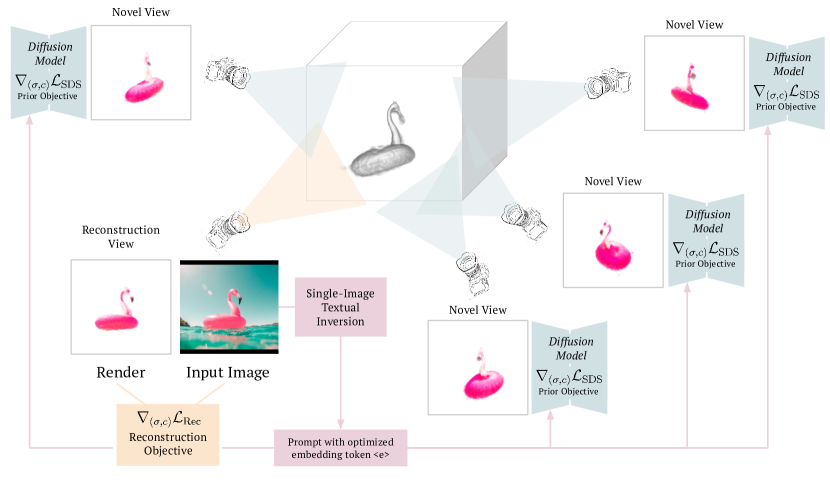
- Represent appearance and geometry as a neural radiance field (RF) optimized to match the input view via a reconstruction loss.
- Condition a pretrained diffusion model on a prompt embedding learned from single-image textual inversion to synthesize plausible novel views of the object.
- Apply Score Distillation Sampling (SDS) to align the RF with diffusion-model priors over randomly sampled novel viewpoints.
- Use a coarse-to-fine training schedule with an InstantNGP grid-based RF for efficiency.
- Incorporate regularizers: 2D normal smoothness, texture dropout, and a mask-based L2 term to improve surface quality; perform image-aligned mask loss and a normal-regularization term.
- Keep a fixed reconstruction camera and sample novel views at each iteration to enforce prior-consistency while maintaining fidelity to the input view.
Experimental results
Research questions
- RQ1Can a diffusion-model prior conditioned on an input image enable faithful single-view to 360° object reconstruction?
- RQ2How does single-image textual inversion influence the quality and diversity of reconstructed views?
- RQ3What regularizers and training strategies yield plausible geometry and appearance when reconstructing arbitrary objects from one image?
- RQ4How does RealFusion compare to category-specific or multi-view reconstruction methods on standard benchmarks?
Key findings
- RealFusion achieves state-of-the-art quantitative results on benchmark reconstructions from a single image compared to prior monocular 3D methods.
- Quantitative evaluation (F-score) and appearance similarity (CLIP) show improvements over Shelf-Supervised Mesh Prediction across seven object categories, averaged as mean gains.
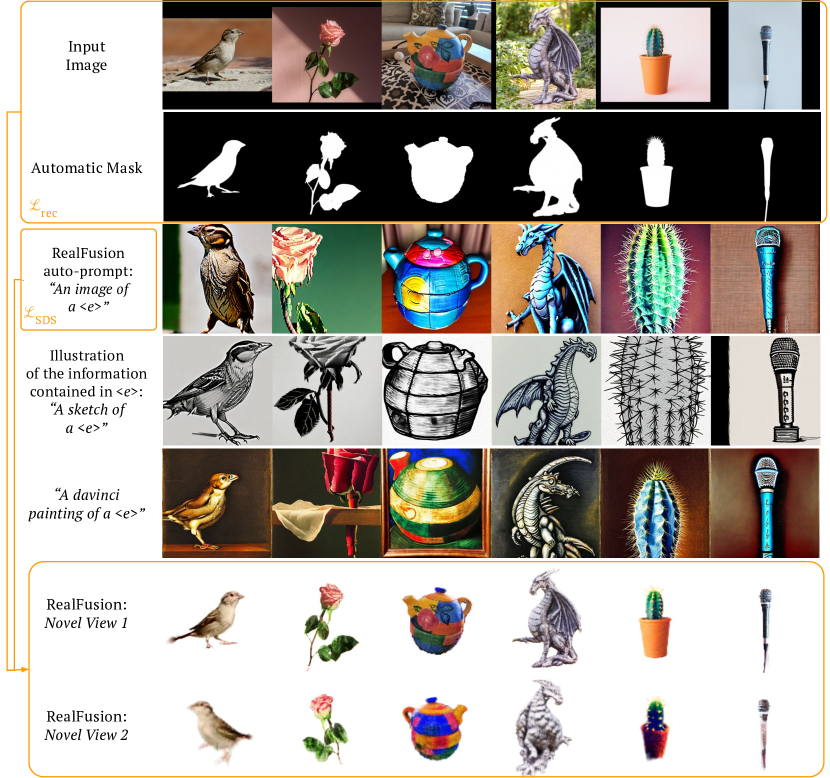
- Single-image textual inversion is crucial for high-quality reconstructions; without it, the backside often resembles a generic category exemplar rather than the true object.
- Coarse-to-fine training and normal-smoothness regularization improve surface quality and reduce artifacts.
- Stable Diffusion as the diffusion prior outperforms alternatives like CLIP in producing higher-quality reconstructions.
- RealFusion can generate multiple plausible 360° reconstructions from the same input view, with variation mainly on the occluded backside.
Read this paper
Open the full text in the Nubint reader and ask about any passage as you read.
Read this paper on NubintThis review was generated by AI from the original paper. Please check the paper before citing it.