
[论文解读] Realizing the Metaverse with Edge Intelligence: A Match Made in Heaven
本文提出边缘智能作为实现元宇宙的基础架构,通过将人工智能驱动的边缘计算与虚拟世界系统相结合,实现低延迟、可扩展且保护隐私的沉浸式体验。本文通过一个关于协作虚拟城市建设的案例研究,展示了这一理念,并提出了一种两阶段随机整数规划模型,以实现预留与按需计划之间的成本优化资源配置。
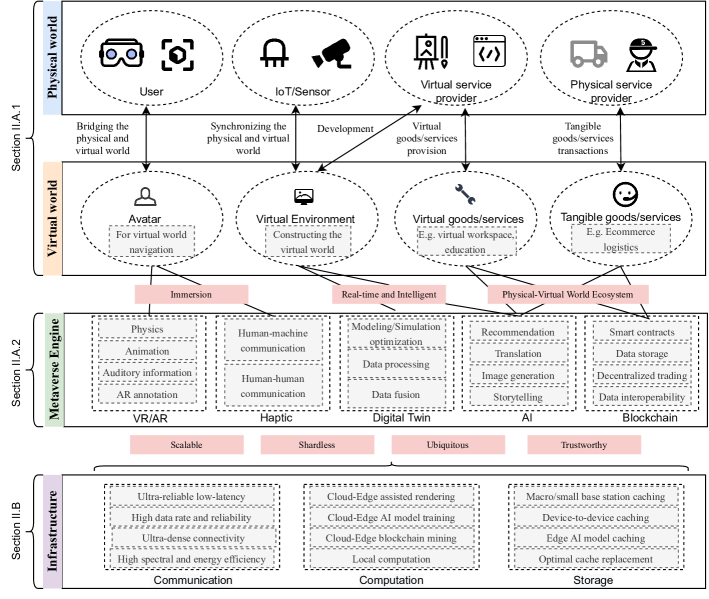
Dubbed "the successor to the mobile Internet", the concept of the Metaverse has recently exploded in popularity. While there exists lite versions of the Metaverse today, we are still far from realizing the vision of a seamless, shardless, and interoperable Metaverse given the stringent sensing, communication, and computation requirements. Moreover, the birth of the Metaverse comes amid growing privacy concerns among users. In this article, we begin by providing a preliminary definition of the Metaverse. We discuss the architecture of the Metaverse and mainly focus on motivating the convergence of edge intelligence and the infrastructure layer of the Metaverse. We present major edge-based technological developments and their integration to support the Metaverse engine. Then, we present our research attempts through a case study of virtual city development in the Metaverse. Finally, we discuss the open research issues.
研究动机与目标
- 建立一个支持无缝、持久且互操作的虚拟生态系统整体架构。
- 推动边缘智能(包括面向人工智能的边缘与面向边缘的人工智能)与元宇宙基础设施层的融合,以满足严格实时性和可扩展性需求。
- 通过协作虚拟城市建设的案例研究,证明边缘智能在支持复杂虚拟世界应用中的可行性。
- 识别并解决在边缘驱动的元宇宙中用户QoE、B5G通信、互操作性、隐私和经济性方面的开放挑战。
提出的方法
- 提出一种两阶段随机整数规划(SIP)公式,以在元宇宙中优化预留与按需计划之间的资源配置,最小化在需求不确定条件下的运营成本。
- 通过利用人工智能实现实时感知、通信和计算卸载决策,将边缘智能集成到元宇宙引擎中。
- 利用历史用户需求数据来确定SIP模型中的概率分布,实现主动且成本高效的资源供应。
- 设计一种基于边缘的框架,用于虚拟城市建设,实现协作性、可扩展性及低延迟的渲染与交互。
- 采用人工智能技术(如聚焦渲染)通过基于眼动追踪优先渲染高注意力视觉区域,降低计算负载。
- 提出一种语义感知、目标导向的B5G网络通信模型,将关注点从原始数据速率转向信息价值(VoI)。
实验结果
研究问题
- RQ1如何系统性地将边缘智能整合到元宇宙的基础设施层,以支持实时、可扩展且低延迟的虚拟体验?
- RQ2在用户需求不确定的条件下,何种资源配置策略可使虚拟服务提供商(VSPs)的运营成本最小化?
- RQ3如何在去中心化、多平台的虚拟世界中确保互操作性与信任?
- RQ4需要哪些新的QoE指标,以反映元宇宙应用在沉浸感和感知需求方面的要求,超越传统网络指标?
- RQ5如何利用区块链和人工智能等新兴技术,在保障安全与隐私的同时,支持新型经济模式?
主要发现
- 所提出的两阶段随机整数规划模型通过利用历史需求数据预测用户负载,显著降低了运营成本,优于非概率性方案。
- 边缘智能的集成实现了人工智能推理与渲染任务的高效卸载,降低了延迟,提升了沉浸式虚拟环境的响应能力。
- 基于眼动追踪数据的聚焦渲染技术,仅对高焦点区域以高质量渲染,从而降低计算负载,与人类视觉感知保持一致。
- 元宇宙需要从传统QoE指标转向基于感知的指标,例如13毫秒的人眼视觉感知阈值,以指导网络设计。
- B5G网络必须向语义感知、目标导向的通信模型演进,优先考虑信息价值(VoI),而不仅仅是数据速率。
- 互操作性标准对实现用户生成内容和跨平台交互至关重要,其缺失是实现无缝元宇宙的主要障碍。

更好的研究,从现在开始
从阅读论文到最终审阅,大幅缩短您的研究时间。
无需绑定信用卡
本解读由 AI 生成,并经人工编辑审核。