
[Paper Review] Relating tSNE and UMAP to Classical Dimensionality Reduction
This paper establishes theoretical connections between modern attraction/repulsion-based dimensionality reduction (tSNE, UMAP) and classical methods like PCA and LLE by showing that PCA can be recovered via attraction/repulsion dynamics and that LLE gradients closely match those of tSNE/UMAP when using UMAP’s kernel. The key contribution is a formal framework linking ARDR methods to classical DR, enabling potential convergence guarantees and interpretability for tSNE/UMAP embeddings.
It has become standard to use gradient-based dimensionality reduction (DR) methods like tSNE and UMAP when explaining what AI models have learned. This makes sense: these methods are fast, robust, and have an uncanny ability to find semantic patterns in high-dimensional data without supervision. Despite this, gradient-based DR methods lack the most important quality that an explainability method should possess: themselves being explainable. That is, given a UMAP output, it is currently unclear what one can say about the corresponding input. We work towards closing this question by relating UMAP to classical DR techniques. Specifically, we show that one can fully recover methods like PCA, MDS, and ISOMAP in the modern DR paradigm: by applying attractions and repulsions onto a randomly initialized dataset. We also show that, with a small change, Locally Linear Embeddings (LLE) can indistinguishably reproduce UMAP outputs. This implies that the UMAP effective objective is minimized by this modified version of LLE (and vice versa). Given this, we discuss what must be true of UMAP emebddings and present avenues for future work.
Motivation & Objective
- To address the lack of convergence guarantees and interpretability in tSNE and UMAP, which are widely used for explaining neural network representations.
- To bridge the gap between well-understood classical dimensionality reduction (e.g., PCA, LLE) and modern attraction/repulsion DR (ARDR) methods like tSNE and UMAP.
- To formalize conditions under which ARDR embeddings can be meaningfully attributed back to the original data distribution.
- To investigate whether tSNE and UMAP can be reinterpreted as optimizing classical DR objectives with specific kernels.
- To propose a path toward direct, non-iterative computation of embeddings similar to tSNE/UMAP, enabling theoretical guarantees.
Proposed method
- Formalizes a framework to represent classical DR methods (PCA, LLE) within the ARDR setting using attraction and repulsion forces.
- Demonstrates that applying attraction/repulsion dynamics to a random initialization can provably recover a PCA embedding, even under low-rank approximations.
- Shows that minimizing the LLE objective with UMAP’s kernel yields gradients and embeddings highly similar to those of tSNE and UMAP.
- Introduces a metric $ f^* $ to quantify the structural similarity between embeddings from classical and ARDR methods.
- Proposes Conjecture 1: UMAP’s gradient dynamics are on average aligned with LLE gradients when using UMAP’s kernel on the embedding space.
- Proposes Conjecture 2: A direct, non-iterative algorithm exists that approximates the global optimum of tSNE/UMAP with provable error bounds.
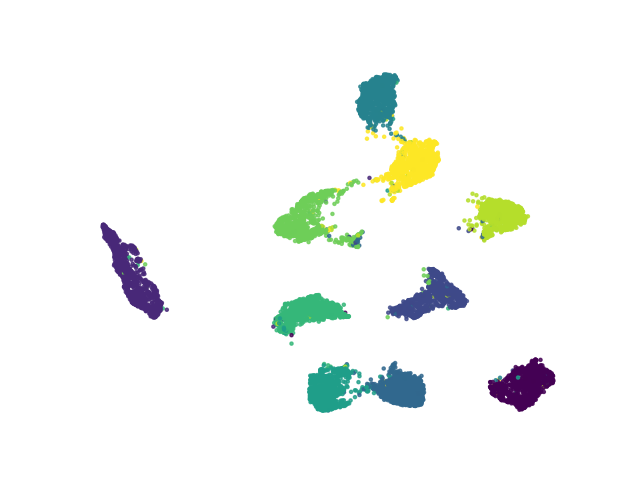
Experimental results
Research questions
- RQ1Can classical dimensionality reduction methods like PCA and LLE be recovered using attraction and repulsion dynamics?
- RQ2To what extent do tSNE and UMAP gradients align with those of classical DR methods when using UMAP’s kernel on the embedding space?
- RQ3Is there a direct, non-iterative method that can produce embeddings provably similar to those of tSNE and UMAP?
- RQ4What structural properties in the input data are consistently preserved in tSNE/UMAP embeddings that map to the same region in the 2D space?
- RQ5Under what conditions can the explainability of classical DR methods be transferred to ARDR methods like tSNE and UMAP?
Key findings
- Applying attraction and repulsion forces to a randomly initialized dataset can provably recover a PCA embedding, even with fast low-rank approximations.
- Minimizing the LLE objective with UMAP’s kernel produces embeddings that are structurally similar to those of tSNE and UMAP, as confirmed experimentally.
- The gradient dynamics of UMAP are on average positively correlated with those of LLE when using UMAP’s kernel, supporting Conjecture 1.
- The proposed framework with metric $ f^* $ quantifies the structural similarity between ARDR and classical DR embeddings, enabling formal comparison.
- Conjecture 2 suggests that a direct, non-iterative algorithm could compute embeddings with $ (1\pm\varepsilon) $-optimal cost, offering a path to convergence guarantees.
- The results imply that the core structure in tSNE/UMAP embeddings may be attributable to underlying classical DR objectives, especially LLE with dual kernels.

Read this paper
Open the full text in the Nubint reader and ask about any passage as you read.
Read this paper on NubintThis review was generated by AI from the original paper. Please check the paper before citing it.