
[Paper Review] RestNet: Boosting Cross-Domain Few-Shot Segmentation with Residual Transformation Network
This paper proposes RestNet, a novel residual transformation network for cross-domain few-shot segmentation that enhances knowledge transfer across domains while preserving critical intra-domain support-query feature relationships. By introducing a Semantic Enhanced Anchor Transform (SEAT) for domain-agnostic feature learning and an Intra-domain Residual Enhancement (IRE) module to retain original discriminative features, RestNet achieves state-of-the-art performance on ISIC, Chest X-ray, and FSS-1000 with minimal parameter overhead.
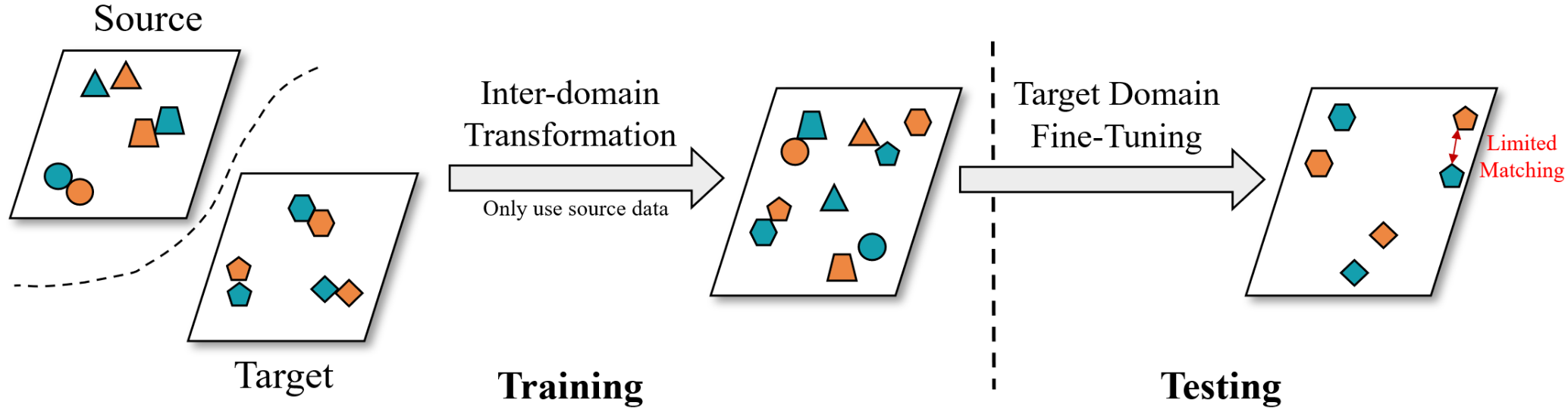
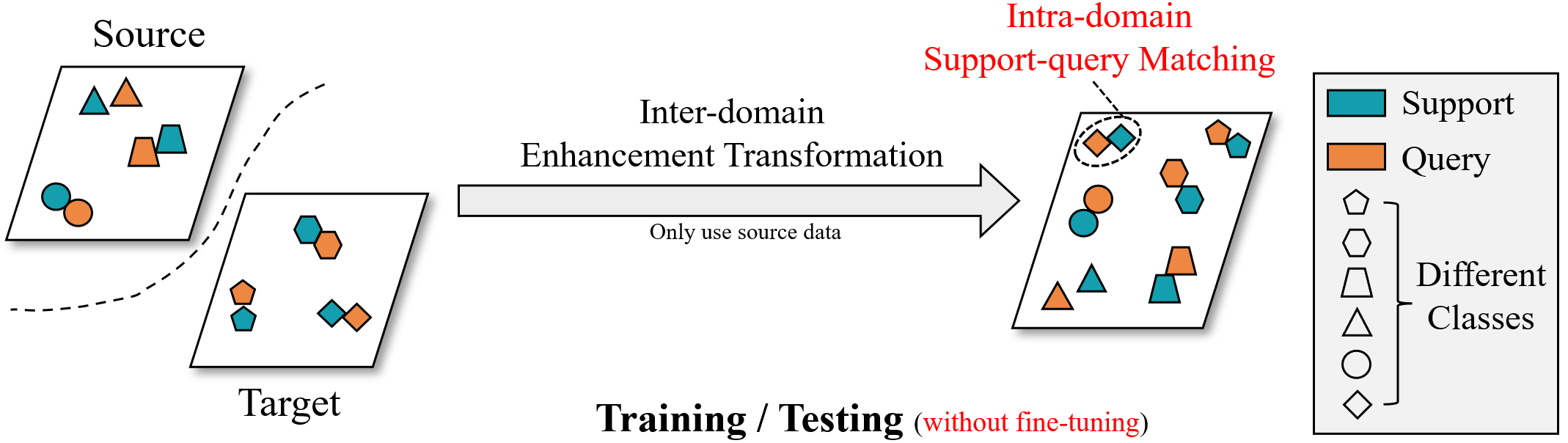
Cross-domain few-shot segmentation (CD-FSS) aims to achieve semantic segmentation in previously unseen domains with a limited number of annotated samples. Although existing CD-FSS models focus on cross-domain feature transformation, relying exclusively on inter-domain knowledge transfer may lead to the loss of critical intra-domain information. To this end, we propose a novel residual transformation network (RestNet) that facilitates knowledge transfer while retaining the intra-domain support-query feature information. Specifically, we propose a Semantic Enhanced Anchor Transform (SEAT) module that maps features to a stable domain-agnostic space using advanced semantics. Additionally, an Intra-domain Residual Enhancement (IRE) module is designed to maintain the intra-domain representation of the original discriminant space in the new space. We also propose a mask prediction strategy based on prototype fusion to help the model gradually learn how to segment. Our RestNet can transfer cross-domain knowledge from both inter-domain and intra-domain without requiring additional fine-tuning. Extensive experiments on ISIC, Chest X-ray, and FSS-1000 show that our RestNet achieves state-of-the-art performance. Our code will be available soon.
Motivation & Objective
- To address the limitation of existing cross-domain few-shot segmentation models that lose intra-domain feature information during domain adaptation.
- To improve knowledge transfer between domains without requiring target domain fine-tuning.
- To preserve discriminative intra-domain support-query matching during cross-domain feature transformation.
- To develop a mask prediction strategy that enables progressive segmentation learning through prototype fusion.
- To achieve state-of-the-art performance on multiple cross-domain few-shot segmentation benchmarks with minimal parameter increase.
Proposed method
- Proposes a Semantic Enhanced Anchor Transform (SEAT) module that uses attention mechanisms to extract advanced semantic features and project them into a domain-agnostic space for robust inter-domain knowledge transfer.
- Introduces an Intra-domain Residual Enhancement (IRE) module that uses residual connections to preserve original intra-domain feature representations in the transformed domain-agnostic space.
- Employs a prototype fusion-based mask prediction strategy that generates coarse soft query masks and refines them iteratively to improve segmentation accuracy.
- Utilizes a unified attention mechanism shared between support and query features to reduce parameters while improving alignment of semantic features.
- Designs the network to perform both inter-domain and intra-domain knowledge transfer simultaneously, avoiding reliance on target domain fine-tuning.
- Trains the model end-to-end on source domain data (e.g., PASCAL VOC) and applies it directly to unseen target domains without additional adaptation.
Experimental results
Research questions
- RQ1Can inter-domain knowledge transfer be improved while preserving essential intra-domain support-query feature relationships in cross-domain few-shot segmentation?
- RQ2How can a residual learning mechanism enhance the retention of discriminative intra-domain features during domain-agnostic feature transformation?
- RQ3Does a prototype fusion-based mask prediction strategy enable more effective and progressive segmentation learning in unseen domains?
- RQ4To what extent does a unified attention mechanism reduce parameters while maintaining or improving performance in CD-FSS?
- RQ5Can the proposed method achieve state-of-the-art results across diverse benchmarks like ISIC, Chest X-ray, and FSS-1000 without target domain fine-tuning?
Key findings
- RestNet achieves 81.53% mIOU on the FSS-1000 dataset with 1-shot cross-domain few-shot segmentation, outperforming prior methods.
- The ablation study confirms that both SEAT and IRE modules contribute significantly to performance, with the full model (including MPS) achieving 81.53% mIOU on FSS-1000.
- The unified attention mechanism improves performance by 0.34% mIOU (82.03% vs. 81.69%) compared to non-shared attention, while reducing parameters.
- Visualization results show that RestNet preserves significantly more intra-domain active matching (support-query similarity > 0) than PATNet, indicating better retention of intra-domain knowledge.
- RestNet introduces only 2.5812M additional parameters, demonstrating high efficiency with minimal computational overhead.
- The model achieves state-of-the-art performance on three major CD-FSS benchmarks: ISIC, Chest X-ray, and FSS-1000, without requiring any target domain fine-tuning.
Read this paper
Open the full text in the Nubint reader and ask about any passage as you read.
Read this paper on NubintThis review was generated by AI from the original paper. Please check the paper before citing it.