
[Paper Review] Rethinking White-Box Watermarks on Deep Learning Models under Neural Structural Obfuscation
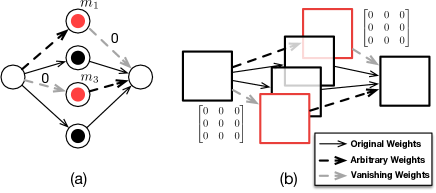
The paper reveals that dummy-neuron based neural structural obfuscation can disable nine mainstream white-box DNN watermarks without harming model utility, by introducing non-vanishing dummy neurons that disrupt watermark verification. It also proposes generation/injection primitives and camouflage techniques to achieve stealthy obfuscation.
Copyright protection for deep neural networks (DNNs) is an urgent need for AI corporations. To trace illegally distributed model copies, DNN watermarking is an emerging technique for embedding and verifying secret identity messages in the prediction behaviors or the model internals. Sacrificing less functionality and involving more knowledge about the target DNN, the latter branch called extit{white-box DNN watermarking} is believed to be accurate, credible and secure against most known watermark removal attacks, with emerging research efforts in both the academy and the industry. In this paper, we present the first systematic study on how the mainstream white-box DNN watermarks are commonly vulnerable to neural structural obfuscation with extit{dummy neurons}, a group of neurons which can be added to a target model but leave the model behavior invariant. Devising a comprehensive framework to automatically generate and inject dummy neurons with high stealthiness, our novel attack intensively modifies the architecture of the target model to inhibit the success of watermark verification. With extensive evaluation, our work for the first time shows that nine published watermarking schemes require amendments to their verification procedures.
Motivation & Objective
- Highlight vulnerabilities of mainstream white-box DNN watermark verification to neural structural obfuscation.
- Propose a comprehensive dummy-neuron based attack framework with generation and injection primitives.
- Demonstrate attack effectiveness across nine published white-box watermarking schemes while preserving model utility.
Proposed method
- Introduce dummy neurons that leave model output invariant while altering watermark verification.
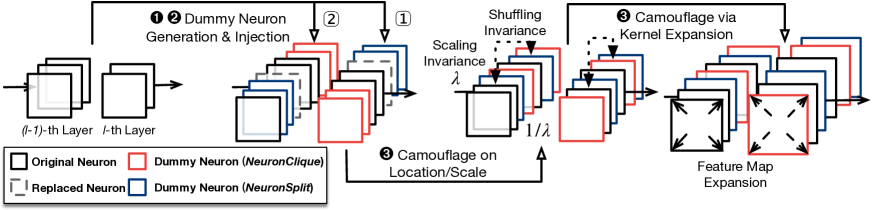
- Develop NeuronClique and NeuronSplit primitives to create dummy neuron groups with non-vanishing weights.
- Inject dummy neurons from back to front with stealthiness considerations and leverage scaling/shuffling invariances.
- Apply kernel expansion and weight distribution tricks to camouflage obfuscated models.
- Provide a defense-oriented discussion including a dummy-neuron elimination approach.
Experimental results
Research questions
- RQ1Can mainstream white-box watermark verification be reliably disrupted without utility loss or data access?
- RQ2Do dummy neurons with non-vanishing weights effectively invalidate watermark verification across diverse schemes?
- RQ3How can dummy neurons be autonomously generated and stealthily injected while preserving model functionality?
- RQ4What defenses exist against such neural structural obfuscation and watermark elimination?
Key findings
- Nine published white-box watermark schemes lose successful verification after the attack, with verification reduced to random.
- Normal model utility remains unchanged after obfuscation.
- The attack framework automatically generates and injects dummy neurons using NeuronClique and NeuronSplit primitives.
- Stealthiness is enhanced via scaling, shuffling, and kernel expansion techniques.
- The paper discusses defender knowledge requirements and provides a dummy-neuron elimination algorithm.
Read this paper
Open the full text in the Nubint reader and ask about any passage as you read.
Read this paper on NubintThis review was generated by AI from the original paper. Please check the paper before citing it.