
[论文解读] Robust Tiny Object Detection in Aerial Images amidst Label Noise
本文分析了用于航空影像的微小目标检测中的标签噪声,并提出 DN-TOD,一种具有类别感知标签校正和趋势引导学习的鲁棒检测器,以缓解类别漂移和边框噪声。
Precise detection of tiny objects in remote sensing imagery remains a significant challenge due to their limited visual information and frequent occurrence within scenes. This challenge is further exacerbated by the practical burden and inherent errors associated with manual annotation: annotating tiny objects is laborious and prone to errors (i.e., label noise). Training detectors for such objects using noisy labels often leads to suboptimal performance, with networks tending to overfit on noisy labels. In this study, we address the intricate issue of tiny object detection under noisy label supervision. We systematically investigate the impact of various types of noise on network training, revealing the vulnerability of object detectors to class shifts and inaccurate bounding boxes for tiny objects. To mitigate these challenges, we propose a DeNoising Tiny Object Detector (DN-TOD), which incorporates a Class-aware Label Correction (CLC) scheme to address class shifts and a Trend-guided Learning Strategy (TLS) to handle bounding box noise. CLC mitigates inaccurate class supervision by identifying and filtering out class-shifted positive samples, while TLS reduces noisy box-induced erroneous supervision through sample reweighting and bounding box regeneration. Additionally, Our method can be seamlessly integrated into both one-stage and two-stage object detection pipelines. Comprehensive experiments conducted on synthetic (i.e., noisy AI-TOD-v2.0 and DOTA-v2.0) and real-world (i.e., AI-TOD) noisy datasets demonstrate the robustness of DN-TOD under various types of label noise. Notably, when applied to the strong baseline RFLA, DN-TOD exhibits a noteworthy performance improvement of 4.9 points under 40% mixed noise. Datasets, codes, and models will be made publicly available.
研究动机与目标
- 研究不同标签噪声类型如何影响航空影像中的微小目标检测器。
- 确定对 TOD 性能影响最大的噪声类型。
- 开发一个鲁棒检测器(DN-TOD),以缓解类别漂移和边框噪声。
- 在合成与真实世界嘈杂数据集上展示 DN-TOD 的有效性。
- 证明 DN-TOD 兼容一阶段和两阶段检测器。
提出的方法
- 介绍 DeNoising Tiny Object Detector (DN-TOD)。
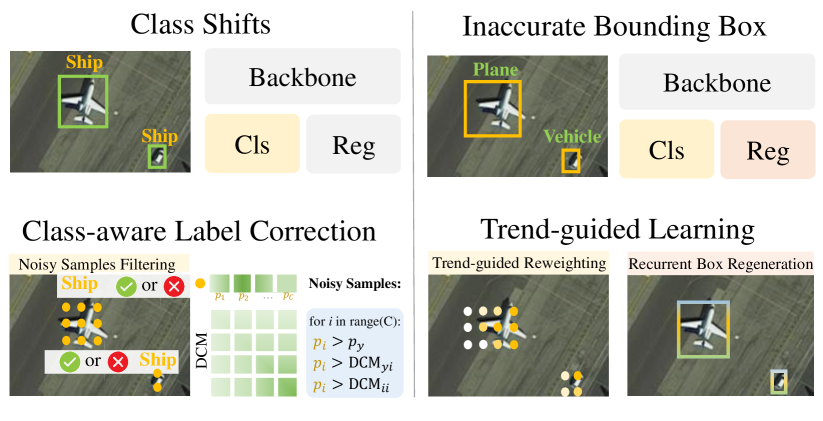
- 增加 Class-aware Label Correction (CLC) 以通过 Dynamic Confidence Matrix (DCM) 和样本筛选来解决类别漂移。
- 增加 Trend-guided Learning Strategy (TLS),包含 Trend-guided Reweighting (TLR) 用于分类,以及 Recurrent Box Regeneration (RBR) 用于回归。
- CLC 通过将类别预测与 DCM 的置信度对比来筛选噪声正样本。
- TLS 使用样本学习趋势来重新加权分类损失,并通过将过去的预测与 GT 融合来再生成边框目标(RBR)。
- 展示与 FCOS(one-stage)和 Faster R-CNN(two-stage)进行 plug-and-play 集成,带 RFLA。
实验结果
研究问题
- RQ1在标注噪声下,缺失标签、额外标签、类别漂移和不准确的边框如何影响 TOD?
- RQ2哪两种噪声类型最显著降低微小目标检测性能?
- RQ3使用类别感知校正和趋势引导学习的去噪检测器是否能在标签噪声下提升鲁棒性?
- RQ4DN-TOD 对合成嘈杂数据集(AI-TOD-v2.0、DOTA-v2.0)和真实世界嘈杂数据(AI-TOD)的泛化能力如何?
主要发现
- 类别漂移和不准确的边框会严重降低 TOD 性能,甚至比缺失标签或额外标签影响更大。
- 配有 CLC 和 TLS 的 DN-TOD 在 AI-TOD-v2.0、DOTA-v2.0 和 AI-TOD 数据集的各种噪声设置下,优于强基线。
- 在 40% 混合噪声下,DN-TOD 将强基线 RFLA 提升约 4.9 点。
- 在边框噪声实验中,TLS 在 20% 噪声下使一阶段 FCOS* 的 AP 提升至多 7.2,同时也增强了两阶段 Faster R-CNN*。
- DN-TOD 在合成嘈杂数据集和真实世界嘈杂数据上均显示出稳健的增益,表明具备实际应用性。
更好的研究,从现在开始
从论文设计到论文写作,大幅缩短您的研究时间。
无需绑定信用卡
本解读由 AI 生成,并经人工编辑审核。