
[Paper Review] Robust Training of Machine Learning Interatomic Potentials with Dimensionality Reduction and Stratified Sampling
This paper introduces DIRECT sampling—a method combining dimensionality reduction and stratified sampling to select robust, diverse training sets for machine learning interatomic potentials (MLIPs). By applying DIRECT to over 1 million structures from the Materials Project, the authors develop a more robust M3GNet universal potential that generalizes better to unseen configurations and enables efficient, high-throughput training of moment tensor potentials for complex systems like titanium hy hydrides without iterative refinement.
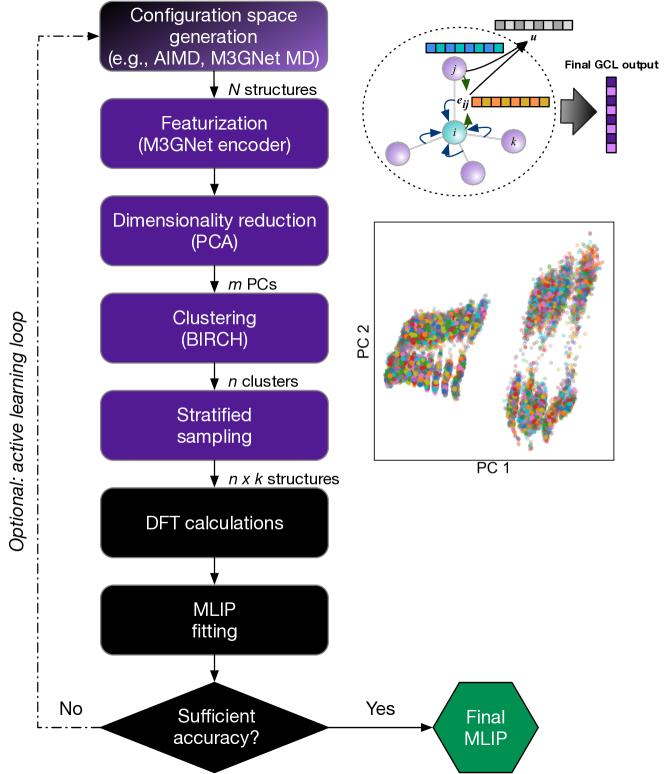
Machine learning interatomic potentials (MLIPs) enable the accurate simulation of materials at larger sizes and time scales, and play increasingly important roles in the computational understanding and design of materials. However, MLIPs are only as accurate and robust as the data they are trained on. In this work, we present DImensionality-Reduced Encoded Clusters with sTratified (DIRECT) sampling as an approach to select a robust training set of structures from a large and complex configuration space. By applying DIRECT sampling on the Materials Project relaxation trajectories dataset with over one million structures and 89 elements, we develop an improved materials 3-body graph network (M3GNet) universal potential that extrapolate more reliably to unseen structures. We further show that molecular dynamics (MD) simulations with universal potentials such as M3GNet can be used in place of expensive extit{ab initio} MD to rapidly create a large configuration space for target materials systems. Combined with DIRECT sampling, we develop a highly reliable moment tensor potential for Ti-H system without the need for iterative optimization. This work paves the way towards robust high throughput development of MLIPs across any compositional complexity.
Motivation & Objective
- To address the challenge of creating robust, generalizable machine learning interatomic potentials (MLIPs) that perform well on unseen materials configurations.
- To reduce reliance on expensive, iterative active learning by pre-selecting diverse, informative training data before DFT calculations.
- To enable high-throughput development of universal MLIPs across complex compositional spaces, including multi-principal element and hydride systems.
- To improve extrapolation performance of MLIPs by ensuring comprehensive coverage of the configuration space through systematic sampling.
- To demonstrate that MD simulations with universal potentials can generate large, diverse training sets for new materials, reducing the need for ab initio data collection.
Proposed method
- Applying dimensionality reduction (autoencoders) to compress atomic structure representations into low-dimensional latent spaces for efficient clustering.
- Using k-means clustering on the latent space to identify representative structural clusters across the configuration space.
- Implementing stratified sampling to ensure proportional representation of clusters in the final training set, maximizing diversity and coverage.
- Combining DIRECT sampling with molecular dynamics simulations using a pre-trained M3GNet universal potential to generate additional diverse configurations for training.
- Training M3GNet and moment tensor potential (MTP) models on DIRECT-sampled datasets and evaluating generalization on unseen structures.
- Validating performance using DFT-calculated energies and forces on test sets, including hypothetical compounds and Ti-H systems.
Experimental results
Research questions
- RQ1Can dimensionality reduction and stratified sampling effectively identify a diverse, representative subset of structures from a massive configuration space?
- RQ2Does DIRECT sampling improve the generalization and robustness of machine learning interatomic potentials compared to traditional or active learning-based sampling?
- RQ3Can MD simulations driven by a universal potential like M3GNet generate high-quality training data for new materials systems without prior DFT data?
- RQ4To what extent can DIRECT-sampled training sets reduce the need for iterative active learning in training moment tensor potentials?
- RQ5How well do MLIPs trained with DIRECT sampling extrapolate to hypothetical and complex materials, such as multi-element hydrides?
Key findings
- DIRECT sampling reduced the number of required DFT calculations by selecting a highly diverse and representative training set from over 1.3 million structures in the Materials Project dataset.
- The M3GNet universal potential trained with DIRECT sampling showed significantly improved extrapolation performance on unseen structures compared to models trained with standard or active learning sampling.
- Molecular dynamics simulations using the M3GNet universal potential successfully generated a large, diverse dataset of 274,000 Ti-H configurations, which were used to train a robust moment tensor potential without iterative optimization.
- The M3GNet-DIRECT potential achieved a mean absolute error of 12.8 meV/atom and a maximum error of 124.3 meV/atom on the test set of hypothetical O- and S-containing compounds, demonstrating strong generalization.
- The moment tensor potential trained on DIRECT-sampled data for Ti-H systems achieved a mean absolute error of 14.5 meV/atom on a test set of 500+ structures, with no need for active learning iterations.
- The DIRECT sampling pipeline was open-sourced in the maml Python library, enabling reproducibility and adoption across materials science research.

Read this paper
Open the full text in the Nubint reader and ask about any passage as you read.
Read this paper on NubintThis review was generated by AI from the original paper. Please check the paper before citing it.