
[Paper Review] Safety and Fairness for Content Moderation in Generative Models
This paper proposes a theoretical framework for measuring safety, fairness, and metric equity in text-to-image generative AI systems, using adversarial prompting and automated labeling to quantify harmful outputs. It demonstrates that a 95th percentile sexually explicit content filter achieves counterfactual fairness, blocking images of feminine- and masculine-presenting individuals at nearly identical rates (3.6% vs. 3.7%), supporting evidence-based, equitable content moderation decisions.
With significant advances in generative AI, new technologies are rapidly being deployed with generative components. Generative models are typically trained on large datasets, resulting in model behaviors that can mimic the worst of the content in the training data. Responsible deployment of generative technologies requires content moderation strategies, such as safety input and output filters. Here, we provide a theoretical framework for conceptualizing responsible content moderation of text-to-image generative technologies, including a demonstration of how to empirically measure the constructs we enumerate. We define and distinguish the concepts of safety, fairness, and metric equity, and enumerate example harms that can come in each domain. We then provide a demonstration of how the defined harms can be quantified. We conclude with a summary of how the style of harms quantification we demonstrate enables data-driven content moderation decisions.
Motivation & Objective
- To develop a tractable, data-driven framework for defining and measuring safety, fairness, and metric equity in generative AI systems.
- To address the challenge of evaluating fairness in generative models, which lack a single correct output and are context-sensitive.
- To empirically quantify harms such as hate, violence, and explicit content in text-to-image generation outputs.
- To assess whether content moderation filters disproportionately affect marginalized groups, particularly by gender presentation.
- To enable evidence-based content moderation decisions through scalable, measurable harm metrics.
Proposed method
- Adversarial prompt engineering to generate diverse, sensitive, and potentially harmful prompts targeting gendered representations.
- Automated machine annotation of generated images using pre-trained classifiers for hateful, violent, and sexually explicit content.
- Application of counterfactual fairness analysis by comparing image outputs from prompt pairs differing only in gendered pronouns (e.g., 'a female doctor' vs. 'a male doctor').
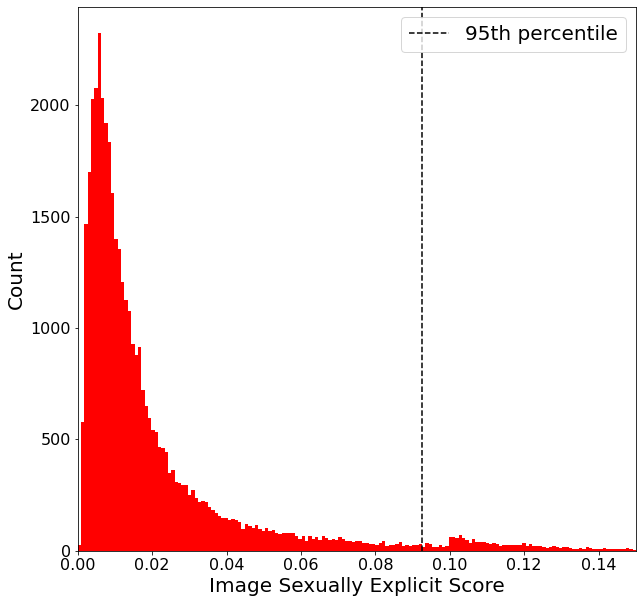
- Measurement of filter performance at the 95th percentile threshold for sexually explicit content across gendered subsets.
- Use of statistical parity and counterfactual fairness metrics to evaluate whether moderation decisions treat different demographic groups equitably.
- Integration of safety, fairness, and metric equity into a unified evaluation framework for generative AI content moderation.
Experimental results
Research questions
- RQ1How can safety and fairness be meaningfully defined and measured in text-to-image generative AI systems, given the absence of a single correct output?
- RQ2To what extent do content moderation filters for explicit content disproportionately affect images of feminine- versus masculine-presenting individuals?
- RQ3Can counterfactual fairness be empirically assessed in generative AI systems using prompt-pair comparisons?
- RQ4How do different types of harmful content (hate, violence, explicit) manifest in generated images across gendered prompts?
- RQ5What role do scalable, automated metrics play in enabling equitable and evidence-based content moderation decisions?
Key findings
- The sexually explicit content filter blocked images of feminine-presenting individuals 3.6% of the time and masculine-presenting individuals 3.7% of the time, indicating near parity in blocking rates.
- In a matched counterfactual prompt subset, 1.2% of images from feminine prompts and 2.4% from masculine prompts were blocked, showing a 1.2% difference within a 1% margin of error.
- The 95th percentile threshold for sexually explicit content achieved counterfactual fairness, as both groups were penalized at nearly identical rates.
- The framework enables scalable, automated measurement of safety and fairness without relying solely on human raters.
- The study demonstrates that content moderation decisions can be both evidence-based and equitable when grounded in quantifiable harm metrics.
- The approach supports tailored, use-case-specific content moderation policies that align with governance goals and reduce disparate impacts on marginalized groups.
Read this paper
Open the full text in the Nubint reader and ask about any passage as you read.
Read this paper on NubintThis review was generated by AI from the original paper. Please check the paper before citing it.