
[Paper Review] Security in Brain-Computer Interfaces: State-of-the-art, opportunities, and future challenges
This paper presents a unified model of the Brain-Computer Interface (BCI) lifecycle, analyzing security threats across data acquisition and neural stimulation phases. It identifies critical vulnerabilities in BCI systems, proposes integrated cybersecurity solutions using 5G, blockchain, TLS/IPsec, and standards like ISO 27001 and NIST, and advocates for proactive, AI-driven threat detection and user awareness to secure emerging brain-to-brain and brain-internet communication paradigms.
BCIs have significantly improved the patients' quality of life by restoring damaged hearing, sight, and movement capabilities. After evolving their application scenarios, the current trend of BCI is to enable new innovative brain-to-brain and brain-to-the-Internet communication paradigms. This technological advancement generates opportunities for attackers since users' personal information and physical integrity could be under tremendous risk. This work presents the existing versions of the BCI life-cycle and homogenizes them in a new approach that overcomes current limitations. After that, we offer a qualitative characterization of the security attacks affecting each phase of the BCI cycle to analyze their impacts and countermeasures documented in the literature. Finally, we reflect on lessons learned, highlighting research trends and future challenges concerning security on BCIs.
Motivation & Objective
- To address the growing security and privacy risks in BCIs as they evolve toward brain-to-brain and brain-to-Internet communication.
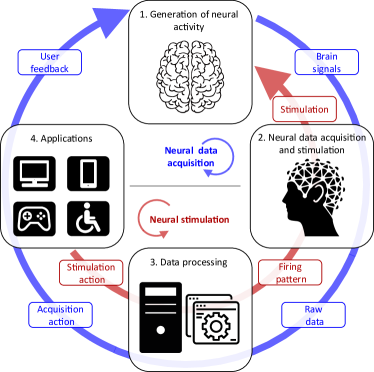
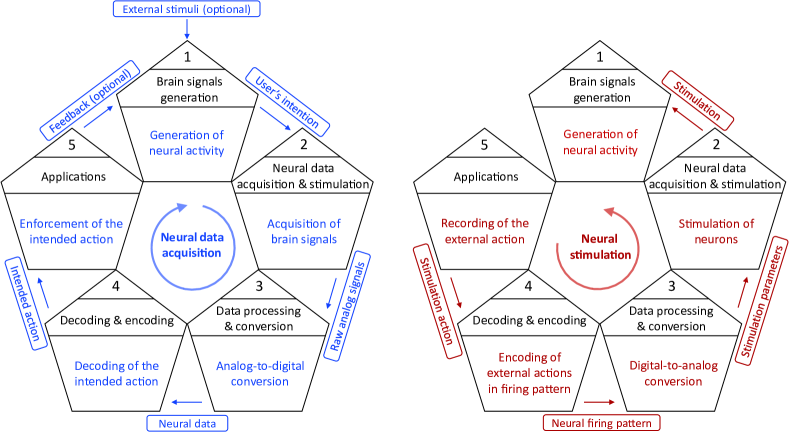
- To unify the fragmented BCI lifecycle models in the literature into a standardized, bidirectional framework for consistent security analysis.
- To identify and categorize security attacks, their impacts, and documented countermeasures across all phases of the BCI cycle.
- To propose actionable, future-oriented security solutions integrating emerging technologies such as 5G, blockchain, and zero-trust protocols.
- To promote standardization, user awareness, and proactive defense mechanisms to secure BCI systems in clinical and consumer applications.
Proposed method
- Proposes a unified, bidirectional BCI lifecycle model integrating neural data acquisition (clockwise) and stimulation (counterclockwise) phases.
- Conducts a qualitative, phase-wise analysis of security threats—confidentiality, integrity, availability, and safety—across the BCI cycle.
- Evaluates existing countermeasures from the literature, focusing on architectural and implementation-level vulnerabilities.
- Proposes integration of 5G technologies (SDN, NFV) for dynamic, scalable, and secure network management in BCI systems.
- Recommends cryptographic protocols (TLS, IPsec) and data integrity mechanisms (blockchain) to secure data transmission and storage.
- Suggests adoption of established information security standards (ISO 27001, NIST CSF) and game-theoretic models for adaptive, proactive defense in distributed BCI environments.
Experimental results
Research questions
- RQ1What are the key security threats affecting each phase of the BCI lifecycle, particularly in bidirectional and real-time systems?
- RQ2How do current BCI architectures fail to ensure data confidentiality, integrity, and user safety, especially in clinical and consumer applications?
- RQ3What emerging technologies can be leveraged to build resilient, scalable, and proactive BCI security frameworks?
- RQ4How can standardization and information security frameworks be adapted to address the unique challenges of neurodata and neurostimulation?
- RQ5What role can AI and game theory play in detecting and mitigating evolving cyber threats in BCI systems?
Key findings
- The BCI field remains immature in terms of security, creating significant opportunities for attackers targeting neural data and stimulation systems.
- Even non-sophisticated attacks can severely compromise user safety and data integrity, especially in clinical settings involving neurostimulation.
- The integration of 5G technologies (SDN, NFV) enables dynamic, scalable, and secure network management for future BCI ecosystems.
- Cryptographic protocols like TLS and IPsec, combined with blockchain for data provenance, significantly enhance data confidentiality and integrity.
- Adoption of established standards such as ISO 27001 and NIST Cybersecurity Framework can unify and strengthen BCI security practices.
- Future BCI security must include real-time anomaly detection using AI and proactive, game-theoretic defense models to counter evolving threats.
Read this paper
Open the full text in the Nubint reader and ask about any passage as you read.
Read this paper on NubintThis review was generated by AI from the original paper. Please check the paper before citing it.