
[论文解读] Segment Anything Model (SAM) Enhanced Pseudo Labels for Weakly Supervised Semantic Segmentation
本文提出 SEPL,一种简单方法,使用 CAM 派生的伪标签作为种子来选择并合并 SAM 掩码,产生具备类别感知与对象感知的伪标签,并在 VOC 2012 和 MS COCO 2014 上持续提升 WSSS 性能。
Weakly supervised semantic segmentation (WSSS) aims to bypass the need for laborious pixel-level annotation by using only image-level annotation. Most existing methods rely on Class Activation Maps (CAM) to derive pixel-level pseudo-labels and use them to train a fully supervised semantic segmentation model. Although these pseudo-labels are class-aware, indicating the coarse regions for particular classes, they are not object-aware and fail to delineate accurate object boundaries. To address this, we introduce a simple yet effective method harnessing the Segment Anything Model (SAM), a class-agnostic foundation model capable of producing fine-grained instance masks of objects, parts, and subparts. We use CAM pseudo-labels as cues to select and combine SAM masks, resulting in high-quality pseudo-labels that are both class-aware and object-aware. Our approach is highly versatile and can be easily integrated into existing WSSS methods without any modification. Despite its simplicity, our approach shows consistent gain over the state-of-the-art WSSS methods on both PASCAL VOC and MS-COCO datasets.
研究动机与目标
- 推动通过让伪标签具备对象感知,而不仅仅是类别感知,来提升 WSSS 的伪标签质量。
- 利用 Segment Anything Model (SAM) 将精准的对象边界注入伪标签。
- 开发一个轻量级、可即插即用的 SEPL 方法,无需修改现有的 WSSS 方法。
- 在标准基线(PASCAL VOC 2012 和 MS COCO 2014)上展示对现有 WSSS 基线的改进。
提出的方法
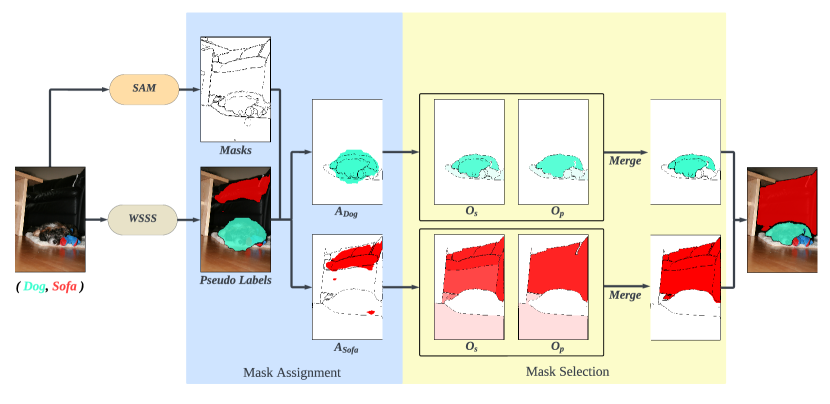
- SEPL 以每个类别的 CAM 派生伪标签作为种子,以及一组图像的 SAM 掩码作为集合。
- 将掩码分配给与 CAM 伪标签重叠最大 的类别(掩码分配)。
- 然后基于两个重叠度量来选择掩码:o_s(掩码与伪标签的重叠比例)和 o_p(伪标签被掩码覆盖的比例)。
- 当 o_s > 0.5 或 o_p > 0.85 时保留该掩码;否则,当没有适用的 SAM 掩码时,保留初始的 CAM 伪标签。
- 通过对所选掩码进行逐位或合并并将该类别标签分配给非零区域,得到最终强化的伪标签。
- SEPL 设计为可轻松集成到现有的 WSSS 流水线中,而无需修改底层方法。
![Figure 1 : Illustration of how SAM addresses partial and false activation on PASCAL VOC 2012 train set: (A) original images; (B) pseudo-labels generated by a SOTA image-level WSSS method, CLIMS [ 50 ] ; (C) masks from SAM; (D) SAM enhanced pseudo-labels; (E) ground-truth labels.](https://ar5iv.labs.arxiv.org/html/2305.05803/assets/figures/fig1_update1.png)
实验结果
研究问题
- RQ1在类别无关的 SAM 掩码在由类别感知的 CAM 伪标签引导下,是否能产生更高质量、具对象感知的伪标签以用于 WSSS?
- RQ2基于这些伪标签训练的下游语义分割,在 VOC 2012 和 COCO 2014 上是否会带来可测量的改进?
- RQ3SEPL 在多样化的基线 WSSS 方法与数据集上的鲁棒性如何?
- RQ4SEPL 的失败模式是什么,如何减轻?
主要发现
- SEPL 在 VOC 2012 和 COCO 2014 上的多种最先进 WSSS 基线中,伪标签质量持续提升。
- 在多个基线下(如 Recurseed、L2G、CLIPES、RCA、EPS、CLIMS、TransCAM、PPC+EPS、PPC+SEAM、SIPE、PuzzleCAM),使用 SEPL 增强的伪标签训练 DeepLab V2(ResNet-101)得到的 IoU 高于使用原始伪标签。
- 在 VOC 2012 训练集上,SEPL 相对于十一种基线的伪标签质量平均提升 5.33%;在 MS COCO 2014 训练集上,平均提升为 3.12%。
- SEPL 的改进无需对现有 WSSS 方法进行改动,凸显了其多功能性与实用性。
- 该研究首次在 WSSS 场景中探讨应用 SAM,且暗示了分割基础模型在 CV 任务中的更广泛应用潜力。
更好的研究,从现在开始
从论文设计到论文写作,大幅缩短您的研究时间。
无需绑定信用卡
本解读由 AI 生成,并经人工编辑审核。