
[Paper Review] Shedding light on the MRI driven dynamo in a stratified shearing box
This study investigates the MRI-driven dynamo in a stratified, zero-net-flux shearing box using high-resolution simulations and a novel inversion method (IROS) to extract turbulent dynamo coefficients. It reveals an $α$-$\Omega$ dynamo mechanism where the $\alpha_{yy}$ effect generates poloidal fields from toroidal fields, while shear regenerates the toroidal field, with mean-field transport dominated by vertical outflows and turbulent pumping rather than diffusivity.
We study the magneto-rotational instability (MRI) driven dynamo in a geometrically thin disc ($H/R\ll 1$) using stratified zero net flux (ZNF) shearing box simulations. We find that mean fields and EMFs oscillate with a primary frequency $f_{ m dyn} = 0.017$ ($\approx 9$ orbital period), but also have higher harmonics at $3f_{ m dyn}$. Correspondingly, the current helicity, has two frequencies $2f_{ m dyn}$ and $4f_{ m dyn}$ respectively, which appear to be the beat frequencies of mean fields and EMFs as expected from the magnetic helicity density evolution equation. Further, we adopt a novel inversion algorithm called the `Iterative Removal Of Sources' (IROS), to extract the turbulent dynamo coefficients in the mean-field closure using the mean magnetic fields and EMFs obtained from the shearing box simulation. We show that an $α-$effect ($α_{yy}$) is predominantly responsible for the creation of the poloidal field from the toroidal field, while shear generates back a toroidal field from the poloidal field; indicating that an $α-Ω$-type dynamo is operative in MRI-driven accretion discs. We also find that both strong outflow ($\bar{v}_z$) and turbulent pumping ($γ_z$ ) transport mean fields away from the mid-plane. Instead of turbulent diffusivity, they are the principal sink terms in the mean magnetic energy evolution equation. We find encouraging evidence that a generative helicity flux is responsible for the effective $α$-effect. Finally, we point out potential limitations of horizontal ($x-y$) averaging in defining the `mean' on the extraction of dynamo coefficients and their physical interpretations.
Motivation & Objective
- To understand the nature of the MRI-driven dynamo in a geometrically thin, stratified, zero-net-flux accretion disc.
- To extract turbulent dynamo coefficients (e.g., $\alpha$, $\eta$) from shearing box simulations using an unbiased inversion method.
- To investigate the role of mean-field transport mechanisms—particularly vertical outflows and turbulent pumping—in magnetic energy evolution.
- To assess the physical interpretation of dynamo coefficients under horizontal (x-y) averaging and its potential degeneracy issues.
- To explore whether a generative helicity flux underlies the effective $\alpha$-effect in MRI turbulence.
Proposed method
- Conducts high-resolution, isothermal, stratified zero-net-flux shearing box simulations of MRI turbulence with $H/R \ll 1$.
- Applies the 'Iterative Removal Of Sources' (IROS) algorithm to invert mean magnetic fields and electromotive forces (EMFs) into turbulent dynamo coefficients.
- Uses time-averaged mean fields and EMFs to compute the $\alpha_{ij}$, $\eta_{ij}$, and $\gamma_{ij}$ coefficients in the mean-field closure framework.
- Imposes constraints on $\eta_{yy} = f_\eta \eta_{xx}$ to test sensitivity and degeneracy in coefficient recovery, comparing fits with and without constraints.
- Analyzes vertical profiles and residual EMFs to validate the quality of the inversion and assess the relative contributions of $\alpha$ and $\eta$ terms.
- Examines the magnetic helicity density evolution equation to interpret the origin of observed oscillatory frequencies in mean fields and EMFs.
Experimental results
Research questions
- RQ1What is the dominant dynamo mechanism (e.g., $\alpha$-effect, $\alpha$-$\Omega$) operating in MRI-driven turbulence within a stratified, zero-net-flux shearing box?
- RQ2How do vertical outflows ($\bar{v}_z$) and turbulent pumping ($\gamma_z$) influence the evolution of mean magnetic fields and energy?
- RQ3To what extent do the extracted dynamo coefficients depend on the choice of averaging scheme, particularly horizontal (x-y) averaging?
- RQ4Can a generative helicity flux explain the effective $\alpha$-effect observed in MRI turbulence?
- RQ5How do the turbulent diffusivity coefficients ($\eta_{ij}$) behave, and what constraints do they impose on the physical interpretation of the dynamo process?
Key findings
- The MRI-driven dynamo operates via an $\alpha$-$\Omega$ mechanism, with $\alpha_{yy}$ being the dominant term responsible for generating poloidal fields from toroidal fields.
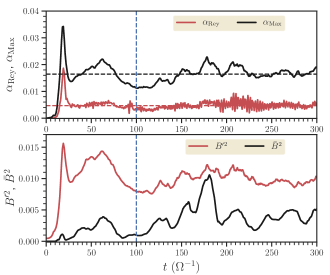
- The primary oscillation frequency of mean fields and EMFs is $f_{\rm dyn} = 0.017$, corresponding to approximately 9 orbital periods, with higher harmonics at $3f_{\rm dyn}$.
- Current helicity exhibits frequencies at $2f_{\rm dyn}$ and $4f_{\rm dyn}$, consistent with beat frequencies expected from the magnetic helicity density evolution equation.
- Vertical outflows ($\bar{v}_z$) and turbulent pumping ($\gamma_z$) are the dominant sinks in the mean magnetic energy evolution equation, surpassing the role of turbulent diffusivity.
- The effective $\alpha$-effect is likely driven by a generative helicity flux, supported by the observed oscillatory behavior and correlation with helicity dynamics.
- The $\eta_{yy}$ coefficient is nearly vanishing, while $\eta_{xx}$ and $\eta_{yx}$ are positive; however, $\eta_{yx}$ becomes increasingly negative as $\eta_{yy}$ is scaled up via $\eta_{yy} = f_\eta \eta_{xx}$, indicating a strong correlation between these terms.
Better researchstarts right now
From reading papers to final review, dramatically reduce your research time.
No credit card · Free plan available
This review was created by AI and reviewed by human editors.