
[Paper Review] SoftTiger: A Clinical Foundation Model for Healthcare Workflows
SoftTiger is a 13B and 70B parameter clinical foundation model fine-tuned on de-identified, credentialed clinical notes from MIMIC-IV to structure unstructured clinical narratives into standardized FHIR-compliant data (e.g., International Patient Summary, Clinical Impression, Medical Encounter). It achieves state-of-the-art performance on clinical note processing, outperforming open-source models and GPT-3.5, and is comparable to Gemini-Pro with a narrow gap from GPT-4, while supporting long context windows up to 8k tokens.
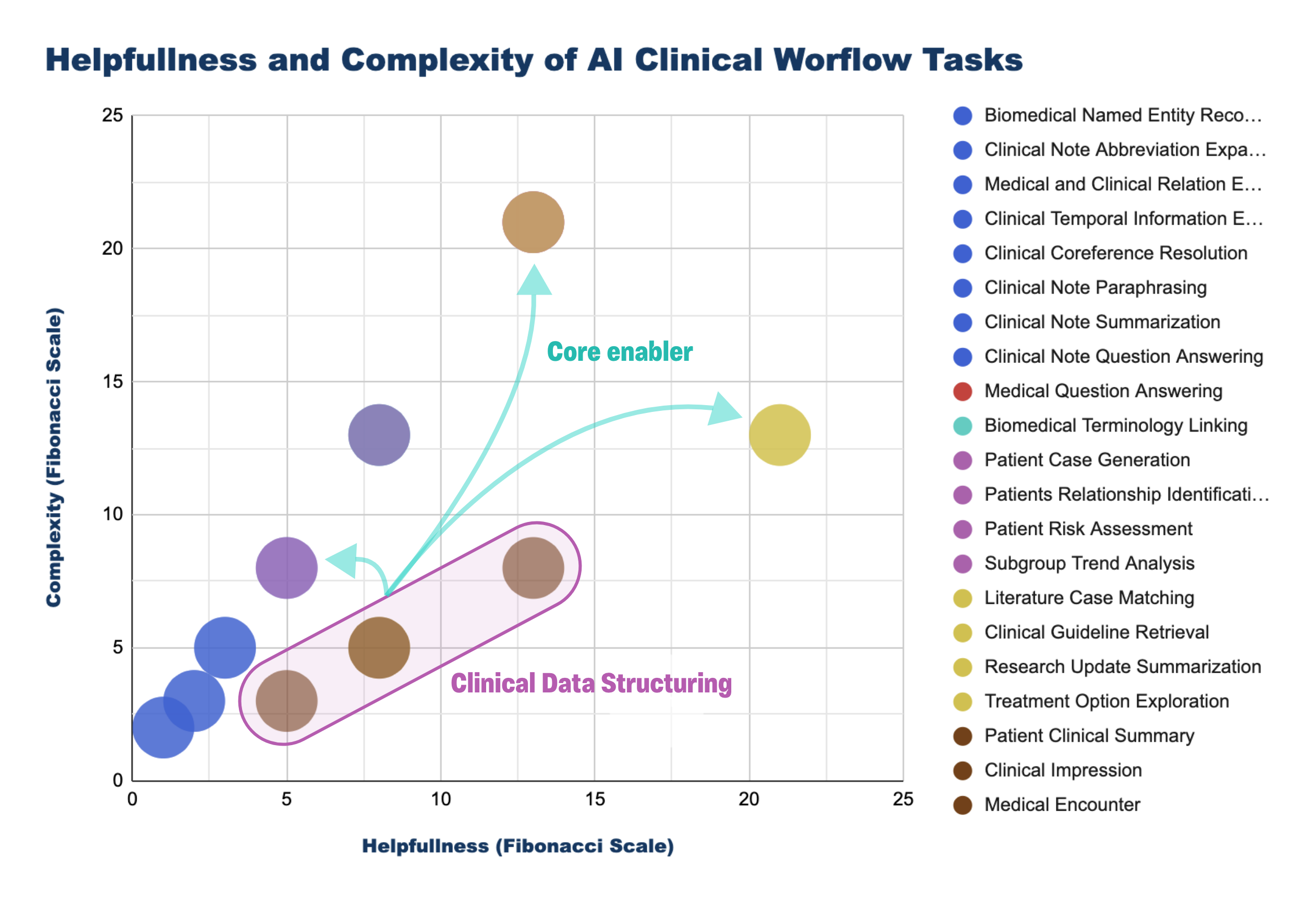
We introduce SoftTiger, a clinical large language model (CLaM) designed as a foundation model for healthcare workflows. The narrative and unstructured nature of clinical notes is a major obstacle for healthcare intelligentization. We address a critical problem of structuring clinical notes into clinical data, according to international interoperability standards. We collect and annotate data for three subtasks, namely, international patient summary, clinical impression and medical encounter. We then supervised fine-tuned a state-of-the-art LLM using public and credentialed clinical data. The training is orchestrated in a way that the target model can first support basic clinical tasks such as abbreviation expansion and temporal information extraction, and then learn to perform more complex downstream clinical tasks. Moreover, we address several modeling challenges in the healthcare context, e.g., extra long context window. Our blind pairwise evaluation shows that SoftTiger outperforms other popular open-source models and GPT-3.5, comparable to Gemini-pro, with a mild gap from GPT-4. We believe that LLMs may become a step-stone towards healthcare digitalization and democratization. Therefore, we publicly release SoftTiger models at scales of 13 billion and 70 billion parameters, as well as datasets and code for our innovative scalable evaluation, hopefully, making a significant contribution to the healthcare industry.
Motivation & Objective
- To address the critical challenge of transforming unstructured clinical notes into standardized, interoperable clinical data using large language models.
- To develop a lightweight, efficient fine-tuning pipeline for clinical LLMs that supports both basic tasks (e.g., abbreviation expansion) and complex clinical workflow tasks.
- To overcome limitations in context length and medical jargon understanding by training on long-context clinical data (up to 8k tokens) and curated annotations.
- To enable healthcare digitalization and democratization by publicly releasing the 13B and 70B parameter models, datasets, and evaluation code.
- To ensure safety, reliability, and regulatory compliance through human-in-the-loop validation, ethics review, and FHIR standard adherence.
Proposed method
- Fine-tuned a state-of-the-art general-purpose LLM on public and credentialed clinical data from MIMIC-IV, focusing on structuring clinical notes into FHIR-compliant entities.
- Designed a staged training strategy: first enabling basic tasks (e.g., temporal information extraction, abbreviation expansion), then progressing to complex clinical data structuring.
- Extended the context window to 8k tokens during training to avoid resolution loss from length extrapolation during inference.
- Annotated 100 clinical notes via GPT-4 and expert physician review to create a high-quality, FHIR-aligned dataset for training and evaluation.
- Implemented a scalable, open-source evaluation framework using LLM-as-judge and ChatbotArena-style pairwise comparisons for model benchmarking.
- Integrated safety and reliability protocols, including human evaluation and ethics board compliance, for real-world clinical deployment.
Experimental results
Research questions
- RQ1Can a clinical foundation model effectively transform unstructured clinical notes into standardized, interoperable FHIR-compliant data?
- RQ2How does a long-context fine-tuned LLM perform on complex clinical data structuring tasks compared to existing open-source and proprietary models?
- RQ3To what extent can a staged training approach improve model performance on both basic and advanced clinical tasks?
- RQ4How reliable and safe is the model’s output when used in clinical workflows, especially with respect to terminology mapping and patient data privacy?
- RQ5What is the impact of curated, expert-annotated data on model generalization and performance across diverse clinical note types?
Key findings
- SoftTiger outperforms other open-source LLMs and GPT-3.5 in blind pairwise evaluations, achieving performance comparable to Gemini-Pro with a narrow gap from GPT-4.
- The model demonstrates strong performance on long-context clinical notes, maintaining resolution and accuracy by training with up to 8k-token context windows instead of extrapolating during inference.
- The staged training approach successfully enabled the model to first master basic clinical tasks (e.g., abbreviation expansion, temporal extraction) before tackling complex data structuring.
- The publicly released 13B and 70B parameter models, along with datasets and evaluation code, are available on Hugging Face and PhysioNet, enabling reproducibility and community extension.
- The model’s output is aligned with FHIR standards (e.g., International Patient Summary, Clinical Impression, Medical Encounter), ensuring interoperability with existing EHR systems.
- The study highlights the importance of expert-annotated data and human-in-the-loop validation, with future work expected to improve data curation transparency and inter-annotator agreement metrics.
Read this paper
Open the full text in the Nubint reader and ask about any passage as you read.
Read this paper on NubintThis review was generated by AI from the original paper. Please check the paper before citing it.