
[Paper Review] Splatter Image: Ultra-Fast Single-View 3D Reconstruction
Splatter Image introduces an ultra-fast, learning-based method for single- and few-view 3D reconstruction using Gaussian Splatting, where a 2D U-Net predicts a 'Splatter Image'—a pseudo-image encoding one 3D Gaussian per pixel. The method achieves 38 FPS inference and state-of-the-art performance on ShapeNet and CO3D benchmarks, outperforming slower baselines in PSNR and LPIPS while training efficiently on a single GPU.
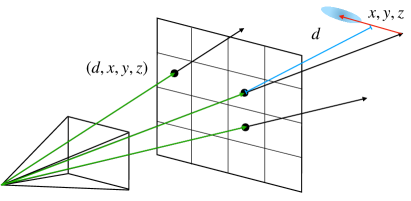
We introduce the \method, an ultra-efficient approach for monocular 3D object reconstruction. Splatter Image is based on Gaussian Splatting, which allows fast and high-quality reconstruction of 3D scenes from multiple images. We apply Gaussian Splatting to monocular reconstruction by learning a neural network that, at test time, performs reconstruction in a feed-forward manner, at 38 FPS. Our main innovation is the surprisingly straightforward design of this network, which, using 2D operators, maps the input image to one 3D Gaussian per pixel. The resulting set of Gaussians thus has the form an image, the Splatter Image. We further extend the method take several images as input via cross-view attention. Owning to the speed of the renderer (588 FPS), we use a single GPU for training while generating entire images at each iteration to optimize perceptual metrics like LPIPS. On several synthetic, real, multi-category and large-scale benchmark datasets, we achieve better results in terms of PSNR, LPIPS, and other metrics while training and evaluating much faster than prior works. Code, models, demo and more results are available at https://szymanowiczs.github.io/splatter-image.
Motivation & Objective
- To enable real-time, high-quality 3D reconstruction from a single monocular image using efficient deep learning.
- To overcome the computational bottleneck of implicit 3D representations like NeRF by leveraging the speed and quality of Gaussian Splatting.
- To design a training-efficient framework that allows full-image supervision using perceptual metrics like LPIPS, even with limited views.
- To extend the method to multi-view reconstruction using cross-view attention and relative camera poses, avoiding reliance on absolute poses.
- To achieve state-of-the-art reconstruction quality with minimal computational cost, enabling training and inference on a single GPU.
Proposed method
- The method uses a 2D U-Net-based image-to-image network to predict a 'Splatter Image'—a 2D feature map where each pixel encodes the 3D position, color, opacity, and shape of a 3D Gaussian.
- Each predicted 3D Gaussian is rendered via Gaussian Splatting, enabling fast and high-quality rendering at 588 FPS, decoupling rendering from training bottlenecks.
- The 3D Gaussians are stored in a 2D image structure, allowing the use of efficient 2D convolutions instead of costly 3D operations, simplifying training and inference.
- For multi-view input, the method fuses predictions from multiple views by registering them to a common reference frame and injecting lightweight cross-view attention layers.
- The model is trained using a combination of L1, LPIPS, and perceptual losses, with full 360° rendered views generated per training iteration to optimize for visual realism.
- Post-processing includes culling inactive Gaussians (opacity ≈ 0), reducing memory and rendering cost without sacrificing quality.
Experimental results
Research questions
- RQ1Can Gaussian Splatting be effectively adapted to monocular 3D reconstruction using a simple 2D network to predict 3D Gaussians?
- RQ2Does a 2D image-to-image network mapping to a 3D Gaussian mixture enable high-fidelity 360° reconstruction from a single view?
- RQ3Can the method achieve state-of-the-art performance in reconstruction quality while maintaining ultra-low inference and training latency?
- RQ4How does the use of perceptual losses (e.g., LPIPS) with full-view rendering improve generalization compared to partial-view supervision?
- RQ5To what extent can multi-view attention improve reconstruction quality when fusing predictions from multiple input images without requiring absolute camera poses?
Key findings
- Splatter Image achieves 38 FPS inference speed on a single GPU, making it over 1000× faster than PixelNeRF and VisionNeRF in test-time efficiency.
- The method trains efficiently on a single A6000 GPU in 7 days, achieving state-of-the-art PSNR and LPIPS on ShapeNet and CO3D benchmarks, outperforming VisionNeRF (which requires 16 A100 GPUs for 5 days).
- On the ShapeNet-SRN benchmark, Splatter Image achieves a PSNR of 28.98 and LPIPS of 0.033, outperforming PixelNeRF (PSNR 28.45, LPIPS 0.037) and VisionNeRF (PSNR 28.71, LPIPS 0.037) with significantly lower latency.
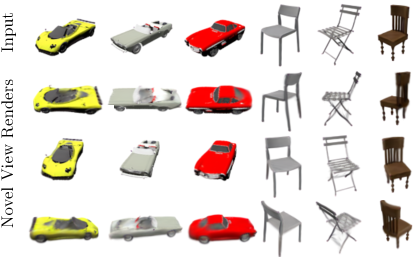
- The method generalizes well to unseen views: even though only one side is seen during inference, the model reconstructs full 360° objects with high fidelity due to strong inductive bias from training.
- Over 50% of Gaussians are inactive (opacity ≈ 0) in post-processing, allowing efficient culling without quality loss, enhancing rendering speed and memory efficiency.
- The method does not require canonical or absolute camera poses, relying only on relative poses, which simplifies deployment and improves robustness to pose variation.
Read this paper
Open the full text in the Nubint reader and ask about any passage as you read.
Read this paper on NubintThis review was generated by AI from the original paper. Please check the paper before citing it.