
[Paper Review] Stacking disorder and thermal transport properties of $α$-RuCl$_3$
This study reveals that even minimal stacking disorder in high-quality α-RuCl₃ single crystals significantly suppresses the structural transition temperature, magnetic ordering temperature (T_N), and lattice thermal conductivity. Despite similar oscillatory thermal conductivity and thermal Hall resistivity features across samples, crystals with minimal stacking disorder exhibit higher thermal conductivity, pushing the thermal Hall conductivity closer to the half-integer quantized value, highlighting the critical role of interlayer coupling in this Kitaev quantum spin liquid candidate.
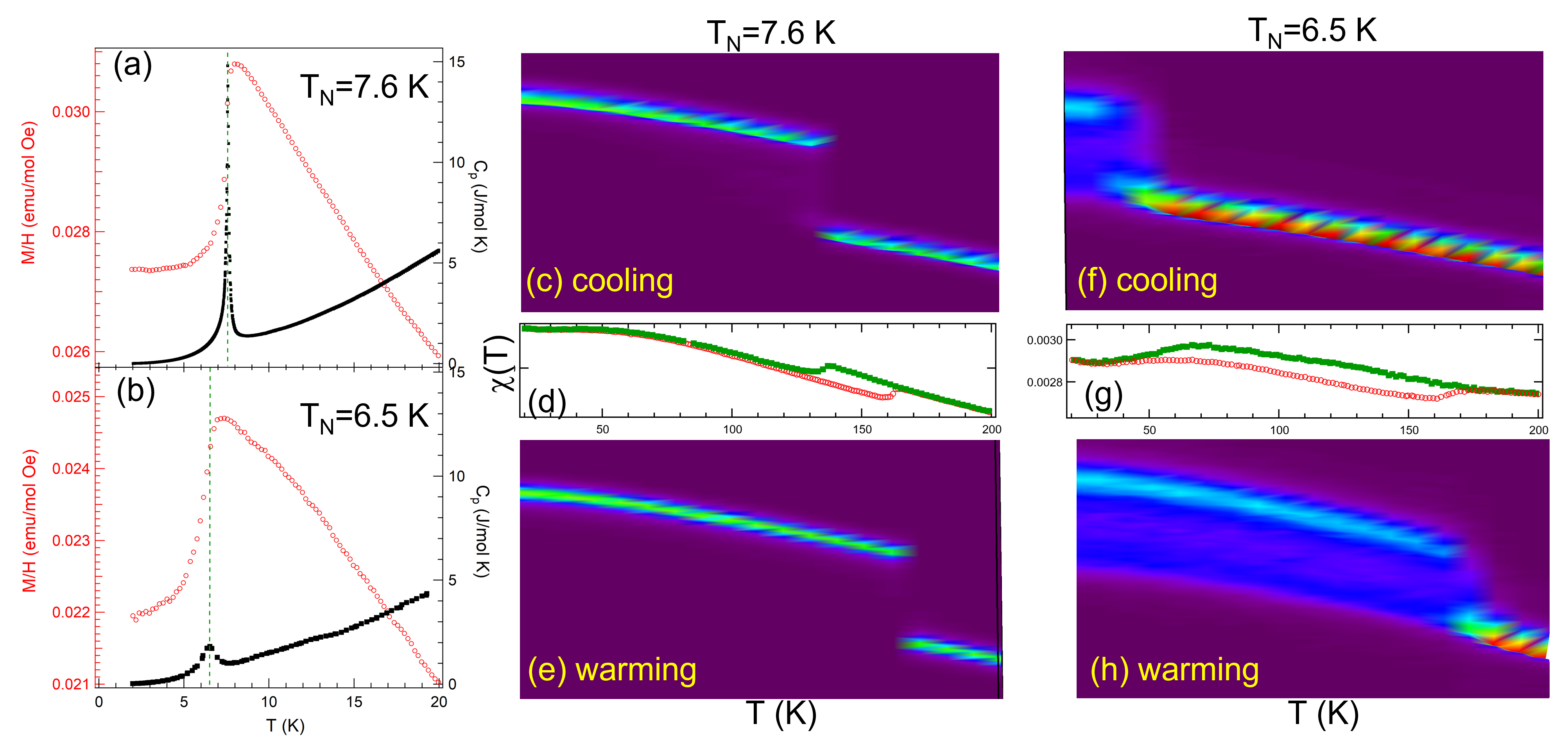
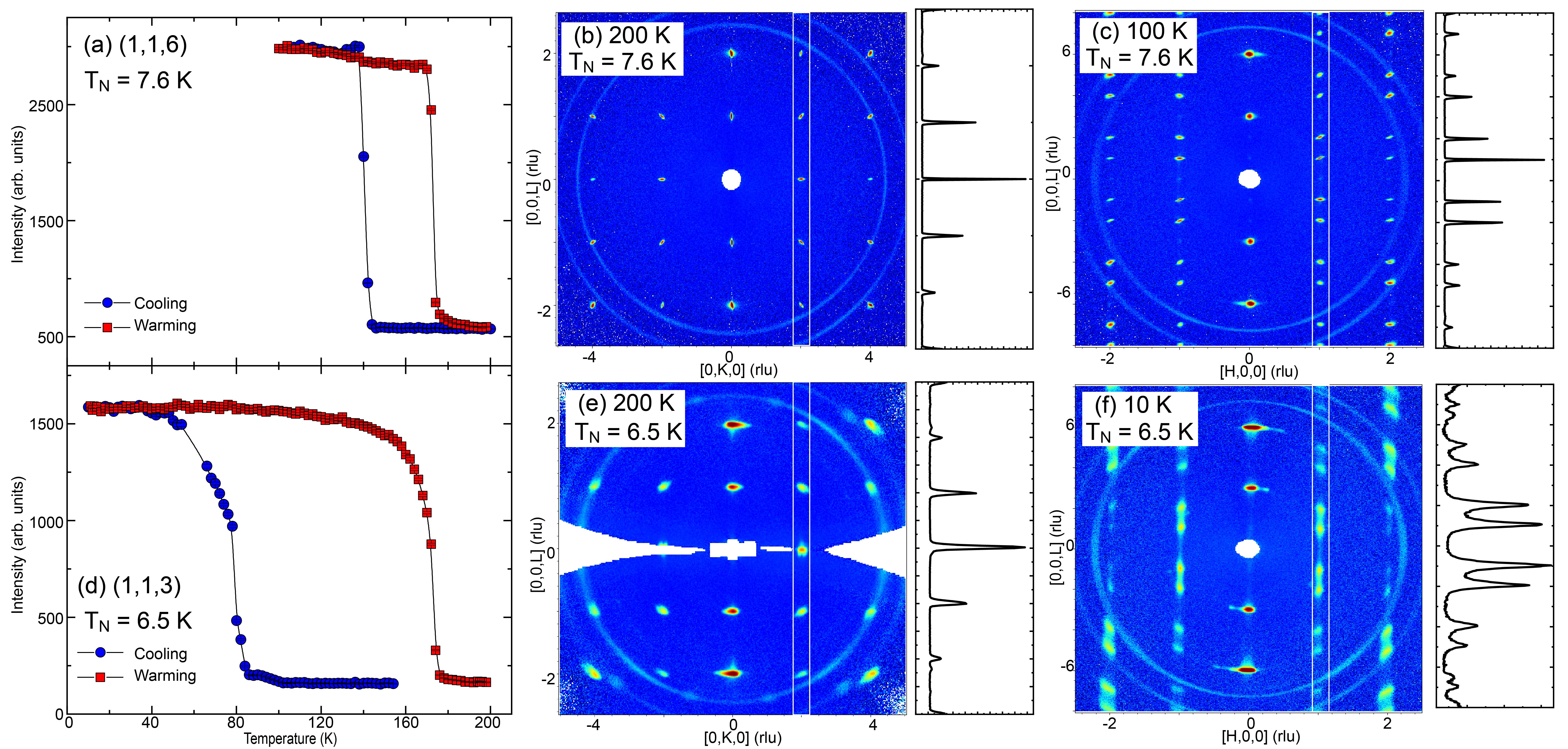
$α$-RuCl$_3$, a well-known candidate material for Kitaev quantum spin liquid, is prone to stacking disorder due to the weak van der Waals bonding between the honeycomb layers. After a decade of intensive experimental and theoretical studies, the detailed correlation between stacking degree of freedom, structure transition, magnetic and thermal transport properties remains unresolved. In this work, we reveal the effects of a small amount of stacking disorder inherent even in high quality $α$-RuCl$_3$ crystals. This small amount of stacking disorder results in the variation of the magnetic ordering temperature, suppresses the structure transition and thermal conductivity. Crystals with minimal amount of stacking disorder have a T$_N>$7.4\,K and exhibit a well-defined structure transition around 140\,K upon cooling. For those with more stacking faults and a T$_N$ below 7\,K, the structure transition occurs well below 140\,K upon cooling and is incomplete, manifested by the diffuse streaks and the coexistence of both high temperature and low temperature phases down to the lowest measurement temperature. Both types of crystals exhibit oscillatory field dependent thermal conductivity and a plateau-like feature in thermal Hall resistivity in the field-induced quantum spin liquid state. However, $α$-RuCl$_3$ crystals with minimal amount of stacking disorder have a higher thermal conductivity that pushes the thermal Hall conductivity to be closer to the half-integer quantized value. These findings demonstrate a strong correlation between layer stacking, structure transition, magnetic and thermal transport properties, underscoring the importance of interlayer coupling in $α$-RuCl$_3$ despite the weak van der Waals bonding.
Motivation & Objective
- To investigate the impact of intrinsic stacking disorder on structural, magnetic, and thermal transport properties in high-quality α-RuCl₃ single crystals.
- To resolve the unresolved correlation between stacking sequence, structure transition, magnetic ordering, and thermal transport in α-RuCl₃.
- To establish reliable experimental criteria for identifying α-RuCl₃ crystals with minimal stacking disorder based on measurable physical properties.
- To clarify whether oscillatory thermal conductivity and thermal Hall effect features are intrinsic or extrinsic, and how stacking disorder influences them.
- To assess the role of weak interlayer coupling in determining macroscopic transport and magnetic behavior despite van der Waals bonding.
Proposed method
- Synthesis and characterization of high-quality α-RuCl₃ single crystals with varying degrees of stacking disorder.
- Measurement of temperature-dependent magnetization to identify magnetic ordering temperature (T_N) and detect multiple anomalies.
- Use of x-ray and neutron diffraction to monitor structural transitions and detect stacking fault signatures.
- Quantitative analysis of thermal conductivity under magnetic fields to identify oscillatory features and field-dependent behavior.
- Measurement of thermal Hall resistivity to assess quantization behavior and field evolution in the quantum spin liquid state.
- Correlation of T_N, structure transition temperature, and thermal conductivity with stacking disorder levels to derive selection criteria.
Experimental results
Research questions
- RQ1How does a small amount of stacking disorder in α-RuCl₃ affect the structural transition temperature upon cooling?
- RQ2What is the relationship between stacking disorder and the suppression of magnetic ordering temperature (T_N) in α-RuCl₃?
- RQ3How does stacking disorder influence lattice thermal conductivity in α-RuCl₃ single crystals?
- RQ4Why do thermal Hall conductivity values vary between samples, and how is this related to stacking disorder?
- RQ5Can well-defined experimental criteria be established to identify α-RuCl₃ crystals with minimal stacking disorder?
Key findings
- α-RuCl₃ crystals with minimal stacking disorder exhibit a well-defined structural transition near 140 K upon cooling, while those with higher disorder show a suppressed and incomplete transition below 140 K.
- The magnetic ordering temperature T_N is strongly correlated with stacking disorder: crystals with minimal disorder have T_N > 7.4 K, while those with more disorder have T_N < 7 K.
- Stacking disorder suppresses both the structural transition temperature and the lattice thermal conductivity, with higher thermal conductivity observed in crystals with minimal stacking disorder.
- Despite variations in T_N and thermal conductivity, all crystals exhibit similar oscillatory field-dependent thermal conductivity and a plateau-like feature in thermal Hall resistivity in the field-induced quantum spin liquid state.
- Crystals with minimal stacking disorder achieve a thermal Hall conductivity closer to the half-integer quantized value due to their higher longitudinal thermal conductivity.
- The study establishes that a structural transition near 140 K upon cooling and a single magnetic anomaly at ~7.6 K in specific heat are reliable indicators of minimal stacking disorder in α-RuCl₃.
Better researchstarts right now
From reading papers to final review, dramatically reduce your research time.
No credit card · Free plan available
This review was created by AI and reviewed by human editors.