
[Paper Review] Static Replication of Impermanent Loss for Concentrated Liquidity Provision in Decentralised Markets
This paper proposes static replication strategies using European call and put options to hedge impermanent loss (IL) in concentrated liquidity provision on decentralized exchanges like Uniswap v3. By modeling IL as a portfolio of options with strikes spanning the liquidity provision interval, the authors demonstrate near-perfect replication accuracy using real Deribit BTC option data, enabling liquidity providers to hedge IL efficiently on centralized exchanges.
This article analytically characterizes the impermanent loss of concentrated liquidity provision for automatic market makers in decentralised markets such as Uniswap. We propose two static replication formulas for the impermanent loss by a combination of European calls or puts with strike prices supported on the liquidity provision price interval. It facilitates liquidity providers to hedge permanent loss by trading crypto options in more liquid centralised exchanges such as Deribit. Numerical examples illustrate the astonishing accuracy of the static replication.
Motivation & Objective
- To analytically characterize the option-like payoff structure of impermanent loss in concentrated liquidity provision on Uniswap v3.
- To develop static replication formulas that express impermanent loss as a combination of European calls or puts with strikes in the liquidity provision price interval.
- To enable liquidity providers to hedge impermanent loss by trading options on more liquid centralized exchanges like Deribit.
- To validate the accuracy of the replication formulas using real market data from Deribit’s BTC options market.
Proposed method
- The paper derives closed-form expressions for impermanent loss as a weighted sum of European call and put options with strikes distributed across the liquidity provision interval [P_l, P_u].
- It employs the Heston stochastic volatility model to simulate price dynamics and validate replication accuracy under realistic market conditions.
- The replication formulas are based on the second derivative of the IL payoff with respect to the underlying price, leading to a portfolio of options with specific strike weights.
- The authors use tick-by-tick Deribit BTC option data (Jan 2020–Dec 2020) to backtest the static replication strategy over 1- and 2-week holding periods.
- They compute replication error by comparing the actual impermanent loss with the payoff of the static option portfolio.
- The method assumes constant product AMM mechanics and models the liquidity provider’s exposure as a long position in a portfolio of options with strikes in the specified price range.
Experimental results
Research questions
- RQ1How can impermanent loss in concentrated liquidity provision be analytically decomposed into a portfolio of standard options?
- RQ2Can a static portfolio of European options replicate the payoff of impermanent loss with high accuracy in practice?
- RQ3What is the impact of liquidity provision interval width (u and d) on the magnitude of impermanent loss and replication error?
- RQ4How accurate is the static replication strategy when applied to real-world options data from centralized exchanges like Deribit?
- RQ5Does the replication accuracy improve with higher strike density or longer time to maturity?
Key findings
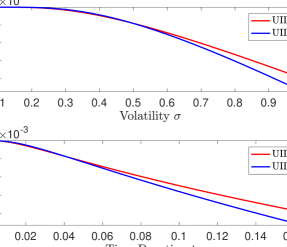
- The static replication formulas achieve exceptional accuracy, with replication errors as low as 1.18×10⁻⁶ under the Heston model, indicating near-perfect replication.
- Impermanent loss increases significantly with wider liquidity provision intervals, with right-side (higher price) intervals posing greater risk due to strong bull market dynamics in 2020.
- Even with only 3–10 actively traded strikes in the relevant price range, the replication error remains low, demonstrating robustness in real market conditions.
- The right-side impermanent loss (UIL^R) is consistently more severe than the left-side loss (UIL^L), reflecting the asymmetric price appreciation of BTC in 2020.
- The replication error does not exhibit clear patterns with longer holding periods (1 vs. 2 weeks), suggesting stable performance across investment horizons.
- The empirical results using Deribit BTC options show strong alignment between actual impermanent loss and the payoff of the static option portfolio, validating the practical applicability of the model.
Read this paper
Open the full text in the Nubint reader and ask about any passage as you read.
Read this paper on NubintThis review was generated by AI from the original paper. Please check the paper before citing it.