
[Paper Review] Statistical analysis of the gravitational anomaly in {\it Gaia} wide binaries
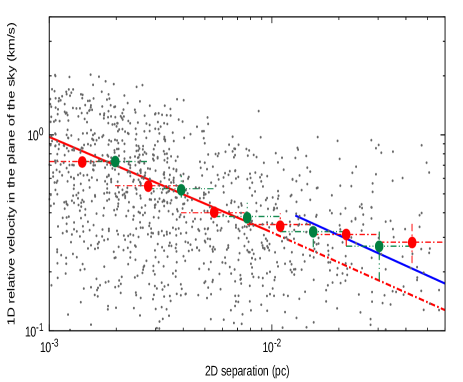
This study develops a formal statistical framework to test modified gravity in isolated, kinematically clean wide binary star systems using Gaia DR3 data. Applying the method to 466 binaries at r₂D < 0.01 pc yields γ = 1.000 ± 0.096, consistent with Newtonian gravity, while 108 binaries at r₂D > 0.01 pc yield γ = 1.5 ± 0.2, inconsistent with Newtonian gravity at 2.6σ and consistent with MOND predictions.
The exploration of the low acceleration $a0.01$pc region however, we obtain $γ=1.5 \pm 0.2$, inconsistent with the Newtonian value of $γ=1$ at a $2.6 σ$ level, and much more indicative of MOND AQUAL predictions of close to $γ=1.4$.
Motivation & Objective
- To develop a formal statistical framework for testing modified gravity in small, kinematically clean wide binary samples, avoiding contamination from flybys and unresolved binaries.
- To provide an independent, high-precision validation of previous wide binary gravity tests that relied on larger, potentially contaminated samples.
- To test the hypothesis that gravity deviates from Newtonian dynamics at low accelerations (a < a₀), as predicted by MOND.
- To calibrate the method using a high-acceleration region (r₂D < 0.01 pc) where Newtonian gravity is expected to hold, ensuring methodological robustness.
- To assess the consistency of the inferred effective gravitational constant γ across different assumptions about the orbital ellipticity distribution.
Proposed method
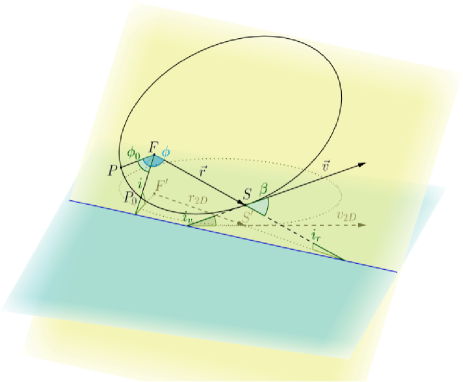
- Construct a likelihood-based statistical model to infer the effective gravitational constant γ, where G → γG, from observed 2D relative velocities (v₂D) and projected separations (r₂D) of wide binaries.
- Use synthetic data generation with Monte Carlo sampling to validate the inference method under controlled conditions, including known input γ values and varying ellipticity distributions.
- Model the orbital velocity distribution using a parametric form dependent on γ and the assumed ellipticity distribution parameterized by α.
- Apply Kolmogorov-Smirnov (KS) tests to quantify the goodness of fit between observed and modelled velocity distributions, using the KS statistic as a merit function.
- Account for systematic uncertainties by propagating errors from the assumed ellipticity distribution and measurement noise, estimating σ_sy and σ_re.
- Use the synthetic sample distribution of recovered γ values to validate that the method's confidence intervals are well-calibrated, with the centroid offset from the true value being less than one standard deviation.
Experimental results
Research questions
- RQ1Does the observed velocity distribution of isolated wide binaries at low accelerations (r₂D > 0.01 pc) deviate from Newtonian predictions?
- RQ2Is the inferred effective gravitational constant γ consistent with γ = 1 (Newtonian gravity) in the high-acceleration regime (r₂D < 0.01 pc)?
- RQ3Can a clean, small sample of wide binaries yield a statistically robust measurement of γ that is insensitive to kinematic contaminants?
- RQ4How does the inferred γ depend on the assumed distribution of orbital ellipticities, and what is the resulting systematic uncertainty?
- RQ5Is the observed deviation from Newtonian gravity at low accelerations consistent with MOND predictions (γ ≈ 1.4)?
Key findings
- For the high-acceleration sample (r₂D < 0.01 pc, N = 466), the best-fit γ is 1.000 ± 0.096, consistent with Newtonian gravity at the 1σ level.
- For the low-acceleration sample (r₂D > 0.01 pc, N = 108), the best-fit γ is 1.5 ± 0.2, inconsistent with Newtonian gravity (γ = 1) at the 2.6σ significance level.
- The inferred γ value of 1.5 ± 0.2 in the low-acceleration regime is in strong agreement with MOND AQUAL predictions, which predict γ ≈ 1.4.
- Systematic uncertainty from the ellipticity distribution (σ_sy) is small, with γ_BFsy values differing by less than 0.1 from the best-fit γ across different α values.
- The method's internal consistency is validated: the offset between the true γ and the centroid of the synthetic recovery distribution is less than one standard deviation in all cases.
- The synthetic data tests confirm that the method correctly recovers the input γ value within uncertainty, validating the statistical framework for real data analysis.
Read this paper
Open the full text in the Nubint reader and ask about any passage as you read.
Read this paper on NubintThis review was generated by AI from the original paper. Please check the paper before citing it.