
[Paper Review] Supercooling in Radiative Symmetry Breaking: Theory Extensions, Gravitational Wave Detection and Primordial Black Holes
This paper extends a model-independent framework for studying first-order phase transitions in radiative symmetry breaking (RSB) scenarios, enabling accurate predictions of gravitational wave (GW) spectra and primordial black hole (PBH) formation across a broader class of models. By refining the supercool expansion to include cubic terms in the effective potential, the approach becomes valid even for moderate supercooling (ε ~ 1), allowing quantitative estimates of GW amplitudes, peak frequencies, and PBH dark matter fractions in terms of four key parameters: χ₀, β̄, g, and ḡ.
First-order phase transitions, which take place when the symmetries are predominantly broken (and masses are then generated) through radiative corrections, produce observable gravitational waves and primordial black holes. We provide a model-independent approach that is valid for large-enough supercooling to quantitatively describe these phenomena in terms of few parameters, which are computable once the model is specified. The validity of a previously-proposed approach of this sort is extended here to a larger class of theories. Among other things, we identify regions of the parameter space that correspond to the background of gravitational waves recently detected by pulsar timing arrays (NANOGrav, CPTA, EPTA, PPTA) and others that are either excluded by the observing runs of LIGO and Virgo or within the reach of future gravitational wave detectors. Furthermore, we find regions of the parameter space where primordial black holes produced by large over-densities due to such phase transitions can account for dark matter. Finally, it is shown how this model-independent approach can be applied to specific cases, including a phenomenological completion of the Standard Model with right-handed neutrinos and gauged $B-L$ undergoing radiative symmetry breaking.
Motivation & Objective
- Extend the validity of the supercool expansion approach to model-independent studies of first-order phase transitions in radiative symmetry breaking (RSB) beyond the original small-ε limit.
- Develop a systematic improved supercool expansion that includes cubic terms in the effective potential to maintain accuracy even when supercooling is moderate (ε ~ 1).
- Apply the extended framework to predict gravitational wave spectra and primordial black hole (PBH) production in a model-independent way.
- Identify parameter space regions compatible with or excluded by current (LIGO/Virgo) and future (LISA, CE, ET, DECIGO) gravitational wave detectors.
- Assess the viability of PBHs from RSB phase transitions as a dark matter candidate, particularly via the late-blooming mechanism.
Proposed method
- Adapt the supercool expansion formalism by including the cubic term in the effective potential, which was neglected in prior work, to improve accuracy at moderate supercooling.
- Define four key model-independent parameters: χ₀ (symmetry breaking scale), β̄ (beta function of χ’s quartic coupling), g (collective coupling strength), and ḡ (cubic coupling strength).
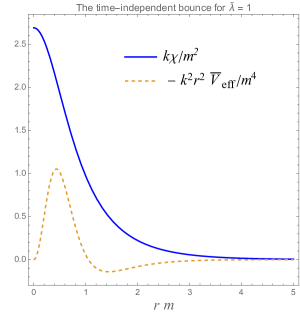
- Use the improved bounce action computation with cubic terms to determine the nucleation temperature Tₙ and phase transition strength α.
- Compute the gravitational wave spectrum amplitude and peak frequency fₚₑₐₖ using the phase transition parameters, assuming fast reheating.
- Apply the framework to specific models, including a simple RSB model and a gauged B-L model with right-handed neutrinos, to test its predictive power.
- Assess reheating dynamics post-supercooling to validate the fast-reheating assumption in GW and PBH calculations.
Experimental results
Research questions
- RQ1Can the model-independent supercool expansion approach be extended to work for moderate supercooling (ε ~ 1), beyond the original small-ε regime?
- RQ2How does including the cubic term in the effective potential improve the accuracy of phase transition predictions in the supercool expansion?
- RQ3What regions of the parameter space produce gravitational wave backgrounds detectable by pulsar timing arrays (NANOGrav, CPTA, etc.)?
- RQ4Which parameter regions are excluded by LIGO/Virgo O3 observations or within reach of future detectors like LISA and Einstein Telescope?
- RQ5Can primordial black holes formed during RSB phase transitions account for a significant fraction of dark matter, and under what conditions?
Key findings
- The improved supercool expansion, which includes the cubic term in the effective potential, allows accurate prediction of phase transition parameters (Tₙ, α, β⁻¹) for ε ~ 1, significantly broadening the applicability of the model-independent approach.
- Regions of parameter space with fₚₑₐₖ ~ 10⁻⁹–10⁻⁶ Hz and detectable GW amplitudes are identified as consistent with the NANOGrav 12.5-year GW background.
- Parameter regions where the GW spectrum exceeds LIGO/Virgo O3 sensitivity are ruled out, while others are within the reach of future detectors such as LISA and Einstein Telescope.
- The model-independent framework predicts that PBHs produced via the late-blooming mechanism can account for a significant fraction of the observed dark matter density in specific regions of the parameter space.
- In the gauged B-L model with right-handed neutrinos, fast reheating is possible for certain parameter choices (e.g., χ₀ ~ 10⁵ GeV), validating the fast-reheating assumption used in GW and PBH calculations.
- The method provides a semi-analytical, parameter-based prediction of GW spectra and PBH yields without requiring full numerical simulations for each model.
Better researchstarts right now
From reading papers to final review, dramatically reduce your research time.
No credit card · Free plan available
This review was created by AI and reviewed by human editors.