
[Paper Review] The second data release from the European Pulsar Timing Array: IV. Implications for massive black holes, dark matter and the early Universe
This paper analyzes the European Pulsar Timing Array's second data release to explore implications for massive black holes, dark matter, and the early Universe. It discusses how DR2 constrains related physics.
The European Pulsar Timing Array (EPTA) and Indian Pulsar Timing Array (InPTA) collaborations have measured a low-frequency common signal in the combination of their second and first data releases respectively, with the correlation properties of a gravitational wave background (GWB). Such signal may have its origin in a number of physical processes including a cosmic population of inspiralling supermassive black hole binaries (SMBHBs); inflation, phase transitions, cosmic strings and tensor mode generation by non-linear evolution of scalar perturbations in the early Universe; oscillations of the Galactic potential in the presence of ultra-light dark matter (ULDM). At the current stage of emerging evidence, it is impossible to discriminate among the different origins. Therefore, in this paper, we consider each process separately, and investigate the implications of the signal under the hypothesis that it is generated by that specific process. We find that the signal is consistent with a cosmic population of inspiralling SMBHBs, and its relatively high amplitude can be used to place constraints on binary merger timescales and the SMBH-host galaxy scaling relations. If this origin is confirmed, this is the first direct evidence that SMBHBs merge in nature, adding an important observational piece to the puzzle of structure formation and galaxy evolution. As for early Universe processes, the measurement would place tight constraints on the cosmic string tension and on the level of turbulence developed by first-order phase transitions. Other processes would require non-standard scenarios, such as a blue-tilted inflationary spectrum or an excess in the primordial spectrum of scalar perturbations at large wavenumbers. Finally, a ULDM origin of the detected signal is disfavoured, which leads to direct constraints on the abundance of ULDM in our Galaxy.
Motivation & Objective
- Motivate and quantify how the European Pulsar Timing Array's second data release informs theories of massive black holes.
- Assess potential dark matter signatures accessible with pulsar timing data.
- Investigate early-Universe physics limits derived from PTA observations.
Proposed method
- Use the European Pulsar Timing Array DR2 dataset to study timing residuals.
- Apply cross-pulsar correlation analyses to probe stochastic backgrounds and signal models.
- Incorporate theoretical models for massive black holes, dark matter effects, and early-Universe scenarios into the interpretation of PTA data.
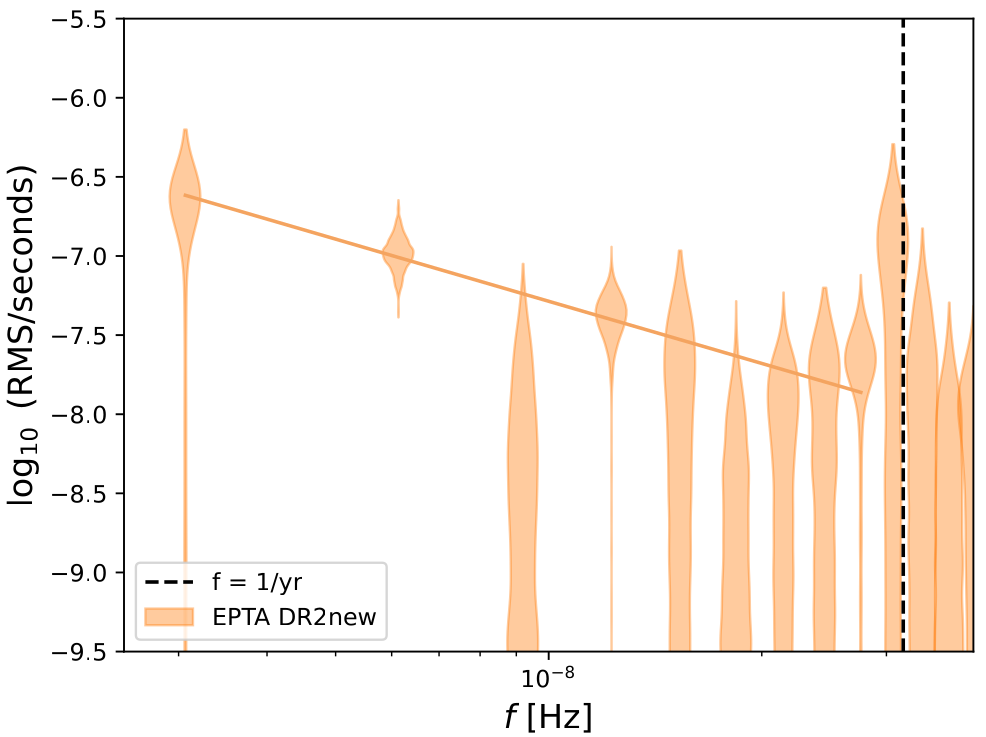
Experimental results
Research questions
- RQ1What constraints does the DR2 dataset place on the population and properties of massive black holes detectable by pulsar timing arrays?
- RQ2What limits or signatures does DR2 set on dark matter interactions or distributions relevant to pulsar timing?
- RQ3How does DR2 inform models of the early Universe through PTA observations?
Key findings
- DR2 provides new insights into the role of massive black holes in the PTA frequency band.
- The data offer updated perspectives on dark matter-related effects within pulsar timing measurements.
- Implications for early-Universe physics are discussed in the context of PTA timing residuals and stochastic backgrounds.
Better researchstarts right now
From reading papers to final review, dramatically reduce your research time.
No credit card · Free plan available
This review was created by AI and reviewed by human editors.