
[Paper Review] Symfind: Addressing the Fragility of Subhalo Finders and Revealing the Durability of Subhalos
Symfind is a new particle-tracking-based subhalo finder that significantly improves subhalo detection in cosmological simulations by tracking particles from infall, enabling recovery of subhalos down to orders-of-magnitude lower masses than Rockstar. It reveals that subhalos survive much longer than previously thought, reducing reliance on 'orphan' subhalo modeling and demonstrating that mass loss is resolvable at $n_{\text{peak}} \gtrsim 4\times10^3$, while $v_{\text{max}}$ requires $n_{\text{peak}} \gtrsim 3\times10^4$ for accurate resolution.
A major question in $Λ$CDM is what this theory actually predicts for the properties of subhalo populations. Subhalos are difficult to simulate and to find within simulations, and this propagates into uncertainty in theoretical predictions for satellite galaxies. We present Symfind, a new particle-tracking-based subhalo finder, and demonstrate that it can track subhalos to orders-of-magnitude lower masses than commonly used halo-finding tools, with a focus on Rockstar and consistent-trees. These longer survival mean that at a fixed peak subhalo mass, we find $\approx 15\%{-}40\%$ more subhalos within the virial radius, $R_ extrm{vir}$, and $\approx 35\%-120\%$ more subhalos within $R_ extrm{vir}/4$ in the Symphony dark-matter-only simulation suite. More subhalos are found as resolution is increased. We perform extensive numerical testing. In agreement with idealized simulations, we show that the $v_{ m max}$ of subhalos is only resolved at high resolutions ($n_ extrm{peak}\gtrsim3 imes 10^4$), but that mass loss itself can be resolved at much more modest particle counts ($n_ extrm{peak}\gtrsim4 imes 10^3$). We show that Rockstar converges to false solutions for the mass function, radial distribution, and disruption masses of subhalos. We argue that our new method can trace resolved subhalos until the point of typical galaxy disruption without invoking ``orphan'' modeling. We outline a concrete set of steps for determining whether other subhalo finders meet the same criteria. We publicly release Symfind catalogs and particle data for the Symphony simulation suite at \url{http://web.stanford.edu/group/gfc/symphony}.
Motivation & Objective
- To address the fragility of existing subhalo finders like Rockstar, which fail to converge reliably at low masses.
- To quantify the true durability of subhalos in $\Lambda$CDM by tracking particles from infall to disruption.
- To determine the minimum resolution required for accurate subhalo mass and velocity function measurements.
- To provide a robust, testable framework for evaluating other subhalo finders based on convergence and physical consistency.
Proposed method
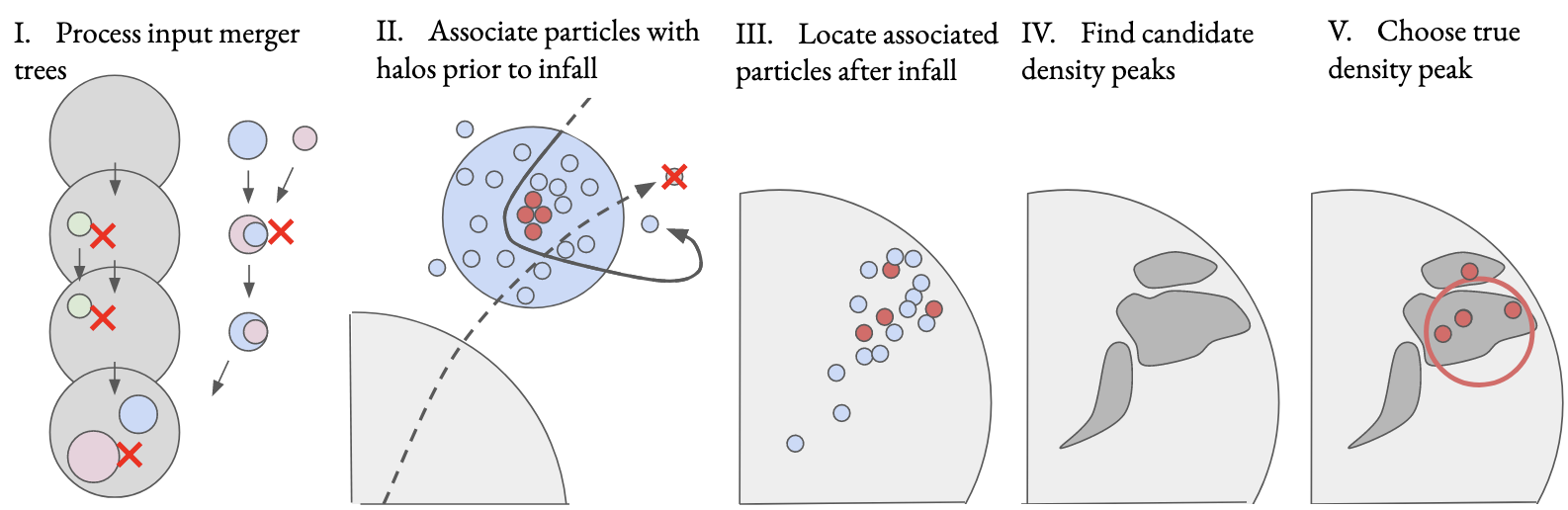
- Symfind tracks particles of subhalos from their infall into host halos, preserving their identity through tidal stripping.
- It uses the most bound particles at infall as seeds for subhalo identification via the Subfind algorithm.
- The method evaluates subhalo properties (mass, $v_{\text{max}}$, $m_{\text{peak}}$) over time to assess survival and disruption.
- It performs extensive numerical convergence tests across resolution levels to determine resolution limits for physical observables.
- It compares Symfind results directly with Rockstar and consistent-trees to expose false convergence in existing tools.
- It introduces statistical corrections to avoid survivor bias in stacked mass loss curves, ensuring accurate mass evolution tracking.
Experimental results
Research questions
- RQ1To what extent do standard subhalo finders like Rockstar fail to converge as resolution increases, leading to false subhalo populations?
- RQ2What is the minimum particle count ($n_{\text{peak}}$) required to resolve subhalo mass loss and $v_{\text{max}}$ evolution reliably?
- RQ3How durable are subhalos in $\Lambda$CDM simulations, and can they be tracked until galaxy disruption without invoking 'orphan' subhalos?
- RQ4To what degree do stacked mass loss curves suffer from survivor bias, and how can this be corrected?
- RQ5Can a particle-tracking-based method like Symfind outperform traditional phase-space finders in low-mass subhalo recovery?
Key findings
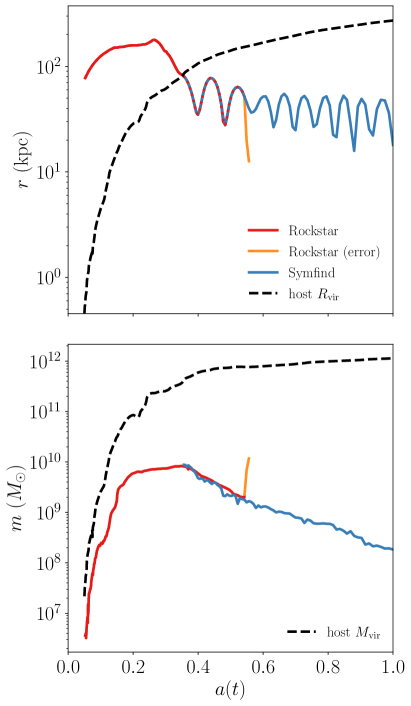
- Symfind recovers 15% to 40% more subhalos within $R_{\text{vir}}$ and 35% to 120% more within $R_{\text{vir}}/4$ at fixed $m_{\text{peak}}$ compared to Rockstar.
- Subhalo mass loss is resolvable at $n_{\text{peak}} \gtrsim 4\times10^3$, while $v_{\text{max}}$ requires $n_{\text{peak}} \gtrsim 3\times10^4$ for accurate resolution.
- Rockstar falsely converges with increasing resolution, producing unreliable mass functions and radial distributions.
- Survivor bias strongly distorts stacked mass loss curves, but Symfind's statistical corrections eliminate this bias.
- Subhalos tracked by Symfind survive long enough that 'orphan' subhalo modeling is unnecessary at $n_{\text{peak}} > 4\times10^3$.
- The method confirms that idealized simulations accurately predict $v_{\text{max}}$ evolution in the deep mass loss regime when resolution is sufficient.
Better researchstarts right now
From reading papers to final review, dramatically reduce your research time.
No credit card · Free plan available
This review was created by AI and reviewed by human editors.