
[论文解读] The evolution of the galaxy UV luminosity function at redshifts z ~ 8-15 from deep JWST and ground-based near-infrared imaging
本研究将早期 JWST NIRCam 数据与 COSMOS 的深层地基 UltraVISTA 成像结合,来自 z ≃ 8 到 15 的演化银河系 UV 光度函数,发现在 z ≈ 10 之前呈现双冪律 LF,在 ρUV 和 ρSFR 在 z ≈ 15 处逐渐下降。
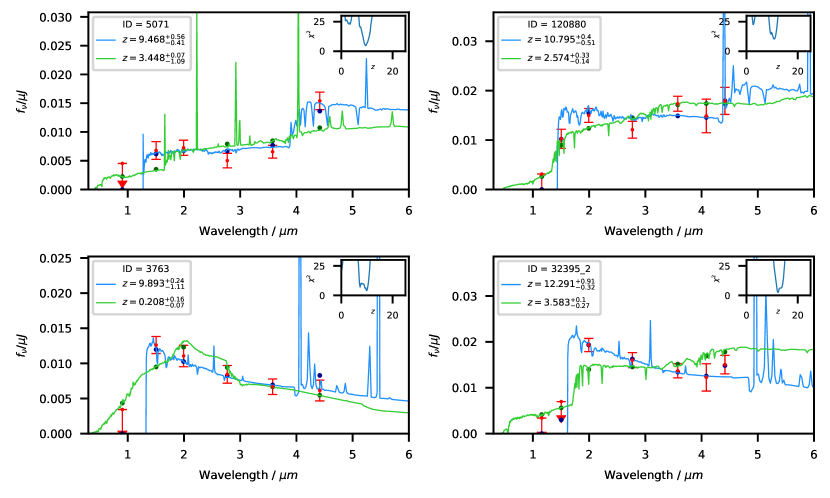
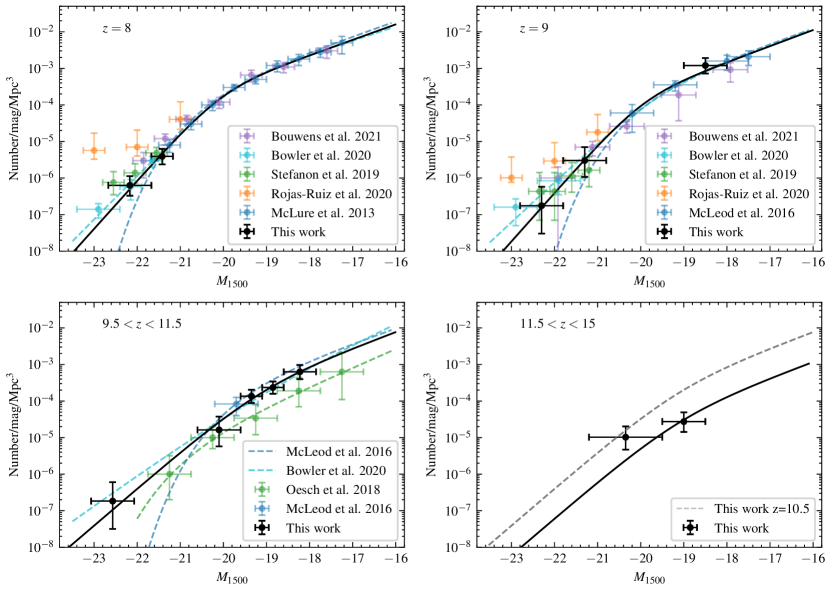
We reduce and analyse the available James Webb Space Telescope (JWST) ERO and ERS NIRCam imaging (SMACS0723, GLASS, CEERS) in combination with the latest deep ground-based near-infrared imaging in the COSMOS field (provided by UltraVISTA DR5) to produce a new measurement of the evolving galaxy UV luminosity function (LF) over the redshift range $z = 8 - 15$. This yields a new estimate of the evolution of UV luminosity density ($ρ_{ m UV}$), and hence cosmic star-formation rate density ($ρ_{ m SFR}$) out to within $< 300$\, Myr of the Big Bang. Our results confirm that the high-redshift LF is best described by a double power-law (rather than a Schechter) function up to $z\sim10$, and that the LF and the resulting derived $ρ_{ m UV}$ (and thus $ρ_{ m SFR}$), continues to decline gradually and steadily up to $z\sim15$ (as anticipated from previous studies which analysed the pre-existing data in a consistent manner to this study). We provide details of the 61 high-redshift galaxy candidates, 47 of which are new, that have enabled this new analysis. Our sample contains 6 galaxies at $z \ge 12$, one of which appears to set a new redshift record as an apparently robust galaxy candidate at $z \simeq 16.4$, the properties of which we therefore consider in detail. The advances presented here emphasize the importance of achieving high dynamic range in studies of early galaxy evolution, and re-affirm the enormous potential of forthcoming larger JWST programmes to transform our understanding of the young Universe.
研究动机与目标
- 使用新的 JWST ERO/ERS NIRCam 数据以及 COSMOS/UltraVISTA DR5 成像,动机并量化在 z ≳ 8 时银河系 UV 光度函数的演化。
- 在三个 JWST 观测域以及 COSMOS/UltraVISTA 构建健壮的高红移星系样本(z > 7.5),以测量 LF 及推导的 UV 光度和星-形成率密度。
- 评估 LF 的形状(双冪律 vs Schechter)及其演化至 z ≈ 15,并识别高红移星系候选体,包括一个可能的 z ≈ 16.4 对象。
- 通过多带光度测度、SED 拟合以及跨场一致性,评估高红移选取的动态范围与可靠性,以尽量减少低-z 污染。
提出的方法
- 将 JWST NIRCam 成像(SMACS0723、CEERS、GLASS)与 COSMOS/ UltraVISTA DR5 近红外数据结合,构建 z > 7.5 的星系样本。
- 执行点扩散函数(PSF)均一化和局部深度估计,以获得一致的多波段光度测量。
- 使用 EAZY 结合 Pegase 模板计算光度红移,检查棕矮星污染并用 LePhare 与 McLure 等代码进行校验。
- 通过针对每个场域定制的 dropout 条件选择高-z 候选体,并以 Δχ2 条件要求具有健壮的高-z 解。
- 推导 UV 绝对星等,校正总通量,并在从 z = 8 到 z ≈ 15 的红移箱中计算 UV 光度函数。
实验结果
研究问题
- RQ1结合 JWST 深场与 COSMOS/UltraVISTA 数据时,银河系 UV 光度函数从 z ≈ 8 到 15 的演化形式是什么?
- RQ2在高-z 期间,UV LF 到 z ≈ 10 是用双冪律还是 Schechter 函数来描述更好?并且这一特征向 z ≈ 15 的演化如何?
- RQ3在 z > 8 时,UV 光度密度与宇宙星形成率密度的含义是什么,包括可能存在的高端亮星系直至 z ≈ 16?
主要发现
- 在 z ≈ 10 之前,高-z UV 光度函数最好用双冪律来描述,而非 Schechter 函数。
- UV 光度密度 ρUV 以及由此推导的宇宙星形成率密度 ρSFR 向 z ≈ 15 逐渐且稳定地下降。
- 61 个高-z 星系候选样本(其中 47 个为新)支撑 LF 分析,其中包括 6 个 z ≥ 12 的星系以及一个可靠的 z ≈ 16.4 候选。
- 该研究通过将 JWST 深场与广域地基成像相结合,展示了高动态范围在早期星系演化研究中的价值。
- 细节包括三场域中 45 arcmin^2 的 JWST NIRCam 数据以及 1.8 deg^2 的 UltraVISTA COSMOS 成像,在 COSMOS/UltraVISTA 中有 16 个 z > 7.5 的星系。
更好的研究,从现在开始
从论文设计到论文写作,大幅缩短您的研究时间。
无需绑定信用卡
本解读由 AI 生成,并经人工编辑审核。