
[论文解读] The galaxy UV luminosity function at $\mathbf{z \simeq 11}$ from a suite of public JWST ERS, ERO and Cycle-1 programs
本论文展示了一项覆盖广域的 JWST NIRCam 搜索(约 260 平方弧分钟),得到 61 个稳健的 z>9.5 星系候选体,以约9.5至12.5的红移范围约束演化中的 UV 光度函数,偏好双幂律形式及较陡的微弱端斜率。
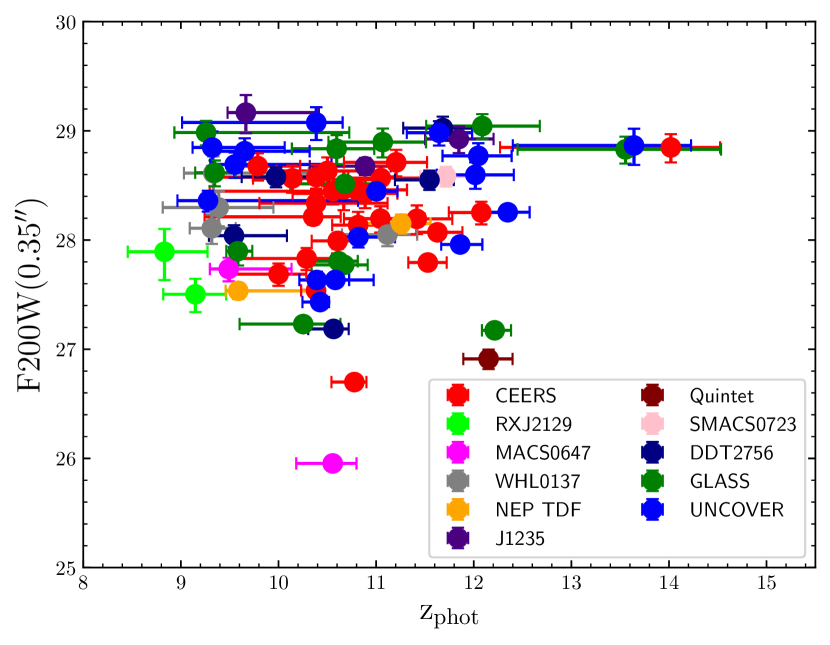
We present a new determination of the evolving galaxy UV luminosity function (LF) over the redshift range $9.5250$ arcmin$^2$) data set of JWST NIRCam near-infrared imaging assembled from thirteen public JWST surveys. Our relatively large-area search allows us to uncover a sample of 61 robust $z>9.5$ candidates detected at $\geq 8σ$, and hence place new constraints on the intermediate-to-bright end of the UV LF. When combined with our previous JWST+UltraVISTA results, this allows us to measure the form of the LF over a luminosity range corresponding to four magnitudes ($M_{1500}$). At these early times we find that the galaxy UV LF is best described by a double power-law function, consistent with results obtained from recent ground-based and early JWST studies at similar redshifts. Our measurements provide further evidence for a relative lack of evolution at the bright-end of the UV LF at $z=9-11$, but do favour a steep faint-end slope ($α\leq-2$). The luminosity-weighted integral of our evolving UV LF provides further evidence for a gradual, smooth (exponential) decline in co-moving star-formation rate density ($ρ_{\mathrm{SFR}}$) at least out to $z\simeq12$, with our determination of $ρ_{\mathrm{SFR}}(z=11)$ lying significantly above the predictions of many theoretical models of galaxy evolution.
研究动机与目标
- 在使用公开调查数据集的广域 JWST NIRCam 数据下,绘制 z≈9.5–12.5 的 rest-frame UV 星系光度函数(LF)的演化。
- 测量 M1500 四个数量级范围内的 UV LF 的明亮端到中等端,并评估其函数形式。
- 将新的广域结果与先前的 JWST+UltraVISTA 约束相结合,推导直至 z≈12 的 ρ_SFR 演化。
- 评估 z>9.5 的明亮星系丰度,并与理论星系演化模型进行比较。
提出的方法
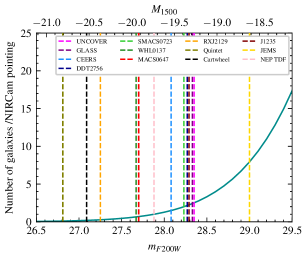
- 汇总一个跨多调查的 JWST NIRCam 目录(涵盖十三个公开调查),在适用时屏蔽簇/引力透镜后总面积约为 ~260 平方弧分钟。
- 进行 PSF 统一并以直径 0.35″ 的孔径进行光度测量,利用 FLUX_AUTO 的总光通量校正并额外考虑 Kron 裂隙之外的 10% 光量。
- 使用 LePhare 进行 SED 拟合,采用 BC03 模板、Chabrier IMF、Calzetti 脉冲塵法则,以及 Madau IGM 吸收来推导光度系数的 photometric redshift 与 M1500。
- 对 z>9.5 选择进行鲁棒性检验:zphot≥8.5、主解/次解 Δχ²≥4、在至少一个关键带中 ≥8σ 检测,以及在 Lyman 跃迁前的波段无检测。
- 在簇场(如 SMACS 0723)中考虑引力透镜效应与有效 survey 面积,并使用已发表的透镜模型推导去扭曲后的面积和放大因子。
实验结果
研究问题
- RQ1在四个数量级的光度范围内,z≈9.5–12.5 的 UV 光度函数形式为何?
- RQ2在这些红移下的 UV LF 是否在明亮端偏向双幂律而非 Schechter 函数?
- RQ3直至 z≈12 的光度密度及隐含的星形成率密度 (ρ_SFR) 有何演化?
- RQ4z>9.5 的 JWST 推导的 LF 测量与现有的早期星系演化理论模型相比有何差异?
主要发现
- 在 z≈9.5–12.5,UV 光度函数最适合用双幂律来描述,这与最近的地基观测和早期 JWST 研究一致。
- 在 z=9–11 的明亮端,UV LF 的演化相对不足的证据存在。
- 基于综合数据,微弱端斜率较陡(α ≤ −2)。
- 演化中的 UV LF 的光度加权积分显示在共动体的星形成率密度向 z≈12 逐渐呈指数下降。
- 推导的 ρ_SFR(z=11) 明显高于许多理论模型的预测,表明早期宇宙的星形成活动高于某些模型的预期。
更好的研究,从现在开始
从论文设计到论文写作,大幅缩短您的研究时间。
无需绑定信用卡
本解读由 AI 生成,并经人工编辑审核。