
[论文解读] The HARPS search for southern extra-solar planets XL. Searching for Neptunes around metal-poor stars
本研究利用HARPS光谱仪的高精度径向速度数据,调查了金属贫乏恒星周围海王星和超级-Earth的频率。基于在金属贫乏恒星周围发现一颗确认的海王星级质量行星和一颗候选行星,报告了行星频率估计值为13.33%(68%可信区间为13.33%⁺⁵.⁸⁰%₋₈.₈⁴%),表明即使在低金属丰度环境中,低质量行星的形成效率可能依然很高。
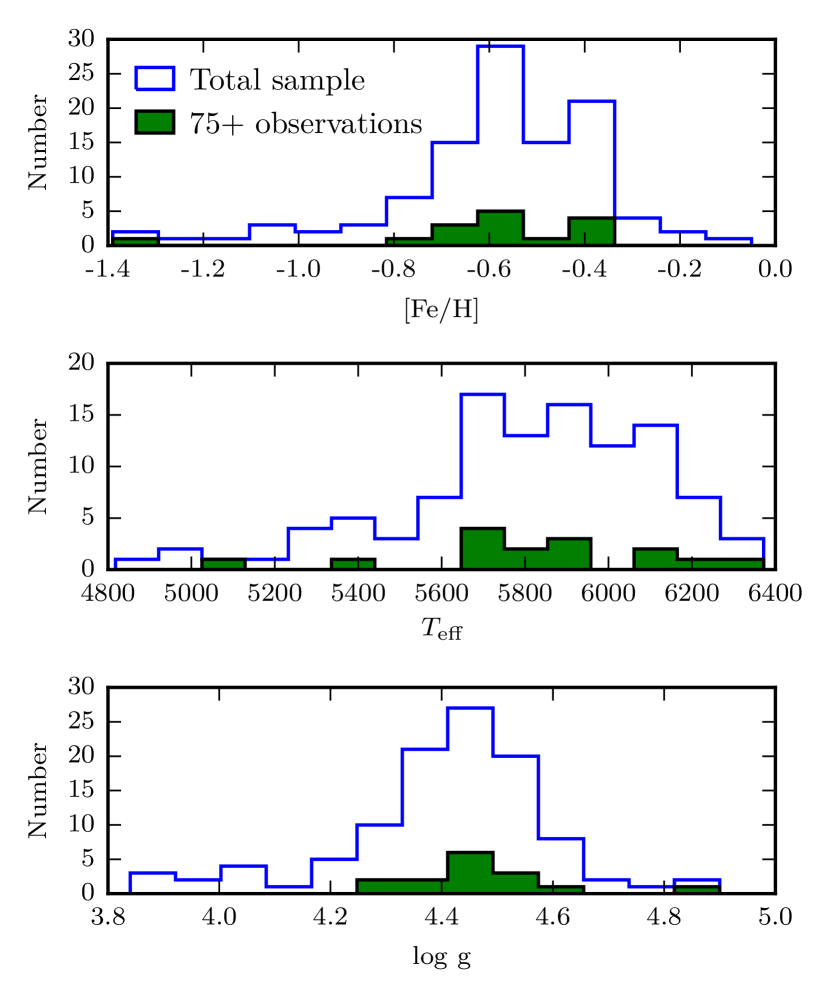
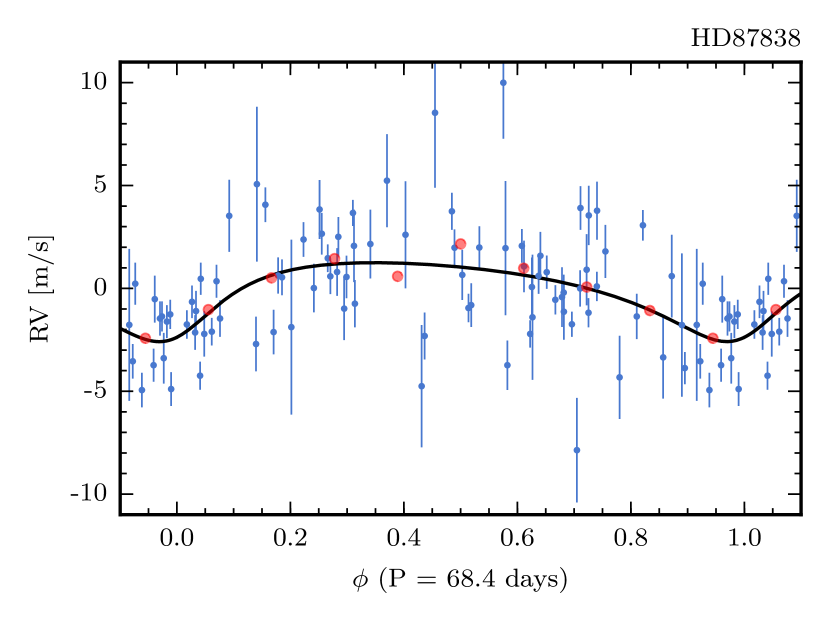
Stellar metallicity -- as a probe of the metallicity of proto-planetary disks -- is an important ingredient for giant planet formation, likely through its effect on the timescales in which rocky/icy planet cores can form. Giant planets have been found to be more frequent around metal-rich stars, in agreement with predictions based on the core-accretion theory. In the metal-poor regime, however, the frequency of planets, especially low-mass planets, and how it depends on metallicity are still largely unknown. As part of a planet search programme focused on metal-poor stars, we study the targets from this survey that were observed with HARPS on more than 75 nights. The main goals are to assess the presence of low-mass planets and provide a first estimate of the frequency of Neptunes and super-Earths around metal-poor stars. We perform a systematic search for planetary companions, both by analysing the periodograms of the radial-velocities and by comparing, in a statistically-meaningful way, models with an increasing number of Keplerians. A first constraint on the frequency of planets in our metal-poor sample is calculated considering the previous detection (in our sample) of a Neptune-sized planet around HD175607 and one candidate planet (with an orbital period of 68.42d and minimum mass $M_p \sin i = 11.14 \pm 2.47 M_{\oplus}$) for HD87838, announced in the present study. This frequency is determined to be close to 13% and is compared with results for solar-metallicity stars.
研究动机与目标
- 评估金属贫乏恒星周围低质量行星(尤其是海王星和超级-Earth)的频率。
- 检验核心吸积模型所预测的:在低金属丰度环境中,行星形成效率是否显著降低。
- 评估恒星活动和观测采样对金属贫乏恒星径向速度探测极限的影响。
- 基于15颗金属贫乏恒星的高精度HARPS数据,提供一个具有统计意义的行星出现频率估计。
- 研究轨道结构和活动引起的信号在长期径向速度监测中是否可能掩盖或模拟行星信号。
提出的方法
- 本研究使用欧洲南方天文台3.6米望远镜上HARPS光谱仪获取的径向速度数据,对15颗金属贫乏恒星进行了超过75个夜晚的观测。
- 采用贝叶斯模型比较方法,逐步增加开普勒信号数量,以评估系外行星伴星的存在,使用贝叶斯因子量化行星信号的证据强度。
- 对轨道周期和半振幅的先验分布进行敏感性检验,以确保检测置信度的稳健性。
- 利用二项分布估算行星出现频率,将检测到的行星数量视为样本大小和观测到的检测数的函数。
- 将结果与现有巡天和理论模型进行比较,特别关注行星形成对金属丰度的依赖性。
- 评估折叠效应结构和活动指标,以减轻恒星活动引起的假阳性信号。
实验结果
研究问题
- RQ1在[Fe/H] < -0.3 dex的金属贫乏恒星周围,海王星和超级-Earth的频率是多少?
- RQ2低质量行星的探测效率在金属贫乏恒星中如何受时间采样和恒星活动的影响?
- RQ3在低金属丰度环境下,行星系统结构与恒星金属丰度之间是否存在可测量的相关性?
- RQ4在金属贫乏恒星中,即使存在恒星噪声,贝叶斯模型比较能否稳健检测到低振幅行星信号?
- RQ5观测到的行星频率与核心吸积理论在低金属丰度环境下的预测相比如何?
主要发现
- 本研究在HD175607周围确认发现了一颗海王星级行星,为金属贫乏系统中存在此类行星提供了直接证据。
- 在HD87838周围发现一颗候选行星,其最小质量为11.14 ± 2.47 M⊕,轨道周期为68.42天,支持低质量行星在金属贫乏恒星周围的普遍存在。
- 基于15颗恒星样本中检测到两颗行星,估算出金属贫乏恒星周围海王星和超级-Earth的行星频率为13.33%⁺⁵.⁸⁰%₋₈.₈⁴%。
- HD87838周围行星信号的贝叶斯证据非常强,与恒定模型相比的似然比约为156:1,表明对开普勒信号存在极强的支持。
- 结果对轨道参数先验分布的变化具有鲁棒性,表明即使样本量较小,检测结果依然可信。
- 本研究强调,即使使用高精度径向速度数据,时间采样和恒星活动仍是探测金属贫乏恒星中低质量行星的主要挑战。
更好的研究,从现在开始
从阅读论文到最终审阅,大幅缩短您的研究时间。
无需绑定信用卡
本解读由 AI 生成,并经人工编辑审核。