
[论文解读] The Herschel Virgo Cluster Survey. XI. Environmental effects on molecular gas and dust in spiral disks
本研究利用IRAM 30米望远镜的CO(1-0)和CO(2-1)线观测数据,结合赫歇尔(Herschel)和VIVA巡天数据,调查了室女座星系团内螺旋星系中分子气体和尘埃的环境效应。研究发现,HI缺乏星系的分子气体和尘埃径向分布轮廓更陡峭,尘气质量比在径向上保持恒定或向外增加,且分子气体与250 μm表面亮度之间存在强烈相关性;当考虑总气体面密度时,该相关性变为线性。
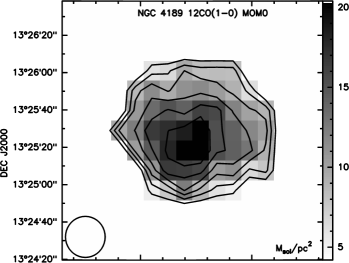
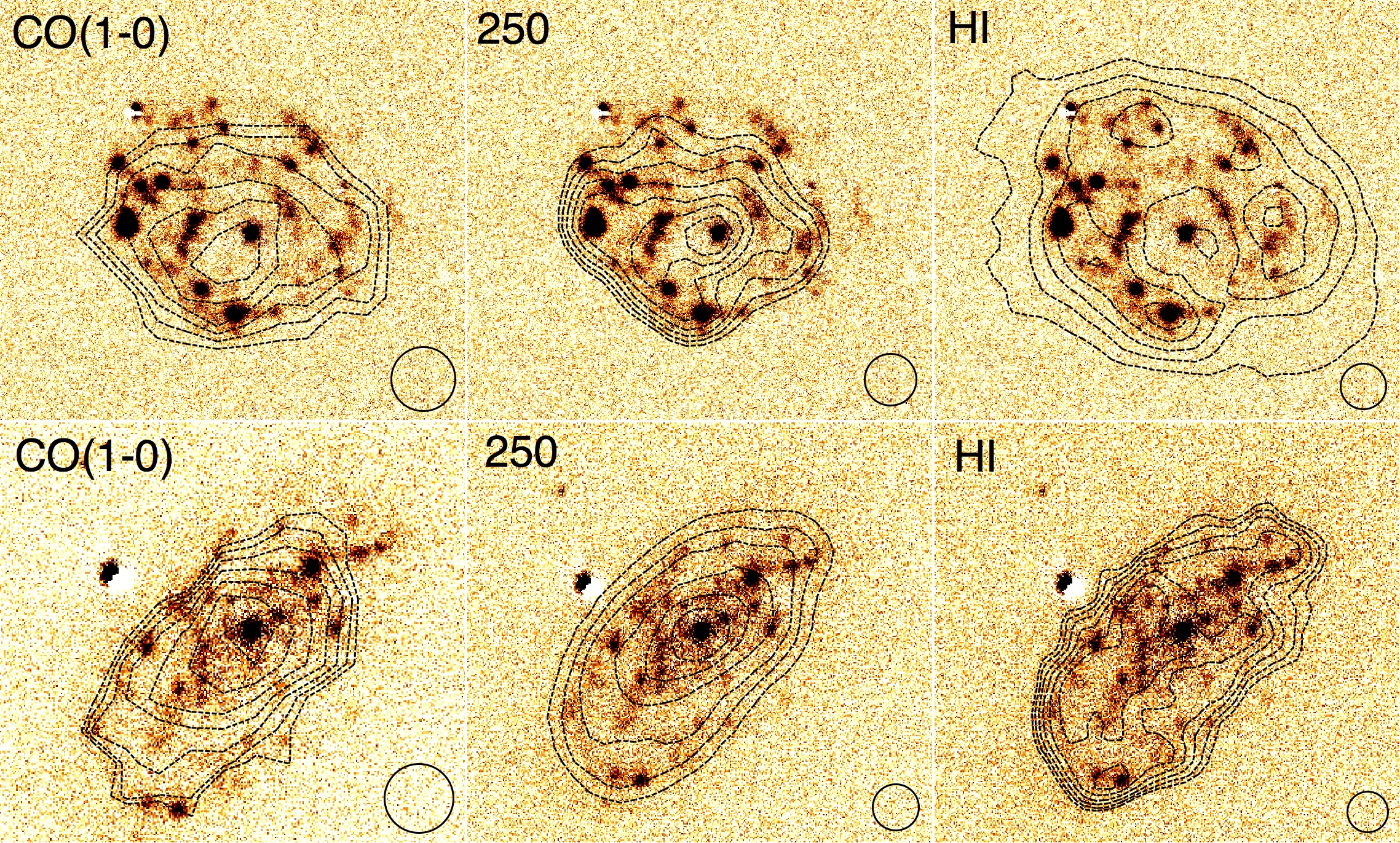
We investigate the dust-to-gas mass ratio and the environmental effects on the various components of the interstellar medium for a spatially resolved sample of Virgo spirals. We have used the IRAM-30m telescope to map over their full extent NGC 4189, NGC 4298, NGC 4388, and NGC 4299 in the 12CO(1-0) and the 12CO(2-1) lines. We observed the same lines in selected regions of NGC 4351, NGC 4294, and NGC 4424. The CO observations are combined with Herschel maps in 5 bands between 100-500 μm from the HeViCS survey, and with HI data from the VIVA survey, to obtain spatially resolved dust and gas distributions. We studied the environmental dependencies by adding to our sample eight galaxies with 12CO(1-0) maps from the literature. We estimate the integrated mass of molecular hydrogen for the galaxies observed in the CO lines. We find molecular-to-total gas mass fractions between 0.04 \leq fmol \leq 0.65, with the lowest values for the dimmest galaxy in the B-band. The integrated dust-to-gas ratio ranges between 0.011 and 0.004. For the 12 mapped galaxies we derive the radial distributions of the atomic gas, molecular gas, and dust. We also study the effect of different CO-to-H2 conversion factors. Both the molecular gas and the dust distributions show steeper radial profiles for HI-deficient galaxies and the average dust-to-gas ratio for these galaxies increases or stays radially constant. On scales of \sim 3 kpc, we find a strong correlation between the molecular gas and the 250 micron surface brightness that is tighter than average for non-deficient galaxies. The correlation becomes linear if we consider the total gas surface mass density. However, the inclusion of atomic hydrogen does not improve the statistical significance of the correlation. The environment can modify the distributions of molecules and dust within a galaxy, although these components are more tightly bound than the atomic gas.
研究动机与目标
- 评估室女座星系团内螺旋星系中分子气体和尘埃分布及质量比的环境影响。
- 确定HI缺乏程度如何影响分子气体和尘埃组分的径向分布轮廓。
- 评估CO-to-H₂转换因子在估算分子气体质量中的作用。
- 研究分子气体与尘埃发射(特别是250 μm波段)之间的相关性,尤其关注总气体面密度的影响。
提出的方法
- 利用IRAM 30米望远镜对四个室女座螺旋星系(NGC 4189、4298、4388、4299)进行了空间分辨的CO(1-0)和CO(2-1)线观测。
- 将CO数据与赫歇尔空间望远镜在100–500 μm波段的HeViCS巡天光度图结合,推导出尘埃面亮度。
- 整合VIVA巡天的HI数据以确定总气体面密度和HI缺乏度(def_HI)。
- 利用文献中的CO图像对另外八个星系进行扩展,以评估环境趋势。
- 应用多种CO-to-H₂转换因子,评估分子气体质量估算中的不确定性。
- 分析原子气体、分子气体和尘埃的径向分布轮廓,并量化分子气体与250 μm发射之间的相关性。
实验结果
研究问题
- RQ1室女座螺旋星系中的HI缺乏程度如何影响分子气体和尘埃的径向分布?
- RQ2在星系团螺旋星系中,分子气体面密度与250 μm尘埃发射之间存在何种关系?
- RQ3引入原子氢是否能显著提高分子气体与尘埃发射相关性的统计显著性?
- RQ4尘气质量比如何随环境变化,特别是在HI缺乏星系中?
- RQ5不同CO-to-H₂转换因子在多大程度上影响推导出的分子气体质量和环境趋势?
主要发现
- 所观测星系中分子气体与总气体质量分数在0.04至0.65之间变化,其中B波段最暗的星系中值最低。
- 整体尘气质量比在0.004至0.011之间变化,HI缺乏程度较低的系统中值较小。
- HI缺乏星系中分子气体和尘埃的径向分布轮廓更陡峭,表明环境约束更强。
- 在HI缺乏星系中,尘气质量比在径向上保持恒定或向外增加,表明尘埃分布受到环境的改造。
- 在约3 kpc尺度上,分子气体面密度与250 μm表面亮度之间存在强烈相关性;当考虑总气体面密度时,该相关性变为线性。
- 引入原子氢并未显著提高分子气体-尘埃相关性的统计显著性,表明紧密关联主要由分子气体与尘埃的空间共位驱动。
更好的研究,从现在开始
从论文设计到论文写作,大幅缩短您的研究时间。
无需绑定信用卡
本解读由 AI 生成,并经人工编辑审核。