
[Paper Review] The massive relic galaxy NGC 1277 is dark matter deficient. From dynamical models of integral-field stellar kinematics out to five effective radii
The study uses Jeans anisotropic modelling on deep integral-field data to show NGC 1277 has negligible dark matter within 5 effective radii, challenging LCDM expectations.
According to the $Λ$CDM cosmology, present-day galaxies with stellar masses $M_\star>10^{11} { m M}_\odot$ should contain a sizable fraction of dark matter within their stellar body. Models indicate that in massive early-type galaxies (ETGs) dark matter should account for $\sim60\%$ of the dynamical mass within five effective radii ($5 R_{ m e}$). Most massive ETGs have been shaped through a two-phase process: the rapid growth of a compact core was followed by the accretion of an extended envelope through mergers. The exceedingly rare galaxies that have avoided the second phase, the so-called relic galaxies, are thought to be the frozen remains of the massive ETG population at $z\gtrsim2$. The best relic galaxy candidate discovered to date is NGC 1277, in the Perseus cluster. We used deep integral field GCMS data to revisit NGC 1277 out to an unprecedented radius of 6 kpc (corresponding to $5 R_{ m e}$). By using Jeans anisotropic modelling we find a negligible dark matter fraction within $5 R_{ m e}$ ($f_{ m DM}(5 R_{ m e})<0.05$; two-sigma confidence level), which is in tension with the expectation. Since the lack of an extended envelope would reduce dynamical friction and prevent the accretion of an envelope, we propose that NGC 1277 lost its dark matter very early or that it was dark matter deficient ab initio. We discuss our discovery in the framework of recent proposals suggesting that some relic galaxies may result from dark matter stripping as they fell in and interacted within galaxy clusters. Alternatively, NGC 1277 might have been born in a high-velocity collision of gas-rich proto-galactic fragments, where dark matter left behind a disc of dissipative baryons. We speculate that the relative velocities of $\approx2000 { m km/s}$ required for the latter process to happen were possible in the progenitors of the present-day rich galaxy clusters.
Motivation & Objective
- Assess the dark matter content of NGC 1277 out to five effective radii (5 Re) using deep integral-field data.
- Compare the DM fraction with Lambda CDM expectations for massive early-type galaxies.
- Investigate whether NGC 1277 is a relic galaxy that avoided the typical two-phase envelope growth.
- Use dynamical modelling to test whether a DM halo is required to describe observed kinematics.
Proposed method
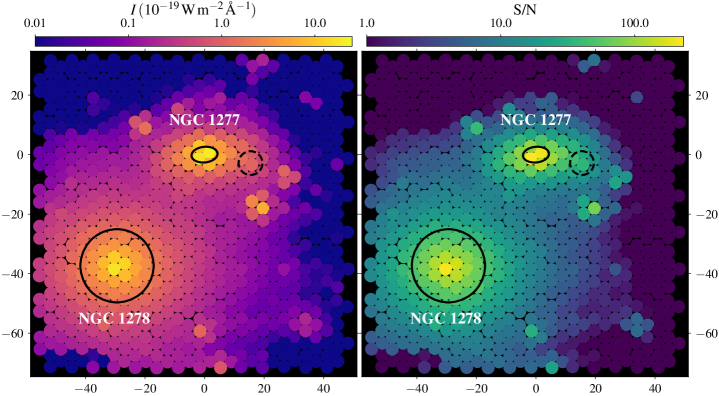
- Obtain deep integral-field spectroscopy of NGC 1277 and NGC 1278 with the George and Cynthia Mitchel Spectrograph (GCMS) to map stellar kinematics out to ~5 Re.
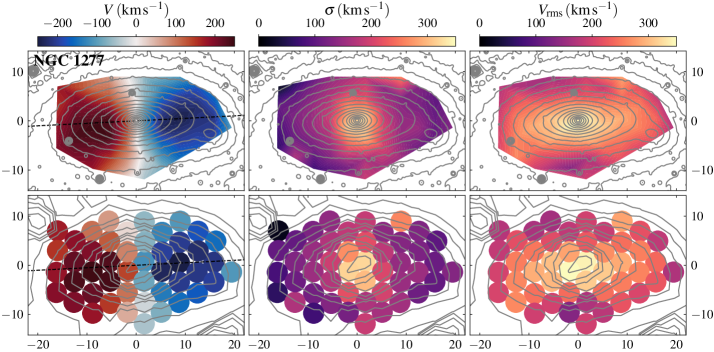
- Extract stellar kinematics using pPXF with E-MILES templates to derive V, sigma, and V_rms maps.
- Construct luminosity and mass models via multi-Gaussian expansion (MGE) from HST images to trace baryonic distribution.
- Apply Jeans anisotropic modelling (JAM) to infer the total mass, including a dark matter halo, and derive the DM fraction within 5 Re.
- Incorporate high-resolution inner data (NIFS, HST) to constrain the central potential and black hole mass, assessing its impact on DM in the outer regions.
- Adopt a flat cosmology (H0=71 km/s/Mpc, Omega_m0=0.265) and distances to Perseus (z=0.017195) for physical scales.
Experimental results
Research questions
- RQ1What is the dark matter fraction within five effective radii of NGC 1277?
- RQ2Does NGC 1277 require a dark matter halo to explain its stellar kinematics out to large radii?
- RQ3How does the DM content of NGC 1277 compare with LCDM expectations for massive early-type galaxies?
- RQ4Can the relic nature of NGC 1277 be reconciled with its DM content (or lack thereof) within the observed extent?
- RQ5What are the implications for black hole mass estimates and central mass modeling on the inferred dark matter distribution?
Key findings
- f_DM(5 Re) < 0.05 at two-sigma, implying negligible dark matter within 5 Re.
- NGC 1277 shows little to no need for an extended DM halo to reproduce stellar kinematics in the outer parts.
- The observed DM deficit is in tension with LCDM expectations of ~15% DM within 1 Re and ~60% within 5 Re for massive ETGs.
- The relic nature (lack of an extended envelope) could explain reduced dynamical friction and envelope growth, consistent with low DM framing in the inner regions.
- A scenario is proposed where DM is stripped early, or DM was intrinsically deficient, possibly linked to cluster-infall processes or high-velocity formation events.
Better researchstarts right now
From reading papers to final review, dramatically reduce your research time.
No credit card · Free plan available
This review was created by AI and reviewed by human editors.