
[论文解读] The NANOGrav 15-year Data Set: Bayesian Limits on Gravitational Waves from Individual Supermassive Black Hole Binaries
该论文在 NANOGrav 15 年数据集中进行个体超大质量黑洞二连星的贝叶斯搜索,发现低频和高频候选信号弱,但在考虑 Hellings-Downs 相关性后并不具有说服力,并给出 GW 应变的上限。
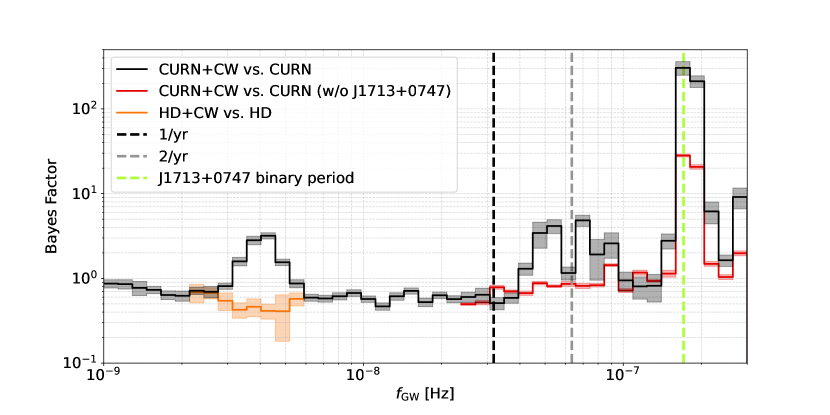
Evidence for a low-frequency stochastic gravitational wave background has recently been reported based on analyses of pulsar timing array data. The most likely source of such a background is a population of supermassive black hole binaries, the loudest of which may be individually detected in these datasets. Here we present the search for individual supermassive black hole binaries in the NANOGrav 15-year dataset. We introduce several new techniques, which enhance the efficiency and modeling accuracy of the analysis. The search uncovered weak evidence for two candidate signals, one with a gravitational-wave frequency of $\sim$4 nHz, and another at $\sim$170 nHz. The significance of the low-frequency candidate was greatly diminished when Hellings-Downs correlations were included in the background model. The high-frequency candidate was discounted due to the lack of a plausible host galaxy, the unlikely astrophysical prior odds of finding such a source, and since most of its support comes from a single pulsar with a commensurate binary period. Finding no compelling evidence for signals from individual binary systems, we place upper limits on the strain amplitude of gravitational waves emitted by such systems.
研究动机与目标
- 在 NANOGrav 15 年脉冲星时延阵列数据集中寻找个体 SMBHB 信号的动机与目标。
- 开发并应用一种改进的贝叶斯搜索框架,以检测来自双星的连续波 GW 信号。
- 在噪声过程和脉冲星距离上进行边际化,从而对 GW 信号做出稳健的约束或检测。
- 在后处理步骤中纳入 Hellings-Downs 相关性,以确保背景建模的一致性。
提出的方法
- 用线性化定时模型加上白噪声、红噪声、公共红噪声分量和潜在的 CW 信号来建模脉冲星时延残差。
- 描述来自圆形 SMBHB 的 CW 信号,包括地球项和脉冲星项,以及八个全局参数加脉冲星特异参数。
- 使用 QuickCW 加速似然计算,并在 MCMC 框架中实现对投影和形状参数的采样。
- 在贝叶斯分析中直接对 GW 频率进行采样,而不是使用固定频率网格;在频率带内进行分析以评估收敛性和鲁棒性。
- 通过似然重加权 CURN 后验样本来考虑 HD 相关性,以比较有 HD 与无 HD 的 CW 模型。
- 对大多数参数采用无信息先验,距离先验基于视差或基于 NE2001 的估计。
实验结果
研究问题
- RQ1在分析的频率范围内,NANOGrav 15 年数据集中是否存在可检测的个体 SMBHB 信号?
- RQ2HD 相关性如何影响个体双星潜在 CW 信号的证据?
- RQ3在该数据集中 GW 应力的上限及相应的排除体积是多少?
- RQ4改进的噪声边际化和采样策略如何影响搜索的鲁棒性和灵敏度?
主要发现
- 在考虑 HD 相关性后没有发现个体 SMBHB 信号的有力证据。
- 在低频候选 near 4 nHz 的证据较弱,包含 HD 相关性后消失。
- near 170 nHz 的高频候选由于缺乏合理宿主对象和先验概率,以及大部分支持来自单个脉冲星,被排除。
- 对应的最敏感 sky-averaged 95% 上限在约 6 nHz 时达到,值为 8×10^-15。
- 计算了排除体积和有效半径,定义了在给定频率下排除的双星所在区域。
- 分析显示边际化共同红噪声和采用全贝叶斯处理(含频率采样)之重要性。

更好的研究,从现在开始
从论文设计到论文写作,大幅缩短您的研究时间。
无需绑定信用卡
本解读由 AI 生成,并经人工编辑审核。