
[Paper Review] The NANOGrav 15-year Data Set: Search for Anisotropy in the Gravitational-Wave Background
This paper reports a search for anisotropy in the nanohertz GWB using the NANOGrav 15-year dataset; no significant anisotropy was found, with a 95% Bayesian upper limit of (C_l>0 / C_l=0) < 20%, and simulations indicate the data are sensitive to a large fraction of the predicted anisotropy.
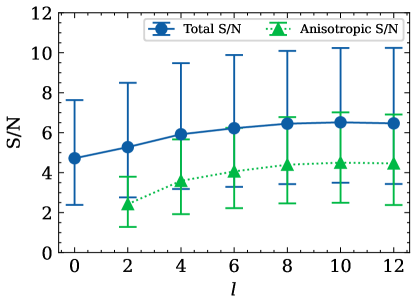
The North American Nanohertz Observatory for Gravitational Waves (NANOGrav) has reported evidence for the presence of an isotropic nanohertz gravitational wave background (GWB) in its 15 yr dataset. However, if the GWB is produced by a population of inspiraling supermassive black hole binary (SMBHB) systems, then the background is predicted to be anisotropic, depending on the distribution of these systems in the local Universe and the statistical properties of the SMBHB population. In this work, we search for anisotropy in the GWB using multiple methods and bases to describe the distribution of the GWB power on the sky. We do not find significant evidence of anisotropy, and place a Bayesian $95\%$ upper limit on the level of broadband anisotropy such that $(C_{l>0} / C_{l=0}) < 20\%$. We also derive conservative estimates on the anisotropy expected from a random distribution of SMBHB systems using astrophysical simulations conditioned on the isotropic GWB inferred in the 15-yr dataset, and show that this dataset has sufficient sensitivity to probe a large fraction of the predicted level of anisotropy. We end by highlighting the opportunities and challenges in searching for anisotropy in pulsar timing array data.
Motivation & Objective
- Motivate and quantify the expectation that a SMBHB-dominated GWB may be anisotropic due to host-galaxy distribution and source properties.
- Describe a comprehensive search for GWB anisotropy using multiple sky-basis representations and Bayesian/frequentist pipelines.
- Provide upper limits on broadband anisotropy and assess the data’s sensitivity to realistic anisotropy levels.
- Contextualize results with astrophysical simulations conditioned on isotropic GWB to interpret implications for SMBHB populations.
Proposed method
- Model GWB anisotropy using radiometer pixel and spherical-harmonic bases to describe the sky power distribution.
- Use a square-root spherical-harmonic basis to enforce positive-definite GWB power and compute angular power spectra C_l.
- Implement Bayesian and frequentist analysis pipelines to assess anisotropy, including comparisons via Hellinger distance between priors and posteriors.
- Represent the overlap reduction function (ORF) with Earth-term and pulsar-term contributions and compute the sky-integrated ORF accordingly.
- Quantify anisotropy with C_l and evaluate broadband anisotropy under a power-law GWB spectrum and a free spectrum approach.
Experimental results
Research questions
- RQ1Is there statistically significant anisotropy in the nanohertz GWB detected by NANOGrav 15-year data?
- RQ2What are the constraints on the angular power spectrum (C_l) beyond the monopole, given the current PTA sensitivity?
- RQ3How does the data constrain broadband anisotropy under a GWB power-law model and under a model-agnostic spectrum?
- RQ4Are the NANOGrav 15-year observations sensitive enough to probe theoretically predicted levels of anisotropy from SMBHB populations?
- RQ5How do different basis choices (radiometer pixels vs spherical harmonics) compare in capturing potential anisotropy?
Key findings
- No significant evidence for GWB anisotropy is detected in the NANOGrav 15-year data.
- A Bayesian 95% upper limit on broadband anisotropy is established with (C_l>0 / C_l=0) < 20%.
- Astrophysical simulations conditioned on the isotropic GWB indicate the dataset has sufficient sensitivity to probe a large fraction of the predicted anisotropy.
- The analysis utilizes multiple bases (radiometer pixel and spherical-harmonic, including square-root formulations) and both Bayesian and frequentist pipelines.
- The work highlights opportunities and challenges in continuing to search for anisotropy with pulsar timing arrays.

Better researchstarts right now
From reading papers to final review, dramatically reduce your research time.
No credit card · Free plan available
This review was created by AI and reviewed by human editors.