
[Paper Review] NANOGrav signal from axion inflation
The paper shows that a pseudoscalar inflaton with a Chern-Simons coupling to a massive U(1) gauge field can produce a parity-violating, blue-tilted gravitational-wave spectrum that may explain the NANOGrav nano-Hz signal, while remaining consistent with cosmological constraints.
Several pulsar timing arrays including NANOGrav, EPTA, PPTA, and CPTA have recently reported the observation of a stochastic background of gravitational wave spectrum in the nano-Hz frequencies. An inflationary interpretation of this observation is challenging from various aspects. We report that such a signal can arise from the Chern-Simons coupling in axion inflation, where a pseudoscalar inflaton couples to a (massive) $U(1)$ gauge field, leading to efficient production of a transverse gauge mode. Such tachyonic particle production during inflation exponentially enhances the primordial perturbations and leads to a unique parity-violating gravitational wave spectrum, that remains flat near the CMB scales but becomes blue-tilted at smaller scales. We identify the parameter space consistent with various cosmological constraints and show that the resultant gravitational wave signals can provide extra contribution on top of the standard astrophysical contribution from inspiraling supermassive black hole binaries towards explaining the observed excess at NANOGrav. The parity-violating nature of the signal can be probed in future interferometers, distinguishing it from most other new physics signals attempting to explain the NANOGrav result.
Motivation & Objective
- Motivate the NANOGrav SGWB as a potential signal from early-universe physics beyond SMBHBs.
- Investigate axion inflation with a Chern-Simons coupling to a (massive) U(1) gauge field as a source of GWs.
- Identify the parameter space consistent with cosmological and observational constraints.
- Demonstrate that the resulting GW signal can augment SMBHB contributions to explain NANOGrav data.
- Highlight the unique parity-violating GW signature as a testable prediction.
Proposed method
- Formulate an axion-like inflaton with a Chern-Simons coupling to a U(1) gauge field in quasi-de Sitter space.
- Derive the gauge-field mode equations; identify tachyonic production of the A+ polarization (Eq. 2.6).
- Compute scalar and tensor perturbations including gauge-field backreaction; fix the CMB-scale spectrum and constrain non-Gaussianity and r (Eqs. 2.3–2.4, 2.8, 2.13–2.15).
- Evolve the system beyond CMB scales using N as the time variable to capture backreaction (Eqs. 3.1–3.2).
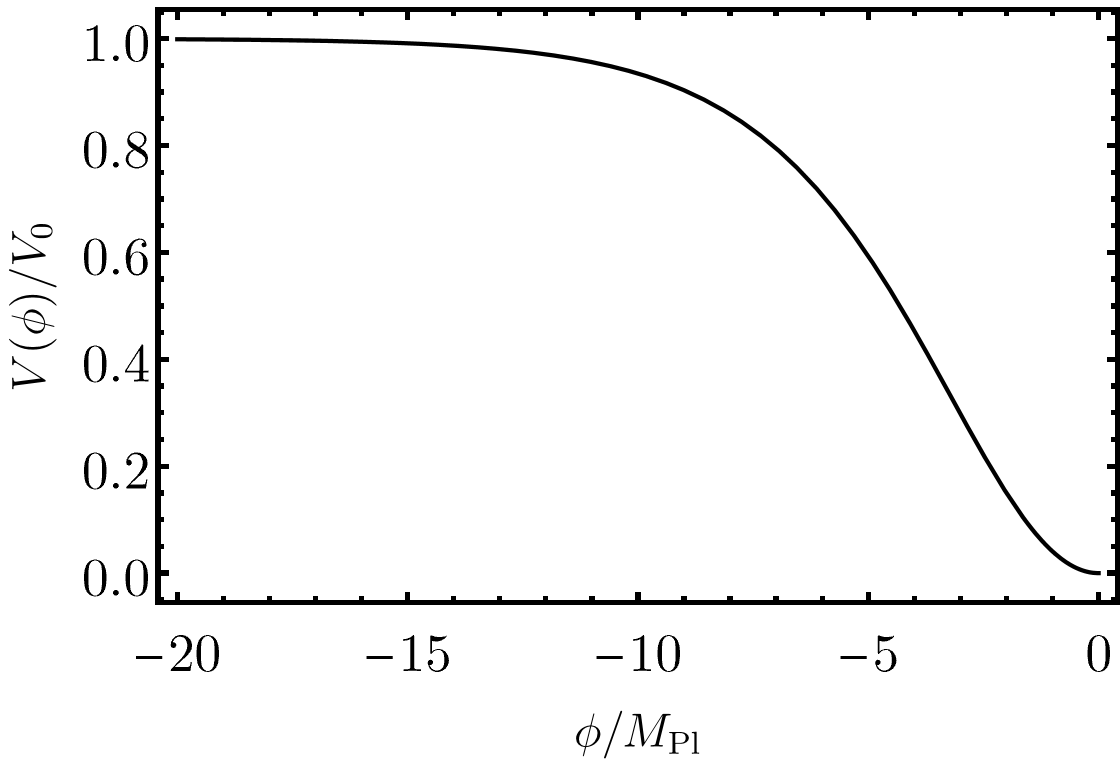
- Adopt the T-model potential V(phi)=V0 tanh^2(phi/√(6αT) Mpl) and compute ξ(N) and mA/H(N) for benchmark points (Eq. 3.3).
- Predict the GW spectrum today, ΩGW(f), including the parity-violating contribution and compare with NANOGrav and LVK constraints (Eq. 4.1, 4.2, 4.3).
![Figure 1 : Shaded regions denote exclusion of the gauge boson’s parameter space from various constraints. Tensor-to-scalar ratio bound is drawn for $H/M_{\rm Pl}=10^{-5}$ . For $f_{\rm NL}^{\rm eq}<-25\pm 47$ [ 156 ] , the left (right) part corresponds to the positive (negative) bound.](https://ar5iv.labs.arxiv.org/html/2307.01192/assets/Allconstraints.png)
Experimental results
Research questions
- RQ1Can axion inflation with a phi F tilde F coupling generate a stochastic gravitational-wave background at NanoHz frequencies compatible with NANOGrav?
- RQ2What regions of parameter space (ξ, mA/H) satisfy CMB constraints, non-Gaussianity, and LVK bounds while producing observable GW signals at PTA scales?
- RQ3Does the model predict a parity-violating GW spectrum that can be tested by future detectors?
- RQ4How does the chosen inflaton potential (T-model) influence the evolution of ξ and backreaction and the resulting GW signal?
- RQ5Is the additional ΔNeff from the GW background within BBN/CMB bounds?
Key findings
- Gauge-field production during axion inflation yields a parity-violating GW spectrum that is flat at CMB scales but blue-tilted at smaller scales.
- Backreaction from gauge fields controls the growth, allowing compatibility with LVK bounds while producing detectable PW signals at nano-Hz frequencies.
- With the T-model potential, three benchmark points generate GW signals that can better fit NANOGrav data than SMBHB backgrounds.
- The predicted ΩGW(f) remains subdominant at LVK scales due to backreaction, and the parity-violating signature provides a distinct experimental handle.
- The additional ΔNeff from the GW background is small (≈0.013) and comfortably within BBN/CMB limits.
- The model implies a testable parity-violating signature for future detectors like ET-CE and LISA-Taiji networks.
Better researchstarts right now
From reading papers to final review, dramatically reduce your research time.
No credit card · Free plan available
This review was created by AI and reviewed by human editors.