
[Paper Review] The quantum geometric origin of capacitance in insulators
This paper establishes that the longitudinal conductivity in band insulators arises from an intrinsic capacitance originating in the quantum geometric tensor, specifically the quantum metric, which governs virtual interband transitions. The key result is that this capacitance, proportional to the ratio of the quantum metric to the band gap, provides a measurable, topologically influenced contribution to the dielectric response in insulators such as hBN-aligned twisted bilayer graphene, diamond, and other obstructed atomic insulators.
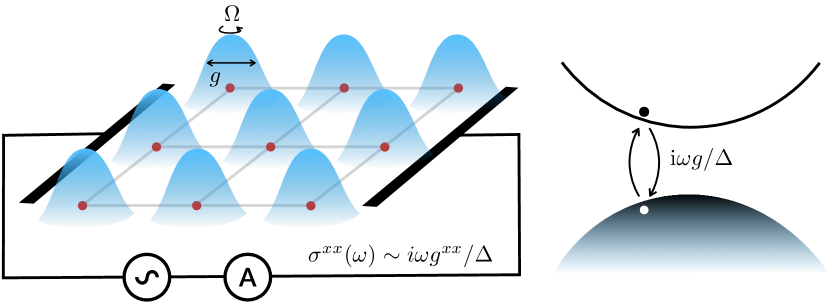
In band insulators, where the Fermi surface is absent, adiabatic transport is allowed only due to the geometry of the Hilbert space. By driving the system at a small but finite frequency $ω$, transport is still expected to depend sensitively on the quantum geometry. Here we show that this expectation is correct and can be made precise by expressing the Kubo formula for conductivity as the variation of the \emph{time-dependent polarization} with respect to the applied field. In particular, a little appreciated effect is that at linear order in frequency, the longitudinal conductivity results from an intrinsic capacitance, determined by the ratio of the quantum metric and the spectral gap. We demonstrate that this intrinsic capacitance has a measurable effect in a wide range of insulators with non-negligible metric, including the electron gas in a quantizing magnetic field, the gapped bands of hBN-aligned twisted bilayer graphene, and obstructed atomic insulators such as diamond whose large refractive index has a topological origin. We also discuss the influence of quantum geometry on the dielectric constant.
Motivation & Objective
- To identify the origin of longitudinal conductivity in band insulators beyond conventional transport mechanisms.
- To investigate how quantum geometry—specifically the quantum metric—contributes to low-frequency response in insulators.
- To establish a direct link between the quantum geometric tensor and the intrinsic capacitance of clean insulators.
- To demonstrate that this capacitance is a measurable, non-perturbative effect in realistic materials with non-zero quantum metric.
- To clarify the role of quantum geometry in determining the dielectric constant, particularly the optical dielectric constant $\epsilon_\infty$.
Proposed method
- Derive the linear response conductivity using the Kubo formula, expressing it as a functional derivative of the time-dependent polarization with respect to the applied electric field.
- Apply a quasistatic expansion in frequency to show that the leading longitudinal contribution to conductivity is governed by an intrinsic capacitance $c = \varepsilon_0 \chi$.
- Relate the static susceptibility $\chi$ to the quantum metric via $\chi \propto \sum_{m \neq n} \frac{g^{xx}_{mn}}{\omega_{mn}}$, where $g^{xx}_{mn}$ is the in-plane component of the quantum metric.
- Use the linear response expression $\epsilon = 1 + \frac{2e^2}{\hbar \varepsilon_0} \sum_{m \neq n} \int_{\text{BZ}} f_n(1 - f_m) \frac{g^{xx}_{mn}}{\omega_{mn}}$ to connect the dielectric constant to quantum geometry.
- Compute theoretical values of $\epsilon_\infty$ and $\left<\bar{g}\right>_z$ for various materials, including hBN, graphene, diamond, and oxides, using ab initio and tight-binding models.
- Compare the behavior of $\left<\bar{g}\right>_z \propto a_z \Delta \chi$ with the conventional $\epsilon_\infty \Delta$ to highlight the superior correlation with quantum geometry.
Experimental results
Research questions
- RQ1How does the quantum geometric tensor influence the longitudinal conductivity in insulators at low frequencies?
- RQ2Can the intrinsic capacitance in insulators be derived from the quantum metric and band gap, and is it measurable?
- RQ3Why does the conventional analysis of $\epsilon_\infty \Delta$ show strong variation across materials, while $\left<\bar{g}\right>_z$ exhibits a more universal trend?
- RQ4To what extent does the quantum metric dominate the dielectric response in materials with non-trivial band topology?
- RQ5How does the quantum geometric origin of capacitance differ from classical or effective-medium contributions?
Key findings
- The longitudinal conductivity in insulators at low frequencies is dominated by an intrinsic capacitance $c$, which arises from the quantum metric and is proportional to $g^{xx}_{mn}/\Delta$.
- This intrinsic capacitance is a purely quantum effect driven by coherent virtual interband transitions, absent in systems with zero quantum metric.
- In materials like hBN-aligned twisted bilayer graphene and diamond, the quantum metric leads to a measurable capacitance contribution that scales with the inverse band gap.
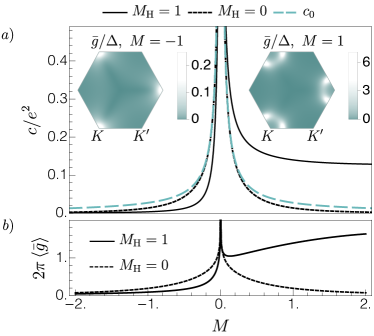
- The dielectric constant $\epsilon_\infty$ is not universally proportional to $\Delta^{-1}$, but its variation is better explained by the quantum metric contribution $\left<\bar{g}\right>_z$.
- Supplementary Table 1 shows that theoretical $\epsilon_\infty$ values computed from the quantum geometric tensor match experimental data for materials like SiO₂, ZnO, and MgO.
- The ratio $\left<\bar{g}\right>_z$ varies by less than a factor of 2.5 across materials with widely differing gaps, indicating a more robust geometric control than the conventional $\epsilon_\infty \Delta$ scaling.
Better researchstarts right now
From reading papers to final review, dramatically reduce your research time.
No credit card · Free plan available
This review was created by AI and reviewed by human editors.