
[Paper Review] The split majoron model confronts the NANOGrav signal and cosmological tensions
The paper reevaluates the split majoron model as a source of the NANOGrav gravitational-wave background, showing that a low-scale first-order phase transition plus SMBHBs can fit the data while addressing extra-radiation and deuterium constraints and potentially easing cosmological tensions.
In the light of the evidence of a gravitational wave background from the NANOGrav 15yr data set, we reconsider the split majoron model as a new physics extension of the standard model able to generate a needed contribution to solve the current tension between the data and the standard interpretation in terms of inspiraling supermassive black hole massive binaries. In the split majoron model the seesaw right-handed neutrinos acquire Majorana masses from spontaneous symmetry breaking of global $U(1)_{B-L}$ in a strong first order phase transition of a complex scalar field occurring above the electroweak scale. The final vacuum expectation value couples to a second complex scalar field undergoing a low scale phase transition occurring after neutrino decoupling. Such a coupling enhances the strength of this second low scale first order phase transition and can generate a sizeable primordial gravitational wave background contributing to the NANOGrav 15yr signal. Some amount of extra-radiation is generated after neutron-to-proton ration freeze-out but prior to nucleosynthesis. This can be either made compatible with current upper bound from primordial deuterium measurements or even be used to solve a potential deuterium problem. Moreover, the free streaming length of light neutrinos can be suppressed by their interactions with the resulting majoron background and this mildly ameliorates existing cosmological tensions. Thus cosmological observations nicely provide independent motivations for the model.
Motivation & Objective
- Reassess the split majoron model as a source for the NANOGrav GW signal in light of the 15-year data set.
- Analyze cosmological constraints from extra radiation (Delta Neff) and BBN/CMB observations.
- Demonstrate how high-scale and low-scale phase transitions influence the GW spectrum.
- Explore whether neutrino–majoron interactions can alleviate cosmological tensions such as the Hubble tension.
Proposed method
- Construct a two-scalar (phi, phi') and right-handed neutrino framework with spontaneous U(1) symmetry breaking.
- Compute the evolution of relativistic degrees of freedom g_rho and g_s, and the dark-sector temperature ratio r_D and Delta Neff.
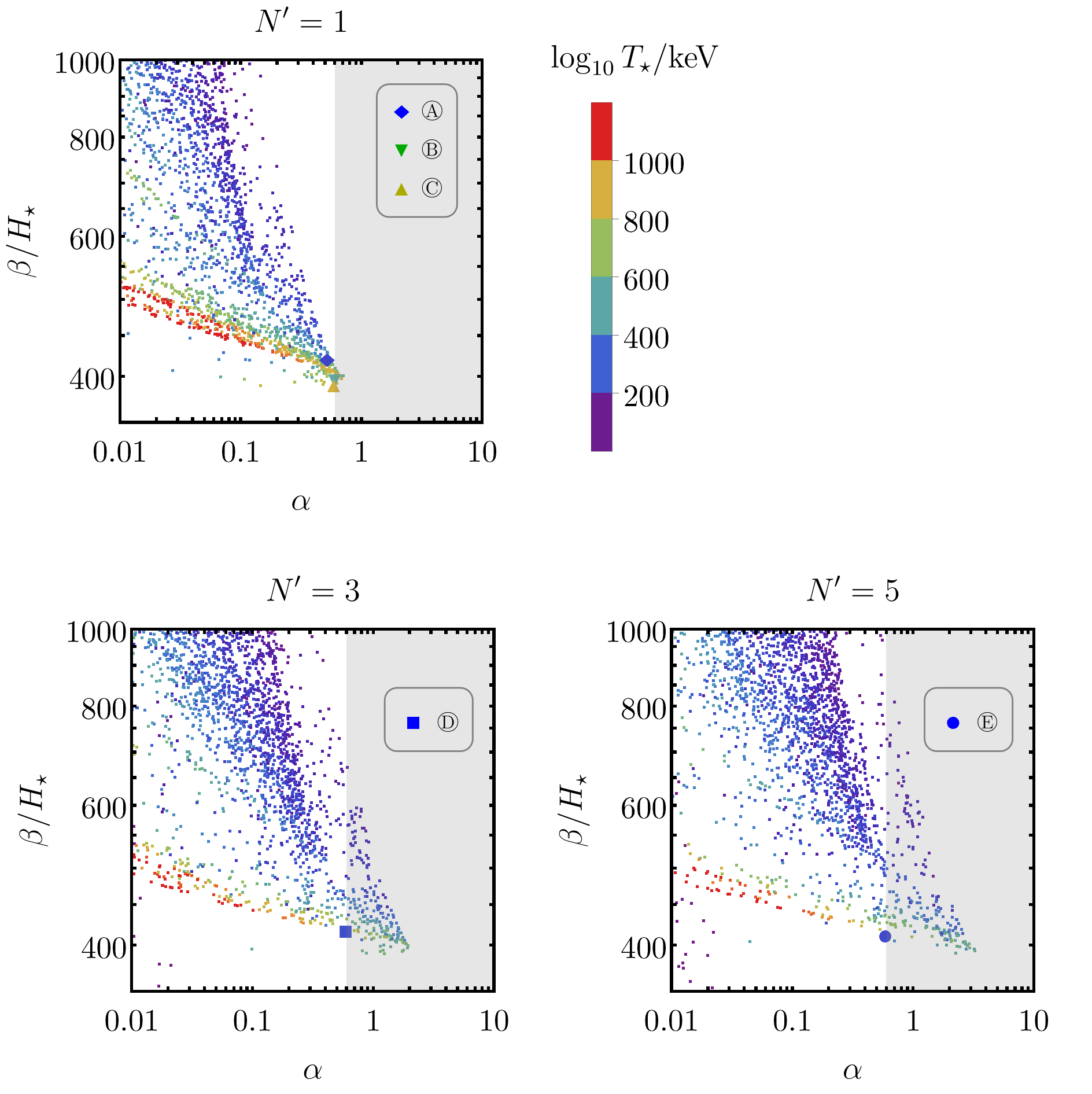
- Model the low-scale phase transition with a finite-temperature effective potential and derive alpha and beta/H_* parameters for GW production.
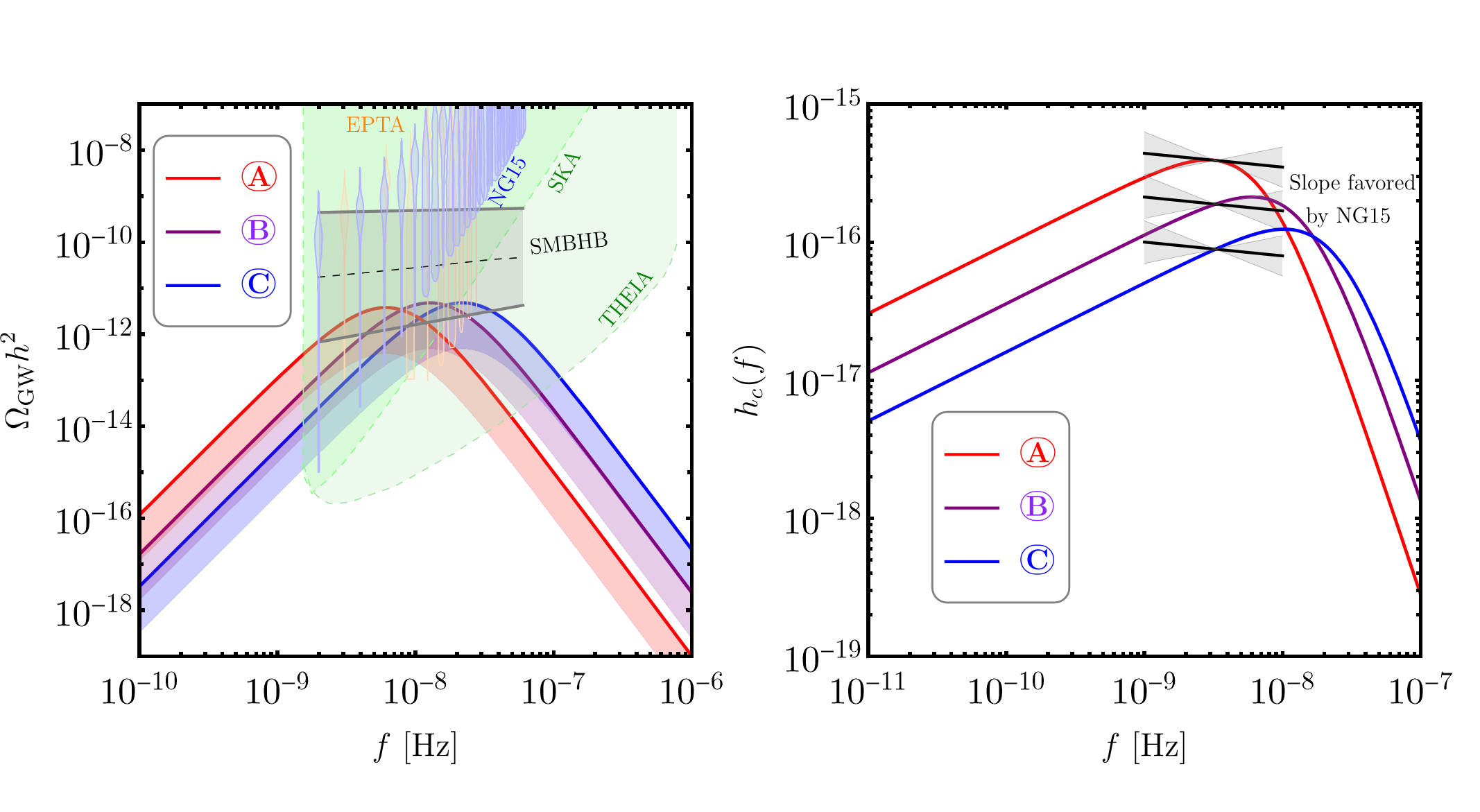
- Use the sound-wave-dominated GW spectrum with Jo(u)guet detonation and suppression factors to predict the GW signal and compare with NANOGrav 15-year results.
- Incorporate cosmological constraints from BBN deuterium measurements and neutrino decoupling to delineate viable parameter space.
Experimental results
Research questions
- RQ1Can the split majoron model produce a GW background with sufficient amplitude to explain the NANOGrav 15-year signal without violating BBN/CMB constraints?
- RQ2What are the allowed ranges of the phase-transition parameters (alpha, beta/H_*, v_w) and dark-sector contributions that fit the NANOGrav data?
- RQ3How does the presence of extra dark radiation (Delta Neff) and its temperature evolution affect compatibility with primordial element abundances and CMB measurements?
- RQ4Can neutrino–majoron interactions modify neutrino free-streaming to alleviate cosmological tensions such as the Hubble tension?
- RQ5Does increasing dark-sector degrees of freedom help reconcile deuterium constraints with the GW signal?
Key findings
- A low-scale first-order phase transition, together with the SMBHB baseline, can improve the fit to the NANOGrav 15-year signal.
- The model predicts extra radiation Delta Neff of order 0.3–0.5 depending on dark-sector content, which can be compatible with, or even mildly advantageous for, BBN and CMB constraints.
- Increasing dark-sector degrees of freedom can reduce the effective Delta Neff, potentially reconciling deuterium constraints with the model.
- Neutrino–majoron interactions can suppress neutrino free streaming, mildly ameliorating existing cosmological tensions such as the Hubble tension.
- The GW spectrum is computed using a finite-temperature effective potential for the low-scale phase transition, with a quantified dependence on alpha_nuD and beta/H_star, and includes a suppression factor for finite sound-wave lifetimes.
Better researchstarts right now
From reading papers to final review, dramatically reduce your research time.
No credit card · Free plan available
This review was created by AI and reviewed by human editors.