
[Paper Review] Towards Building Multilingual Language Model for Medicine
The paper introduces MMedC, a 25.5B-token multilingual medical corpus, an evaluation benchmark MMedBench, and open-source multilingual medical LLMs (MMedLM/MMedLM 2) that achieve strong performance, rivaling GPT-4 on MMedBench.
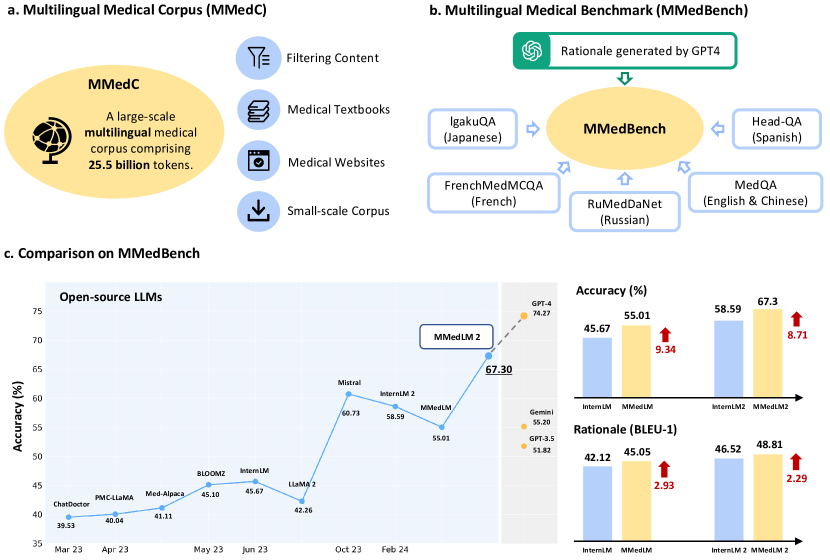
The development of open-source, multilingual medical language models can benefit a wide, linguistically diverse audience from different regions. To promote this domain, we present contributions from the following: First, we construct a multilingual medical corpus, containing approximately 25.5B tokens encompassing 6 main languages, termed as MMedC, enabling auto-regressive domain adaptation for general LLMs; Second, to monitor the development of multilingual medical LLMs, we propose a multilingual medical multi-choice question-answering benchmark with rationale, termed as MMedBench; Third, we have assessed a number of open-source large language models (LLMs) on our benchmark, along with those further auto-regressive trained on MMedC. Our final model, MMed-Llama 3, with only 8B parameters, achieves superior performance compared to all other open-source models on both MMedBench and English benchmarks, even rivaling GPT-4. In conclusion, in this work, we present a large-scale corpus, a benchmark and a series of models to support the development of multilingual medical LLMs.
Motivation & Objective
- Develop an open-source, multilingual medical language model to serve linguistically diverse audiences.
- Construct a large-scale multilingual medical corpus (MMedC) for autoregressive training across six languages.
- Create a multilingual medical QA benchmark (MMedBench) with rationale to evaluate multilingual medical reasoning.
- Evaluate open-source LLMs and models trained on MMedC to assess multilingual medical QA and rationale generation.
Proposed method
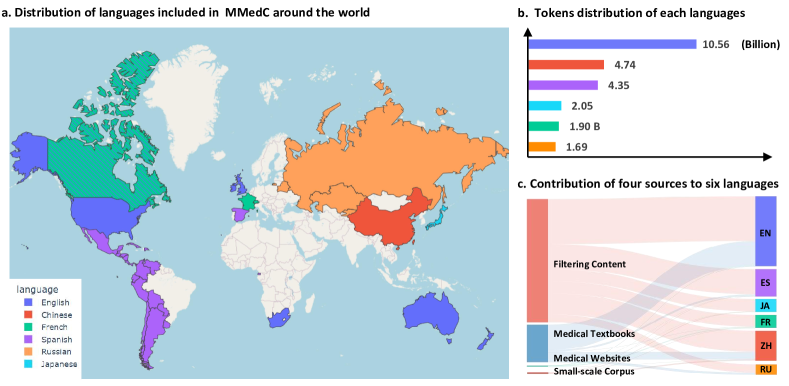
- Assemble MMedC with over 25.5B tokens across English, Chinese, Japanese, French, Russian, and Spanish from four data sources.
- Curate MMedBench by aggregating multilingual medical multiple-choice QA datasets and augmenting with GPT-4 generated rationales.
- Fine-tune and/or evaluate a range of LLMs, including models trained on MMedC (MMedLM/MMedLM 2), under zero-shot, PEFT, and full fine-tuning settings.
- Assess rationale quality with automatic metrics (BLEU-1, ROUGE-1, BERT-score) and human ratings to identify reliable evaluation methods.
Experimental results
Research questions
- RQ1Can a multilingual, medically focused corpus improve open-source LLMs for non-English medical queries?
- RQ2How does training on MMedC affect multilingual medical QA and rationale generation across languages?
- RQ3Which evaluation metrics best reflect human judgments for medical rationale in multilingual LLMs?
- RQ4What is the comparative performance of open-source multilingual medical LLMs versus closed-source models on MMedBench?
Key findings
- MMedC-trained models (MMedLM, MMedLM 2) outperform baselines and rival GPT-4 on MMedBench in multiple settings.
- Across six languages, MMedLM 2 achieves 58.13 (English) to 80.01 (Spanish) accuracy in multilingual full fine-tuning, with an average of 67.30 on the multilingual track.
- Rationale generation benefits from training on MMedC, with improvements in BLEU-1 and ROUGE-1 scores and human ratings favoring MMedLM 2.
- ROUGE-1 and BLEU-1 are identified as reliable automatic metrics for evaluating rationale in MMedBench, with GPT-4 ratings most correlated with human judgments but not easily scalable.
Read this paper
Open the full text in the Nubint reader and ask about any passage as you read.
Read this paper on NubintThis review was generated by AI from the original paper. Please check the paper before citing it.