
[Paper Review] Towards Reliable Evaluation and Fast Training of Robust Semantic Segmentation Models
This paper proposes a novel ensemble attack (SEA) for robust semantic segmentation using complementary loss functions and optimization strategies, significantly improving adversarial robustness evaluation. It further enables fast, efficient training of state-of-the-art robust segmentation models by fine-tuning with adversarially pre-trained ImageNet backbones, achieving SOTA performance on Pascal-VOC and the first robust models on Ade20K with up to 6× lower training cost.
Adversarial robustness has been studied extensively in image classification, especially for the $\ell_\infty$-threat model, but significantly less so for related tasks such as object detection and semantic segmentation, where attacks turn out to be a much harder optimization problem than for image classification. We propose several problem-specific novel attacks minimizing different metrics in accuracy and mIoU. The ensemble of our attacks, SEA, shows that existing attacks severely overestimate the robustness of semantic segmentation models. Surprisingly, existing attempts of adversarial training for semantic segmentation models turn out to be weak or even completely non-robust. We investigate why previous adaptations of adversarial training to semantic segmentation failed and show how recently proposed robust ImageNet backbones can be used to obtain adversarially robust semantic segmentation models with up to six times less training time for PASCAL-VOC and the more challenging ADE20k. The associated code and robust models are available at https://github.com/nmndeep/robust-segmentation
Motivation & Objective
- To address the lack of reliable and strong evaluation protocols for adversarial robustness in semantic segmentation.
- To overcome the high computational cost of adversarial training for segmentation models by leveraging pre-trained robust ImageNet classifiers.
- To develop a more effective and comprehensive attack framework that better exposes model vulnerabilities than existing methods.
- To establish a new training paradigm for robust semantic segmentation that achieves high robustness with significantly reduced training time.
- To demonstrate state-of-the-art robustness on both Pascal-VOC and Ade20K datasets using a computationally efficient fine-tuning approach.
Proposed method
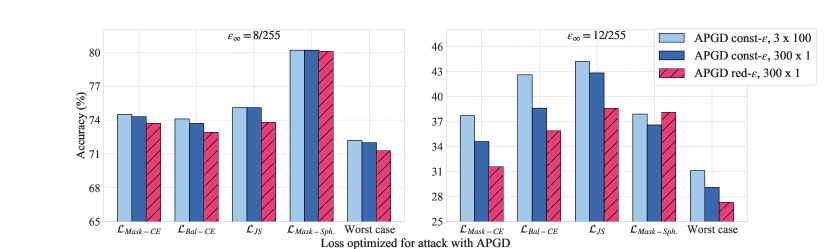
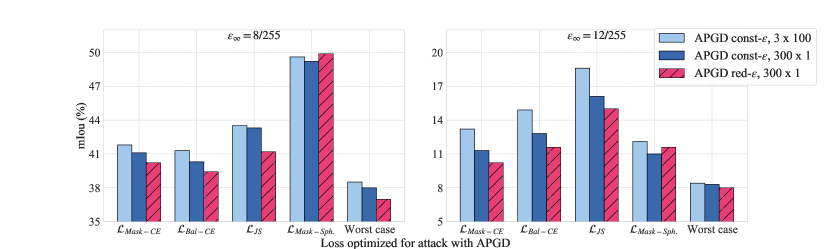
- Proposes novel loss functions tailored for pixel-wise segmentation attacks, specifically designed to flip predictions across all pixels rather than just the image-level prediction.
- Adapts optimization algorithms (e.g., PGD) to better handle the high-dimensional, per-pixel nature of segmentation tasks, improving attack success rates.
- Introduces the Segmentation Ensemble Attack (SEA), combining multiple attacks with complementary loss functions to form a worst-case evaluation protocol, similar to AutoAttack for classification.
- Leverages recently trained robust ImageNet classifiers as pre-trained backbones for segmentation models, enabling efficient fine-tuning instead of full adversarial training from scratch.
- Employs adversarial training with increased epochs and attack steps on the segmentation head while initializing with a robust ImageNet backbone to improve convergence and robustness.
- Uses a multi-objective evaluation strategy, measuring robustness via pixel accuracy and mIoU under the SEA ensemble attack to ensure comprehensive assessment.
Experimental results
Research questions
- RQ1Can existing adversarial attack methods for image classification be directly applied to semantic segmentation, or do they fail due to task-specific challenges?
- RQ2How can the objective function and optimization process be adapted to effectively attack segmentation models by flipping all pixel predictions?
- RQ3Can an ensemble of attacks with complementary loss functions provide a more reliable and stronger evaluation of model robustness than individual attacks?
- RQ4Is it possible to achieve state-of-the-art adversarial robustness in semantic segmentation with significantly reduced computational cost?
- RQ5Can adversarially pre-trained ImageNet backbones be effectively fine-tuned to train robust segmentation models efficiently?
Key findings
- The proposed SEA ensemble attack outperforms existing methods, revealing that prior evaluations overestimated model robustness by up to 10% in average pixel accuracy and 6% in mIoU.
- Models trained with adversarial training from clean initialization require up to 300 epochs to achieve good robustness, while those with robust ImageNet backbones achieve comparable or better robustness in only 32–128 epochs.
- Using a robust backbone for fine-tuning reduces the computational cost of training robust segmentation models by up to 6× compared to training from scratch.
- The method achieves state-of-the-art robustness on Pascal-VOC and establishes the first robust models on the more challenging Ade20K dataset.
- Robust models trained with the proposed method maintain strong clean performance, avoiding the typical accuracy degradation seen in standard adversarial training.
- Even with only 32 epochs of training using a robust backbone, the model outperforms a 128-epoch model trained from clean initialization in terms of robustness at ε = 4/255 on Ade20K.
Read this paper
Open the full text in the Nubint reader and ask about any passage as you read.
Read this paper on NubintThis review was generated by AI from the original paper. Please check the paper before citing it.