
[Paper Review] Tracking Ensemble Performance on Touch-Screens with Gesture Classification and Transition Matrices
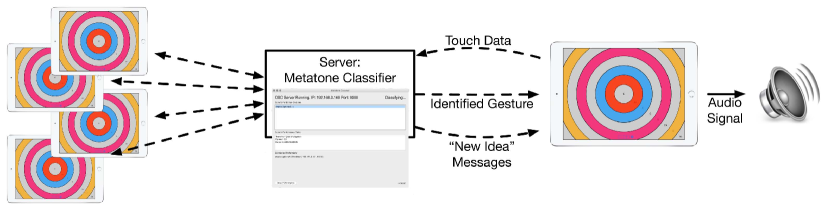
This paper presents a real-time system that tracks ensemble touch-screen performances using gesture classification and transition matrices to detect musical innovation. By applying a Random Forest classifier to touch gestures and computing flux in gesture transition matrices, the system dynamically modifies iPad apps to reward, disrupt, or support improvisational exploration—achieving 97% classification accuracy and scaling to ~25 performers in real time.
We present and evaluate a novel interface for tracking ensemble performances on touch-screens. The system uses a Random Forest classifier to extract touch-screen gestures and transition matrix statistics. It analyses the resulting gesture-state sequences across an ensemble of performers. A series of specially designed iPad apps respond to this real-time analysis of free-form gestural performances with calculated modifications to their musical interfaces. We describe our system and evaluate it through cross-validation and profiling as well as concert experience.
Motivation & Objective
- To develop a server-based agent that tracks ensemble improvisation in real time using touch-screen gestures.
- To detect moments of musical innovation (new ideas) in ensemble performances through gesture transition matrix analysis.
- To design responsive iPad apps that adapt their interfaces based on ensemble behavior to support creative exploration.
- To evaluate the system's accuracy, scalability, and practicality in live concert settings.
Proposed method
- A Random Forest classifier is trained on labeled touch-gesture data to map raw touch inputs to discrete gestural states.
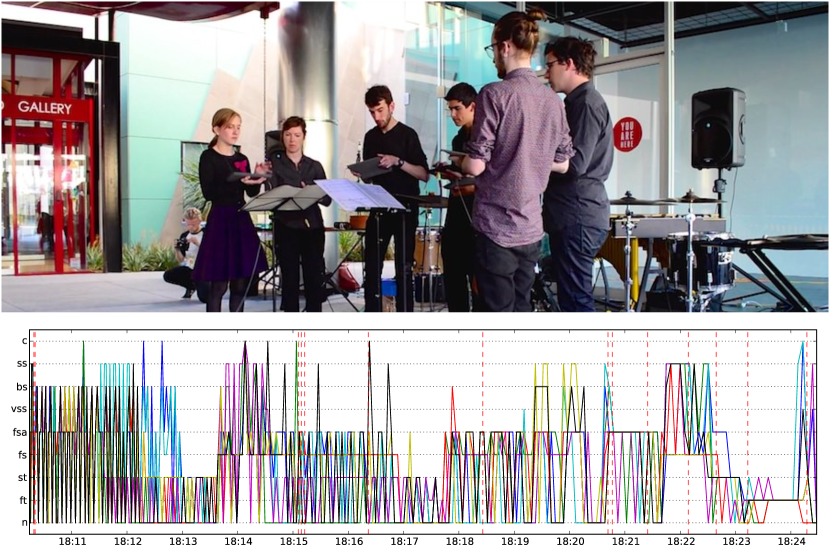
- Gesture-state sequences from multiple performers are used to compute a transition matrix representing state transitions across the ensemble.
- A novel 'flux' measure is computed on the transition matrix to detect significant changes in ensemble behavior, signaling new musical ideas.
- The system triggers real-time interface updates in three custom iPad apps—Snow Music, PhaseRings, and BirdsNest—based on the detected flux.
- Performance evaluation uses cross-validation on gesture classification and time profiling to assess computational scalability.
- The system is deployed in live concerts and installations to assess real-world usability and performer feedback.
Experimental results
Research questions
- RQ1How accurately can a machine learning model classify free-form touch gestures in ensemble performance?
- RQ2Can transition matrix analysis detect meaningful shifts in ensemble behavior indicative of new musical ideas?
- RQ3How does the system scale in terms of computational cost with increasing ensemble size?
- RQ4To what extent do performers perceive the adaptive interface responses as supportive and creative in live performance?
Key findings
- The gesture classifier achieved 97% accuracy when trained on high-quality, automatically captured data, outperforming manual video-based analysis.
- The system's classification and analysis function completed in an average of 0.158 seconds per second with four performers, with a linear relationship between performance time and number of performers.
- Time profiling suggests the system can support up to approximately 25 performers in real time (one analysis per second) on the test hardware.
- Live concert experiences confirmed the system's practicality, with performers developing distinct gestural styles and reporting satisfaction with the adaptive interface responses.
- The flux measure effectively detected moments of musical change, enabling timely and meaningful interventions in the apps.
- The study found that controlled, high-quality training data significantly improved classifier accuracy over manually collected data, justifying automated data collection.
Read this paper
Open the full text in the Nubint reader and ask about any passage as you read.
Read this paper on NubintThis review was generated by AI from the original paper. Please check the paper before citing it.