
[Paper Review] Transfer Learning in ECG Diagnosis: Is It Effective?
This study conducts the first comprehensive empirical evaluation of transfer learning in multi-label ECG diagnosis across diverse datasets and deep learning architectures. It finds that while fine-tuning consistently outperforms training from scratch on small datasets, training from scratch can match fine-tuning performance on large datasets, with CNNs showing significantly better compatibility with transfer learning than RNNs.
The adoption of deep learning in ECG diagnosis is often hindered by the scarcity of large, well-labeled datasets in real-world scenarios, leading to the use of transfer learning to leverage features learned from larger datasets. Yet the prevailing assumption that transfer learning consistently outperforms training from scratch has never been systematically validated. In this study, we conduct the first extensive empirical study on the effectiveness of transfer learning in multi-label ECG classification, by investigating comparing the fine-tuning performance with that of training from scratch, covering a variety of ECG datasets and deep neural networks. We confirm that fine-tuning is the preferable choice for small downstream datasets; however, when the dataset is sufficiently large, training from scratch can achieve comparable performance, albeit requiring a longer training time to catch up. Furthermore, we find that transfer learning exhibits better compatibility with convolutional neural networks than with recurrent neural networks, which are the two most prevalent architectures for time-series ECG applications. Our results underscore the importance of transfer learning in ECG diagnosis, yet depending on the amount of available data, researchers may opt not to use it, considering the non-negligible cost associated with pre-training.
Motivation & Objective
- To systematically evaluate whether transfer learning consistently improves performance in ECG diagnosis compared to training from scratch.
- To investigate the impact of downstream dataset size on the effectiveness of transfer learning in multi-label ECG classification.
- To compare the compatibility of transfer learning with convolutional neural networks (CNNs) versus recurrent neural networks (RNNs) in ECG applications.
- To assess whether transfer learning accelerates model convergence in ECG diagnosis tasks.
- To challenge the prevailing assumption that transfer learning always enhances performance in real-world ECG diagnosis scenarios.
Proposed method
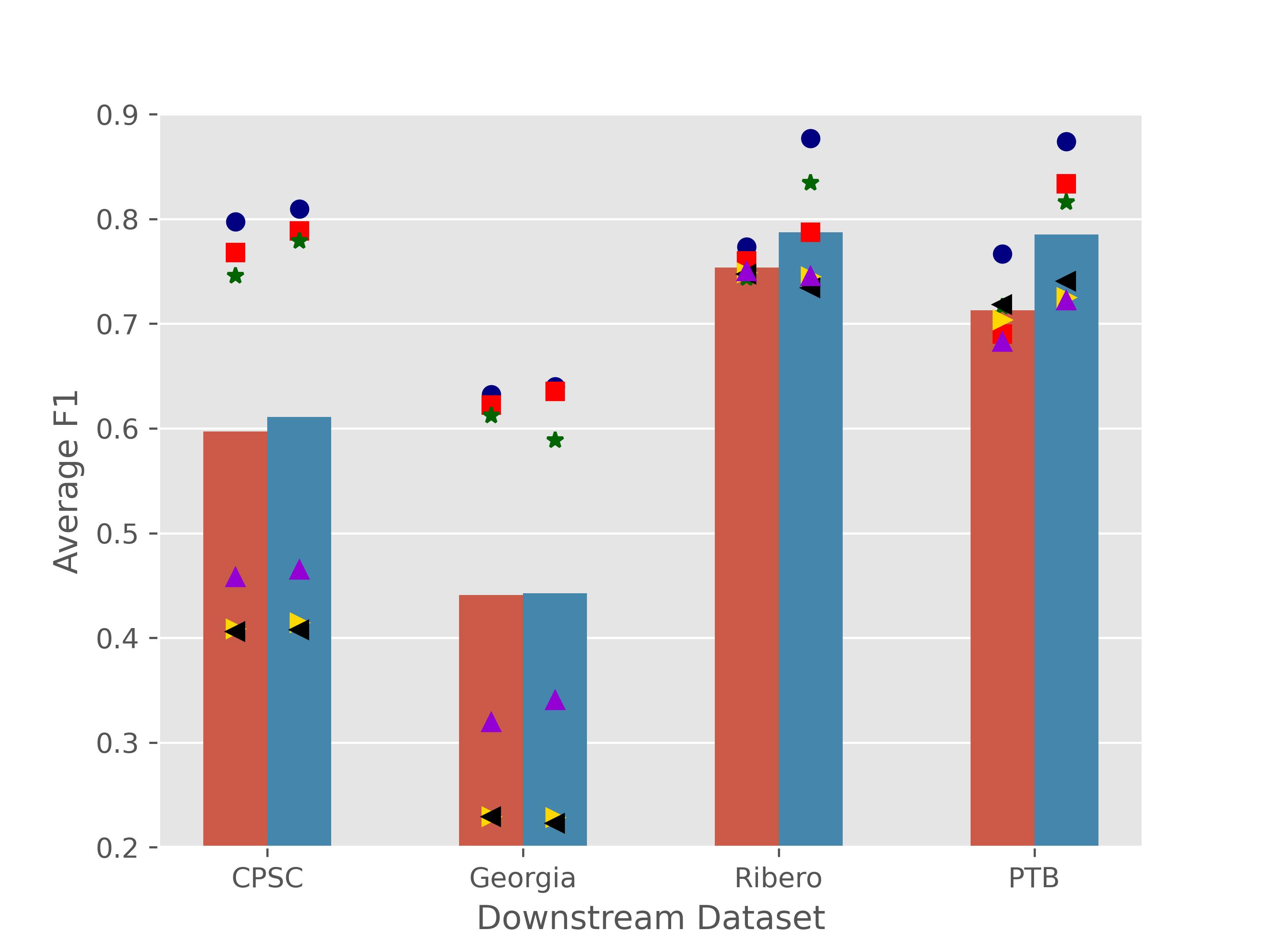
- Conducted extensive experiments using six deep neural network architectures—three CNNs (ResNet1d18, ResNet1d34, ResNet1d101) and three RNNs (LSTM, Bi-LSTM, GRU)—across five public ECG datasets.
- Pre-trained models on three upstream datasets (PTB-XL, CPSC2018, Georgia) and fine-tuned them on five downstream datasets, including PTB, Ribeiro, and others.
- Compared fine-tuning performance against training from random initialization (scratch) across multiple metrics, including F1-score and convergence speed over 100 training epochs.
- Used 2D representations (e.g., spectrograms, scalograms) for 2D CNNs and 1D signal processing for 1D CNNs and RNNs to ensure consistent input processing.
- Evaluated model performance using multi-label classification metrics, focusing on F1-score across all classes and across individual datasets.
- Analyzed convergence patterns over 100 epochs to assess training speed and stability, particularly comparing fine-tuned and randomly initialized models.
Experimental results
Research questions
- RQ1Does transfer learning consistently outperform training from scratch in multi-label ECG classification across diverse datasets and architectures?
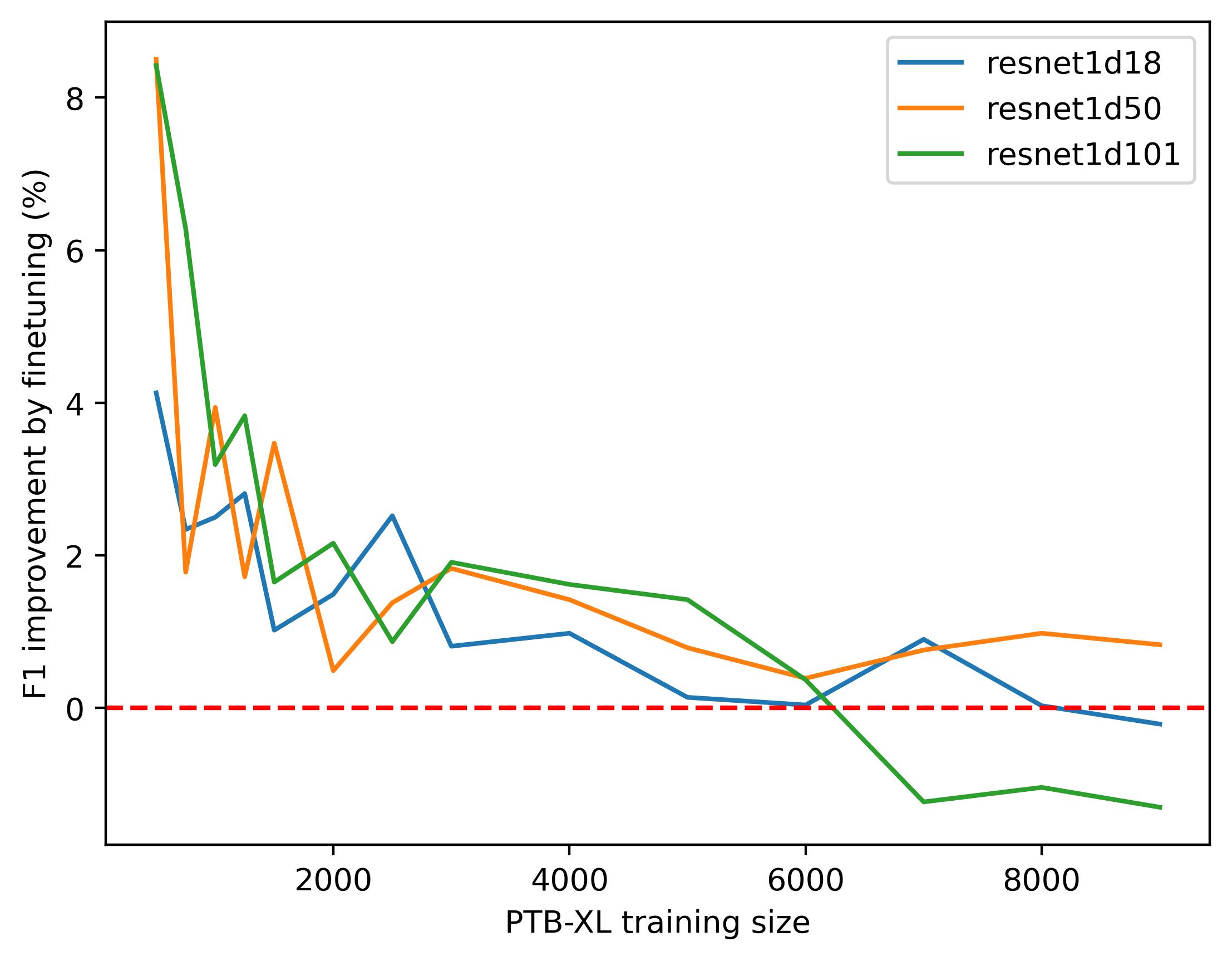
- RQ2How does the size of the downstream dataset affect the relative performance of fine-tuning versus training from scratch?
- RQ3Is transfer learning more effective with convolutional neural networks (CNNs) than with recurrent neural networks (RNNs) in ECG diagnosis?
- RQ4Does fine-tuning accelerate convergence compared to training from scratch in ECG classification tasks?
- RQ5To what extent does pre-training knowledge transfer from one ECG dataset to another improve performance, especially when the downstream dataset is large?
Key findings
- Fine-tuning significantly outperforms training from scratch when the downstream dataset is small, with performance gains diminishing as dataset size increases.
- On sufficiently large downstream datasets (e.g., PTB-XL), training from scratch can achieve comparable performance to fine-tuning, though it requires longer training to converge.
- Fine-tuning accelerates convergence by approximately 30–35 epochs on small datasets, with models reaching peak performance faster than from random initialization.
- Transfer learning shows markedly better compatibility with CNNs than with RNNs, with fine-tuned CNNs consistently outperforming their randomly initialized counterparts across all datasets.
- RNNs (LSTM, Bi-LSTM, GRU) exhibit erratic convergence patterns and often underperform fine-tuned CNNs, with transfer learning providing minimal to no benefit due to the incompatibility of learned memory representations across datasets.
- The inherent design of RNNs—relying on sequential memory for temporal dependencies—makes knowledge transfer between different ECG datasets ineffective, especially given gradient issues like vanishing gradients.
Read this paper
Open the full text in the Nubint reader and ask about any passage as you read.
Read this paper on NubintThis review was generated by AI from the original paper. Please check the paper before citing it.